

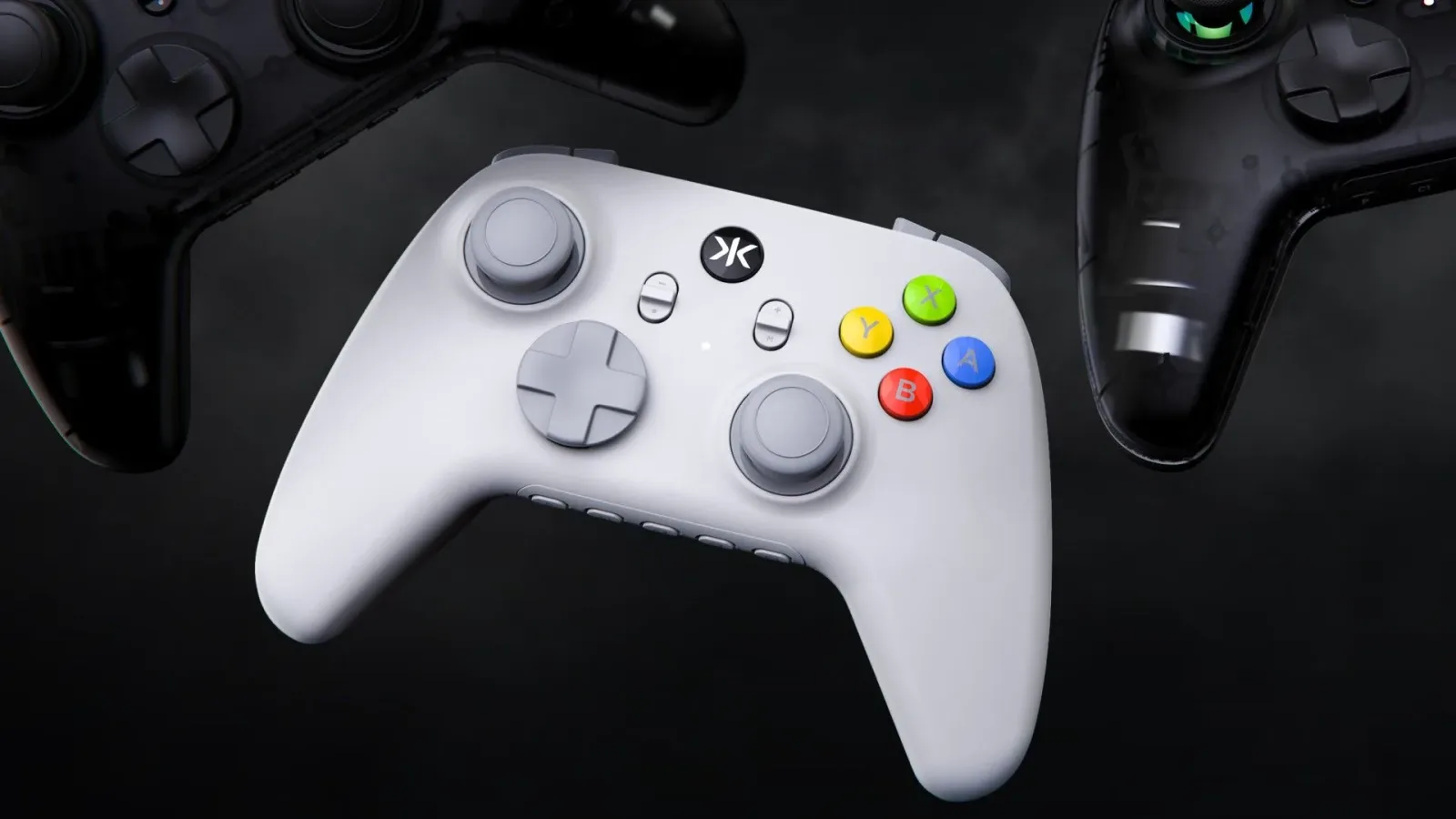
CRKD has entered the pro-controller category with the ULT PRO, a wireless gamepad aimed squarely at players who want more inputs and more customization without moving into the most expensive tier of controller hardware. Launching at $69.99, the ULT PRO arrives with a specification list that includes TMR thumbsticks, trigger stops, interchangeable components, four rear buttons, two additional shoulder buttons, profile selection, and a charging dock.
It is also a notably Nintendo-minded release. CRKD is offering separate versions oriented around Switch and PC button layouts, with the Nintendo-facing edition using a BAYX face-button arrangement. The controller is positioned for Nintendo Switch 2 players, while product compatibility information also lists Switch, Switch OLED, PC, and mobile support. That makes it a potentially broad option for people who split their gaming time across a Nintendo system and other devices.
The ULT PRO is available in Pal Grey and Smoke Black. While the controller's feature set puts it in direct competition with a range of premium-minded pads, its price is more aggressive than many of the high-end PC controller launches seen this year. The key question now is whether CRKD can match the practical feel, reliability, and software polish expected from established names while retaining that value advantage.
A pro-controller feature set at a mid-range price
The headline specification is the use of TMR thumbsticks. TMR, or tunneling magnetoresistance, is increasingly being used in modern controllers as an alternative to conventional stick mechanisms. Its appeal is straightforward: manufacturers are pursuing improved accuracy and durability in a market where players are highly conscious of analog-stick drift. CRKD describes the ULT PRO's sticks as "no stick drift" TMR components, although long-term performance will naturally need to be assessed through extended use rather than a launch-day feature list.
For useful background on this topic, read Wardogs Lead Says Seasonal Balance Will Remain a Long-Term Challenge.
The ULT PRO also includes trigger stops, which allow players to shorten trigger travel. That can be especially useful in games where rapid repeated trigger presses matter, even if the value of the feature varies considerably by genre. Racing fans may prefer longer analog travel for finer throttle and brake control, while players of action games or shooters may appreciate a shorter response.
CRKD has paired those familiar pro-controller staples with a considerable number of remappable physical controls. There are four back buttons, rather than the two found on many controllers in this price bracket. The paddles are relatively slim and sit closer to the style used by PC-focused pads than the larger rear controls sometimes seen on Nintendo-oriented controllers.
Two further shoulder buttons expand the available inputs. Taken together, the four rear buttons and two extra shoulder buttons give the ULT PRO six additional controls beyond a standard layout. For players who prefer to keep their thumbs on the sticks, that could be a major point of differentiation. Extra buttons can make it easier to map actions such as jumping, reloading, gear changes, item use, or menu shortcuts without moving away from movement and camera control.
That flexibility will matter most if the controller's profile system is easy to use in practice. CRKD lists profile selection among the ULT PRO's features, but the launch information does not detail the full configuration workflow or the depth of available customization. Prospective buyers looking for elaborate desktop software, extensive per-game settings, or the fastest competitive polling specifications should keep expectations measured until those aspects are fully tested.
Switch 2 positioning is clear, but one omission stands out
The BAYX face-button configuration makes the Nintendo target audience immediately apparent. Rather than treating Nintendo compatibility as a secondary addition, CRKD has created dedicated Switch- and PC-oriented versions of the ULT PRO. The apparent distinction between the two models is face-button orientation, giving buyers the option to select the arrangement that best suits the platforms they use most.
That approach is useful for players who regularly move between PC and Nintendo hardware, where familiar labeling can matter more than it initially seems. Nintendo's face-button conventions differ from those typically associated with Xbox-style PC controllers, and muscle memory can be surprisingly hard to ignore during fast-paced games.
However, the ULT PRO's Switch 2 pitch comes with one significant caveat: the listed features do not include motion controls. Gyro functionality has become a meaningful consideration for Nintendo players, whether it is used for aiming, steering, motion-based mechanics, or specific platform features. Its absence is particularly conspicuous because the controller otherwise goes to substantial lengths to address the Switch market.
There is no indication that the ULT PRO offers a wake function either. Those omissions do not erase the value of the controller's extra buttons, trigger stops, and dock, but they may influence buyers who prioritize the conveniences and Nintendo-specific features found on alternatives.
How it compares with the 8BitDo Ultimate 2
At the same $69.99 price point, the most immediate rival is the 8BitDo Ultimate 2. Both controllers are built around an asymmetrical stick layout and include TMR thumbsticks, trigger stops, profile selection, and a charging dock. On the basic value equation, they are clearly chasing the same audience: players looking for advanced features without paying official premium-controller prices.
The difference is in emphasis. The 8BitDo option includes motion control and wake functionality, both of which are meaningful advantages for a controller focused on Switch 2 use. CRKD counters by placing more importance on extra physical inputs. Four rear buttons instead of two, plus the two additional shoulder controls, could make the ULT PRO more appealing to players who use complicated control schemes or spend as much time on PC as they do on Nintendo hardware.
Neither approach is automatically better. A Switch-first owner who wants gyro aiming and easy console wake-up behavior may find the 8BitDo feature mix more suitable. Someone looking for as many accessible remappable inputs as possible, particularly across PC and multi-platform play, may see the ULT PRO's control count as the stronger proposition.
The comparison also illustrates a broader shift in the controller market. Features that once belonged almost exclusively to very expensive enthusiast products--drift-resistant stick technology, docks, alternate profiles, trigger adjustments, and rear controls--are now appearing at prices that sit far closer to standard console pads. The battle is increasingly about which compromises each manufacturer chooses, not whether a sub-$100 controller can offer meaningful upgrades.
An alternative to Nintendo's official Pro Controller
CRKD is also making a case to players considering Nintendo's official Switch 2 Pro Controller. The official pad has a strong reputation for its overall feel, from its dampened face buttons to its smooth analog sticks, and tactile quality remains one area that cannot be judged from a specification sheet.
Still, the ULT PRO makes a direct value argument. It costs less than the official controller while adding trigger locks, a charging dock, swappable stick toppers, a swappable d-pad, profile support, and a substantially larger collection of extra controls. For players who value configuration and versatility over an official first-party design, that package is difficult to dismiss on paper.
The interchangeable parts are worth highlighting. Swappable stick toppers and a replaceable d-pad can help players tailor the controller's physical feel to different game types. A particular stick top may suit precision movement, while another can offer a preferred grip or height. D-pad preference is even more personal: fighting games, retro-inspired platformers, menus, and 2D action games can all benefit from a directional input that feels right to the individual player.
Of course, interchangeable components only matter if the available options are well designed and securely fitted. The launch announcement establishes that these parts are included in the ULT PRO's feature set, but hands-on testing will be needed to establish how the implementation compares with the controller's rivals.
PC performance and the limits of the spec sheet
For PC use, CRKD advertises 1,000Hz polling on Windows. Polling rate refers to how frequently the controller reports inputs to the system, and 1,000Hz is a strong figure for a controller at this price. It places the ULT PRO firmly in the modern performance conversation without attempting to compete on the extreme specifications advertised by some specialist PC models.
Players should not expect every high-end feature associated with more expensive controllers. The ULT PRO does not arrive with clicky mechanical face buttons, 8,000Hz polling, or a promise of complex software-driven tuning. Those exclusions help explain how CRKD has reached the $69.99 price point while still including a dock, TMR sticks, rear inputs, and modular parts.
For many people, that could be a sensible balance. Fast polling, trigger stops, and extra programmable buttons are practical benefits, while ultra-high polling figures and deep specialist software are more likely to appeal to a narrower competitive audience. The ULT PRO appears designed around accessible enthusiast features rather than a no-compromise tournament controller identity.
What to watch before buying
CRKD's first pro controller looks well positioned, but several details deserve scrutiny as reviews and longer-term user experiences emerge. Stick durability, wireless stability, battery performance, button feel, dock reliability, and the quality of remapping options will all matter as much as the headline list of features. The lack of listed gyro support is also a clear purchasing consideration for Switch 2 owners.
For now, the ULT PRO's strongest selling point is simple: it offers a large number of enthusiast-level physical features at a price that does not require buyers to leap into the premium $100-and-above category. Its six additional programmable controls are particularly unusual at $69.99, and the combination of TMR sticks, trigger stops, a charging dock, and swappable parts gives CRKD a credible first entry in a crowded field.
With Pal Grey and Smoke Black models now available, the ULT PRO has arrived at a time when controller buyers have more choice than ever. Whether it becomes a leading Switch 2 value pick will depend on the real-world quality behind those specifications, but CRKD has made its intentions clear: this is a feature-heavy alternative for Nintendo, PC, and mobile players who do not want to pay top-tier prices for pro-style controls.
Community
Discussion
Start the conversation.
No comments have been posted yet.