

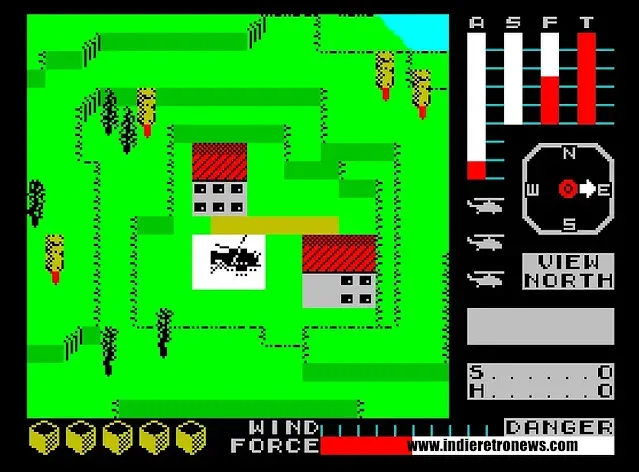
Cyclone, the 1984 helicopter rescue action game originally released for the ZX Spectrum, has finally received an Amstrad CPC 128K version. The new conversion, titled Cyclone CPC, comes from developer NBSystems and arrives more than four decades after the game's original debut.
The port fills a conspicuous gap in the history of the game. Cyclone was part of the busy British home-computer landscape of the 1980s, yet it did not receive a CPC release during that period. NBSystems' project gives Amstrad owners a dedicated version at last, while retaining the central high-pressure rescue premise that defined the original.
Originally programmed by Costa Panayi, a co-founder of Vortex Software, Cyclone was designed as a follow-up to Tornado Low Level. Its action places players in command of a rescue helicopter travelling across a hazardous island chain. The objective sounds straightforward on paper: locate and recover vital crates of medical supplies. The complication is the ever-present cyclone roaming the map, ready to destroy the helicopter if the pilot is caught in its path.
A delayed CPC landing
Ports and conversions were a defining feature of the 8-bit computer era. A game could begin life on one system and appear in substantially different forms on several others, often with each machine demanding its own technical compromises and visual identity. Yet not every game made it to every major platform. Cyclone's lack of an Amstrad CPC edition left the machine without an official version of a notable Spectrum release from one of the period's recognisable developers.
For useful background on this topic, read Race or Destroy Brings Fast Top-Down Racing to Amiga AGA Systems.
Cyclone CPC is an unofficial effort, but it is explicitly built for the Amstrad CPC 128K rather than simply presenting the Spectrum game unchanged. NBSystems has adapted the game with CPC-specific visuals, additional graphics, smoother movement, and an original soundtrack. That combination makes the project more than a historical curiosity: it is a fresh interpretation of the original's design using the capabilities and character of the Amstrad hardware.
For retro players, that distinction matters. The CPC has its own strong visual reputation among 8-bit machines, and a conversion designed around it can offer a different feel even when the core game structure remains faithful. Cyclone CPC aims to preserve the gameplay loop that made the original memorable while giving it a presentation suited to an Amstrad system.
Rescue work across 14 islands
The game's setting is a sprawling archipelago made up of 14 islands. Players pilot a helicopter across this environment in search of five crates containing essential medical supplies. Every journey demands attention to location, flight path, and danger, as the task is not merely to reach objectives but to do so while avoiding a lethal moving threat.
That threat is the cyclone itself. Rather than functioning as a static obstacle placed in a single level, it roams the world and can turn a safe-looking route into a disaster. The player therefore has to weigh urgency against caution. A direct run toward a crate may be tempting, but the weather system can force a change of plan at any moment.
This gives Cyclone a tense blend of exploration and survival. The helicopter's mission is humanitarian, centred on retrieving medicine, but the player's immediate concern is keeping the aircraft intact. Finding an item is only part of the challenge; navigating the islands and returning from a dangerous area are equally important. The roaming cyclone keeps that pressure active across the entire archipelago.
Its multidirectional action also helps distinguish it from more linear 8-bit games. Instead of pushing through a fixed sequence of stages, pilots are dealing with a broader play space and a problem that can be approached through route planning. The islands, medical crates, and unpredictable weather create a compact but demanding rescue scenario.
From Tornado Low Level to Cyclone
Cyclone's relationship to Tornado Low Level is an important part of its background. Costa Panayi developed both games, with Cyclone following on from the earlier title. That lineage is visible in the focus on aircraft control and perilous flight, though Cyclone develops its own identity through the archipelago-wide rescue mission and its mobile storm hazard.
Panayi was also a co-founder of Vortex Software, a name associated with ambitious 1980s computer games. In that context, Cyclone represents a period when designers were experimenting with larger environments, more involved objectives, and systems that could create pressure beyond simply placing enemies on screen. The cyclone's movement transforms the rescue operation into a changing situation, requiring repeated decisions instead of a single memorised solution.
That design has enduring appeal for fans of early home-computer games. It is easy to understand the goal, but the game's tension emerges from trying to execute it under worsening circumstances. Players must read the map, make use of open space, and respond when the storm threatens to cut off an intended route.
A new presentation for Amstrad hardware
NBSystems' conversion brings new graphics alongside its CPC-tailored presentation. Visual changes are particularly meaningful for a game with an expansive island setting, since the player spends much of the experience reading terrain and moving through the world from the cockpit of a small, vulnerable vehicle. A version created with the CPC in mind can give those locations a distinct look rather than treating the system as an afterthought.
Smoother movement is another stated feature of the port. In a game about flying through a hostile landscape, responsiveness and motion are central to the experience. The helicopter must be guided around island terrain while also staying clear of the cyclone, so fluid movement supports both the feel of piloting and the split-second decisions the game demands.
The port also includes an original soundtrack. Audio is a major part of how 8-bit conversions establish their own personality, especially when a game is returning decades after its first release. A new score gives the CPC edition an identity of its own while the underlying mission remains rooted in the 1984 design.
None of these enhancements change the fundamental stakes: five medical crates must be recovered, 14 islands must be searched, and the storm remains a constant danger. Instead, they frame the familiar structure through an Amstrad-specific lens. That is an appealing approach for both people discovering Cyclone for the first time and long-time Spectrum players curious to see how the game translates to another classic machine.
Why this conversion matters
Retro preservation is not limited to keeping old releases playable. It can also mean completing unfinished platform histories. In Cyclone's case, the original game's absence from the CPC library has remained a small but notable omission for decades. An unofficial port cannot change what was released commercially in the 1980s, but it can provide the version that players of the era never received.
Projects such as Cyclone CPC also demonstrate the continuing enthusiasm around 8-bit development. The Amstrad CPC remains a platform with an active community interested in both original games and carefully considered conversions. A new adaptation has to balance respect for the source material with an understanding of the destination hardware, particularly when the goal is to offer more than a direct replication.
For Cyclone, the enduring hook is still clear. It is a rescue game in which the clock is not represented only by a timer. The weather is the pressure. Every flight carries risk, every detour can matter, and every crate recovered brings the player closer to completing a mission that the cyclone is determined to ruin.
Cyclone CPC gives that concept a long-overdue home on the Amstrad CPC 128K. With dedicated CPC visuals, smoother movement, new graphics, and an original soundtrack, NBSystems' conversion offers a modern retro take on a challenging 1984 helicopter adventure--and gives CPC players the chance to tackle a rescue mission that skipped their machine the first time around.
Community
Discussion
Start the conversation.
No comments have been posted yet.