

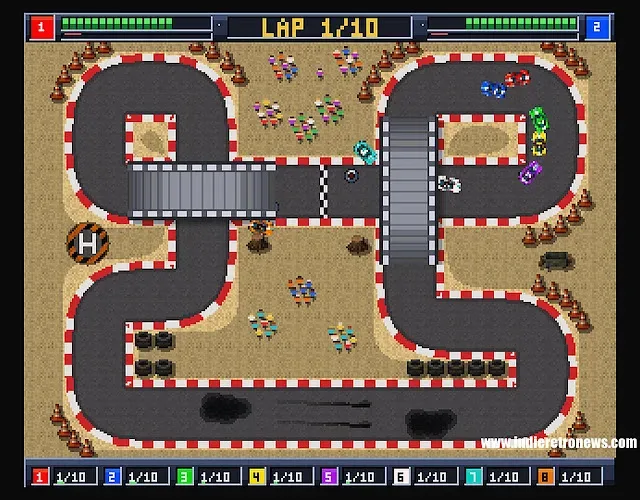
Race or Destroy is a new fast-paced, top-down racing game for Amiga AGA hardware. Designed for between one and three players, the game is aimed at the classic Commodore machines that supported the AGA chipset: the Amiga A1200, Amiga A4000, and the Amiga CD32 when paired with a keyboard.
Its arrival is a welcome reminder that the Amiga scene continues to receive newly made games built around the strengths, limitations, and distinctive setup requirements of original-era hardware. Race or Destroy is specifically a PAL release rather than a broadly specified Amiga package, and prospective players will need to check their machine configuration before attempting to run it.
AGA hardware is the starting point
Race or Destroy requires an Amiga with the AGA graphics architecture. That puts the A1200 and A4000 at the center of its intended audience, while CD32 owners can also run it provided their console is equipped with a keyboard. Earlier Amiga models without AGA support are not listed among the compatible systems.
The PAL requirement is equally important. Retro software often has close ties to a particular video standard, especially when its speed, timing, and display layout have been designed around that environment. Anyone planning to play Race or Destroy on original equipment should therefore make sure their system matches the stated PAL specification rather than assuming any Amiga configuration will behave identically.
For useful background on this topic, read Scion Ex Brings a Rare 1984 Arcade Shooter to the Amiga.
For players familiar with the machine family, the listed support paints a clear picture: this is not a title positioned as a low-memory game for every Amiga ever released. It targets the later AGA generation and expects a machine prepared to run a comparatively demanding modern production.
Memory requirements deserve attention
The minimum memory specification calls for 2 MB of chip RAM and at least 4 MB of fast RAM. The game can use nearly all of the chip RAM available in a stock A1200, so players are advised to close other programs before launching it. That detail matters particularly for users running their systems from Workbench with utilities, tools, or background software already active.
While 4 MB of fast RAM is the stated minimum, 8 MB is described as a more comfortable amount. In practical terms, that makes an expanded A1200 or similarly configured AGA Amiga a better fit than a bare minimum setup. The distinction is useful for enthusiasts who maintain original systems with a variety of accelerator cards, memory expansions, CompactFlash-based storage arrangements, or other period-style upgrades.
Chip RAM and fast RAM serve different roles on classic Amigas. Chip RAM is shared with the machine's custom hardware, including graphics and sound functions, while fast RAM is additional memory that the processor can access without that sharing arrangement. The fact that Race or Destroy consumes so much chip RAM underlines that its presentation and operation have been designed around the resources available to AGA machines, rather than treating the platform as a simple target for a lightweight executable.
Players with a stock A1200 should not read the compatibility note as a guarantee that every multitasking setup will be ideal. Closing unnecessary software first is the sensible preparation step. Users with 8 MB of fast RAM have more headroom, which should make the overall setup less constrained.
A local multiplayer racing proposition
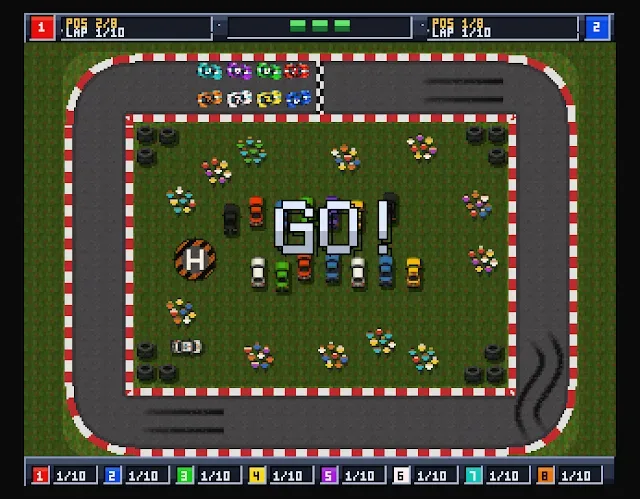
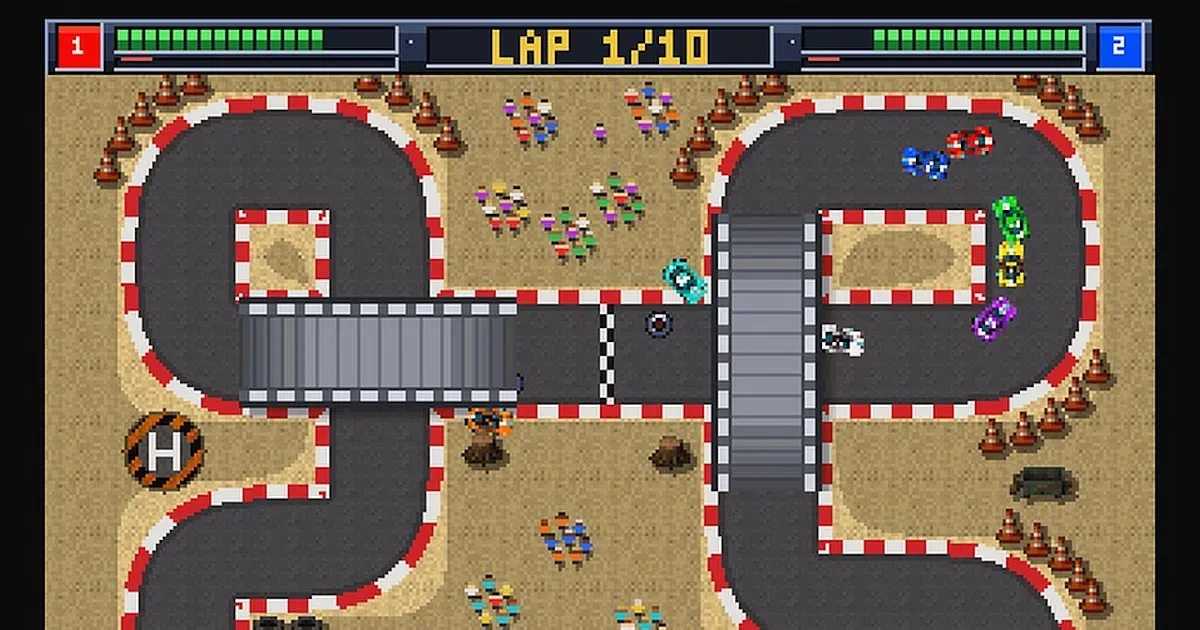
Race or Destroy supports from one to three players. That makes it suitable for solo sessions as well as small local gatherings around an Amiga setup. Top-down racers have long been a natural fit for immediate competitive play: the viewpoint keeps the action readable, places attention on line choice and reactions, and allows a race to move quickly without the heavier technical demands associated with simulated 3D driving.
The game's title suggests an aggressive edge, while its description emphasizes speed. However, the available details do not set out a full feature list, vehicle roster, track count, championship structure, game modes, or control options. Those interested should avoid assuming any particular combat mechanic, progression system, or peripheral support beyond what has been confirmed.
What is clear is the basic format. Race or Destroy is a top-down Amiga racing game intended for quick action and up to three participants. In a hardware community where couch multiplayer remains part of the appeal, support for more than a single player gives the release a potentially strong place alongside other social, score-driven, and competition-focused retro games.
Hard disk storage and a small save file
A hard disk is required. Race or Destroy saves a small file in its own drawer, meaning players should ensure that its installation location remains writable. This is a straightforward but meaningful requirement for Amiga users, particularly those who use carefully managed hard-drive partitions or transfer software to physical machines through removable media and storage adapters.
The use of a game-specific save file indicates that the title retains at least some information between sessions, though the precise contents of that file have not been detailed. It should not be assumed to confirm a particular campaign, unlock system, high-score structure, or configuration menu. The important confirmed point is simply that Race or Destroy writes a small save file to its own directory.
Because the save is placed in the game's drawer, preserving that folder should be part of any backup routine. This is especially relevant for retro users who regularly move software between real hardware, emulation environments, archival drives, or CompactFlash cards. Keeping the game directory intact is the safest approach when transferring or copying an installation.
Launch it from Workbench or Shell
Race or Destroy can be started from either Workbench or a Shell. That flexibility is valuable for different kinds of Amiga owners. Workbench users can approach it through the familiar graphical desktop, while Shell users can launch it through a command-line workflow that may better suit custom startup scripts, organized game partitions, or more hands-on system management.
At the same time, Race or Destroy is not a WHDLoad install. This is an important clarification for the Amiga audience. WHDLoad is widely used within the scene for installing and launching games from hard storage, often with hardware-specific conveniences and compatibility handling. Its absence here does not prevent Race or Destroy from running from a hard disk; the game does require one. It simply means users should not expect it to be packaged as a WHDLoad installation.
The distinction may affect how players organize their libraries. Those who have built a menu-driven collection around WHDLoad will need to treat Race or Destroy as its own direct-install game rather than expecting the usual WHDLoad launch structure. Fortunately, its stated ability to run from Workbench or Shell provides two clearly defined ways to start it.
Preparing an Amiga for the race
For the smoothest path to the starting line, owners should check a short list of essentials before launching Race or Destroy:
- Use a PAL Amiga AGA system: an A1200, A4000, or a CD32 with a keyboard.
- Confirm the presence of 2 MB chip RAM.
- Ensure at least 4 MB fast RAM is installed; 8 MB is the more comfortable configuration.
- Close other programs first, especially on a stock A1200 where chip RAM availability is tight.
- Install and run the game from a hard disk.
- Keep the game's own drawer writable so it can create its small save file.
- Launch through Workbench or Shell, without expecting a WHDLoad installation.
These requirements also reinforce why original-hardware releases remain distinctive. Playing them is not only about loading an old-looking game on modern equipment. It can involve understanding memory layouts, video standards, operating environments, storage practices, and the individual behavior of particular Amiga models.
A new reason to dust off AGA machines
Race or Destroy adds another contemporary project to the enduring Amiga AGA ecosystem. Its mix of fast top-down racing and one-to-three-player support gives it a focused identity, while its hardware notes make clear that it has been built with real system constraints in mind.
There is still plenty not specified about the game's tracks, modes, destruction elements, controls, and broader structure. But the essential technical picture is already established: Race or Destroy is for PAL AGA Amigas, needs meaningful memory resources, runs from a hard drive, supports Workbench and Shell launching, saves within its own folder, and does not use WHDLoad.
For A1200, A4000, and suitably equipped CD32 owners, that is enough information to begin checking a setup. With the appropriate RAM, disk space, and a clean enough Workbench environment, Race or Destroy is positioned to offer a new burst of local racing action on hardware that remains actively supported decades after its original era.
Community
Discussion
Start the conversation.
No comments have been posted yet.