

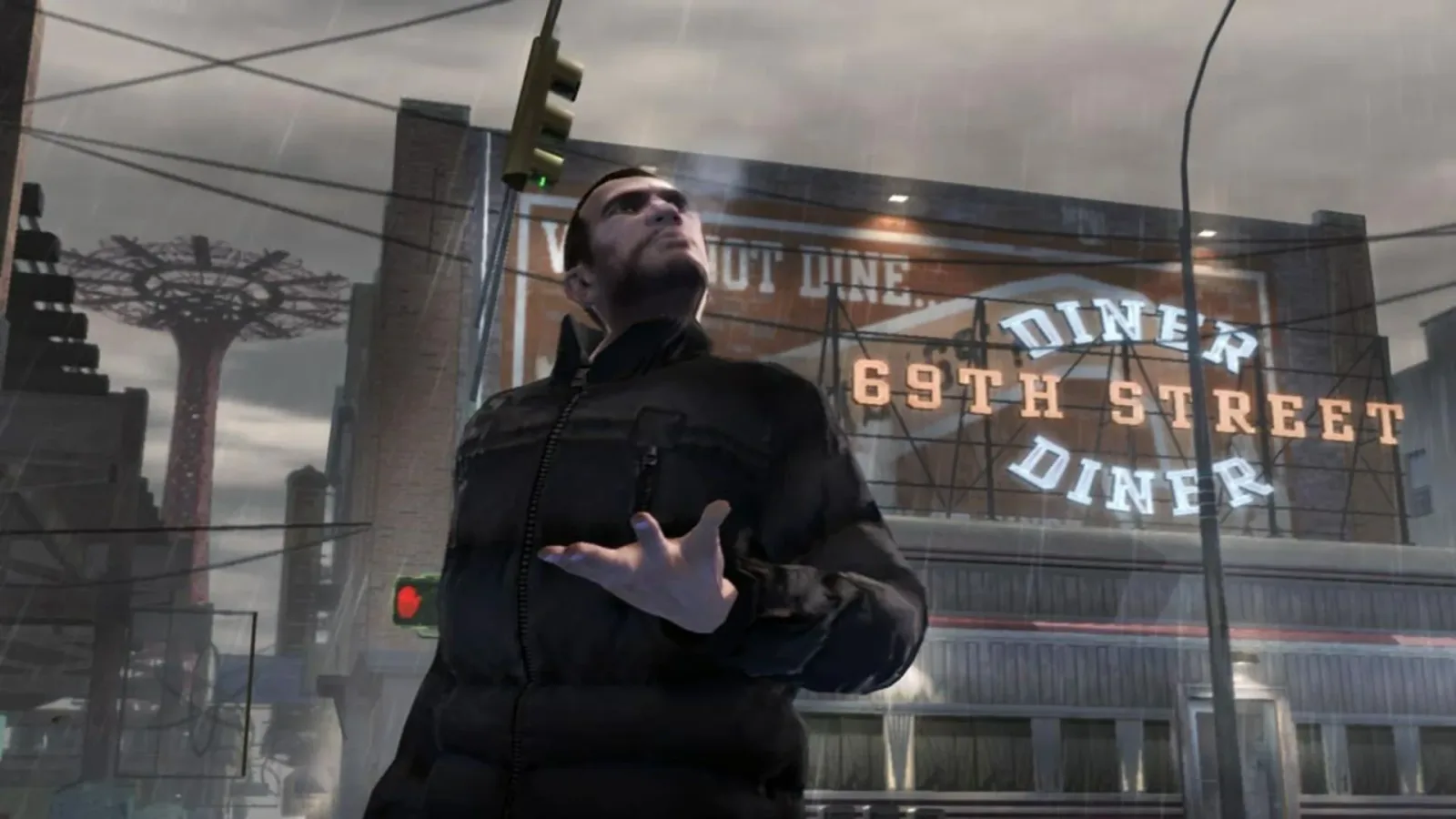
Grand Theft Auto IV was never interested in simply making San Andreas bigger, louder, or more technically elaborate. When Rockstar Games brought the series into the Xbox 360 and PlayStation 3 generation, it took a sharper turn toward a grounded visual style, a somber immigrant story, and a version of Liberty City that often felt cold, lonely, and uneasy. Former Rockstar writer and creative director Dan Houser has explained that this contrast was deliberate: the team believed the series needed to change direction after San Andreas had taken its established high-energy approach as far as it could go.
Houser's comments offer a useful look at the thinking behind one of the biggest tonal shifts in the history of Grand Theft Auto. The games immediately preceding GTA IV--Grand Theft Auto III, Vice City, and San Andreas--had become defining open-world releases of the PlayStation 2 era. They were commercially enormous, critically celebrated, and deeply influential. More importantly, each had broadened the series' personality: GTA III established the 3D open-world template, Vice City leaned into neon-soaked 1980s excess, and San Andreas expanded the formula into a huge, colorful, highly varied playground.
That success could have made a familiar sequel feel like the safest possible move. Instead, Rockstar treated the arrival of more powerful hardware as an opportunity to reassess what Grand Theft Auto should be. Houser said there was a sense that San Andreas had carried the series' "pop" energy to its natural limit. In that context, producing another game built around the same style was not necessarily a guarantee of continued relevance. The risk, as he describes it, was that repeating the old formula could make the franchise feel outdated.
From maximalist San Andreas to a focused Liberty City
San Andreas remains remarkable for the sheer number of ideas it attempted. Its state-sized setting stretched across multiple cities and rural regions. Its protagonist, Carl "CJ" Johnson, could work out, change his appearance, fly aircraft, take part in gang conflicts, build relationships, gamble, race, and wander through a world packed with side activities. Its tone could pivot from crime drama to broad comedy and absurd set pieces with very little warning. That variety was part of its appeal, but it also represented a particular kind of creative escalation.
For useful background on this topic, read Former Marathon Director Describes Internal Disagreements as Bungie Works Toward a Sustainable Future.
Grand Theft Auto IV moved in the opposite direction. Its Liberty City was dense rather than sprawling, centered on a reimagined New York City and its boroughs. The world was still full of dark humor and satirical radio programming, but the central story was more restrained. Niko Bellic arrives in America carrying the weight of war, betrayal, and personal loss, only to find that the promised land is filled with compromises, exploitation, and violence of its own.
The game's missions, color palette, weather, animation work, and urban setting all reinforced that outlook. Gray skies, wet roads, cramped apartments, tense phone calls, and the friction between Niko's moral discomfort and the criminal work he repeatedly accepts combined into an experience with a notably different emotional texture. Rockstar had made crime stories before, but GTA IV sought a more unified dramatic atmosphere.
Houser said that cohesion was one of the game's defining achievements. He pointed to the relationship between the game itself, its art direction, moody lighting, and mission design, arguing that they fit together in a way the earlier entries had not always attempted. The darker direction, in his view, helped the team reach a level of tonal consistency that had been absent from the previous games.
A reinvention driven by fear of stagnation
It is easy to look back at GTA IV as a logical response to the visual capabilities of the Xbox 360 and PlayStation 3. The new hardware enabled more detailed character models, advanced physics, denser city streets, improved lighting, and a more convincing simulation of an urban environment. But Houser's recollection makes clear that the transition was not only technical. It was also about the series' creative future.
Rockstar did not see the departure from the PlayStation 2 games as the main gamble. Instead, Houser said the greater danger was failing to reinvent the company's work and allowing it to become obsolete. That is an important distinction. Franchises with a winning formula often face pressure to preserve the exact elements audiences already know. Yet Grand Theft Auto had built its reputation partly by changing with each major release, adapting its settings, protagonists, technology, and cultural targets rather than merely recycling them.
For GTA IV, reinvention meant embracing a lead character who was less openly triumphant than Tommy Vercetti or CJ. Niko could be ruthless and highly capable, but he was also exhausted by violence and skeptical of the opportunities being sold to him. His relationships with Roman, Little Jacob, Brucie, and other Liberty City figures brought comedy and warmth, but these moments existed alongside a persistent sense that criminal success carried consequences.
The result was a game that could still provide chaotic chases, shootouts, and sharp satire while placing them within a more serious narrative framework. Its choices and endings also pushed players to consider the personal cost of Niko's path. This did not make GTA IV humorless; the series' exaggerated media parodies and eccentric supporting characters remained intact. Rather, it changed the balance between comedy, spectacle, and drama.
Why GTA IV remains a distinct chapter
In the broader public conversation around Grand Theft Auto, GTA IV can sometimes sit between two especially towering entries. San Andreas is remembered for the scale and freedom of its PlayStation 2-era design, while Grand Theft Auto V became a phenomenon in both initial sales and long-term popularity. Houser acknowledged that GTA IV is not quite as popular as the games on either side of it, but that does not diminish its unique place in the series.
Its influence is particularly visible in the way players and developers discuss mood, environmental storytelling, and believable city spaces. Liberty City's density helped make even routine drives feel like part of a living place. Pedestrian conversations, traffic incidents, storefronts, radio stations, and changing weather created an atmosphere that was often as important as any individual mission. The city was not merely a map for completing objectives; it was a crucial part of the game's emotional language.
The game also arrived with a physics-driven sense of impact that made its world feel more volatile. Car handling was heavier, collisions were more dramatic, and Niko's movement had a weight that differed significantly from the more arcade-like feel many players associated with earlier entries. Those choices remain divisive, but they align with the broader ambition Houser describes. Rockstar was trying to make a Grand Theft Auto that felt different at every level, not simply one that looked better.
The series continued to evolve after Liberty City
Grand Theft Auto V later shifted the tone again. Its three-protagonist structure, sunny Los Santos setting, and heightened satire made room for a more playful, outrageous kind of crime story. It retained darker themes beneath the surface, including cynicism about wealth, celebrity, corporate culture, and the American dream, but its presentation was generally more energetic and comedic than Niko Bellic's journey.
That change did not invalidate the approach of GTA IV. If anything, it reinforced Houser's central point: Grand Theft Auto has remained significant because it has not stayed in one emotional register. The series can move from the nightlife fantasy of Vice City to the sprawling coming-of-age crime story of San Andreas, then to the melancholy of GTA IV and the multi-character spectacle of GTA V.
There is also a clear connection between the more reflective side of GTA IV and Rockstar's later work on the Red Dead Redemption games. Those Westerns are not identical in tone or structure, but they share an interest in protagonists haunted by their pasts, worlds undergoing social change, and stories where violence has an emotional cost. GTA IV showed that Rockstar could pair its trademark open-world satire with a protagonist and narrative carrying genuine melancholy.
Houser's recollection ultimately frames Grand Theft Auto IV not as a rejection of the games that came before it, but as a response to their success. San Andreas had achieved an enormous version of the series' colorful, maximalist identity. To follow it with more of the same might have been commercially tempting, but creatively limiting. Rockstar instead chose a narrower, darker, more cohesive vision--and that decision ensured GTA IV would remain one of the franchise's most distinctive entries.
Community
Discussion
Start the conversation.
No comments have been posted yet.