

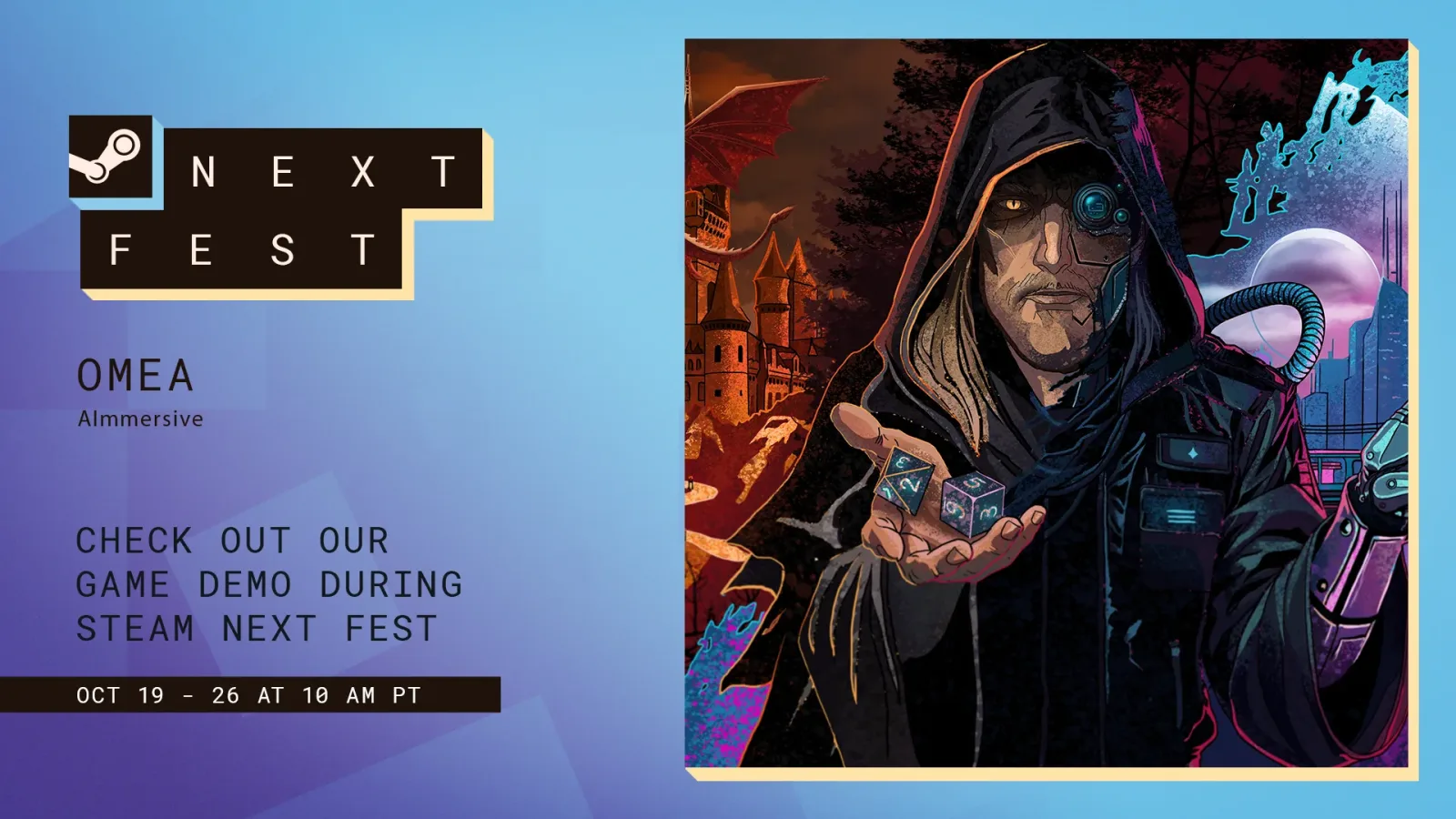
OMEA is heading into Steam Next Fest with its largest free-demo update to date. AImmersive Inc. has added Echoes in the Abyss, a complete second adventure that sits alongside the previously available Odin's Trial. The updated demo is available during Steam Next Fest from October 19 at 10:00 a.m. PT through October 26, 2026.
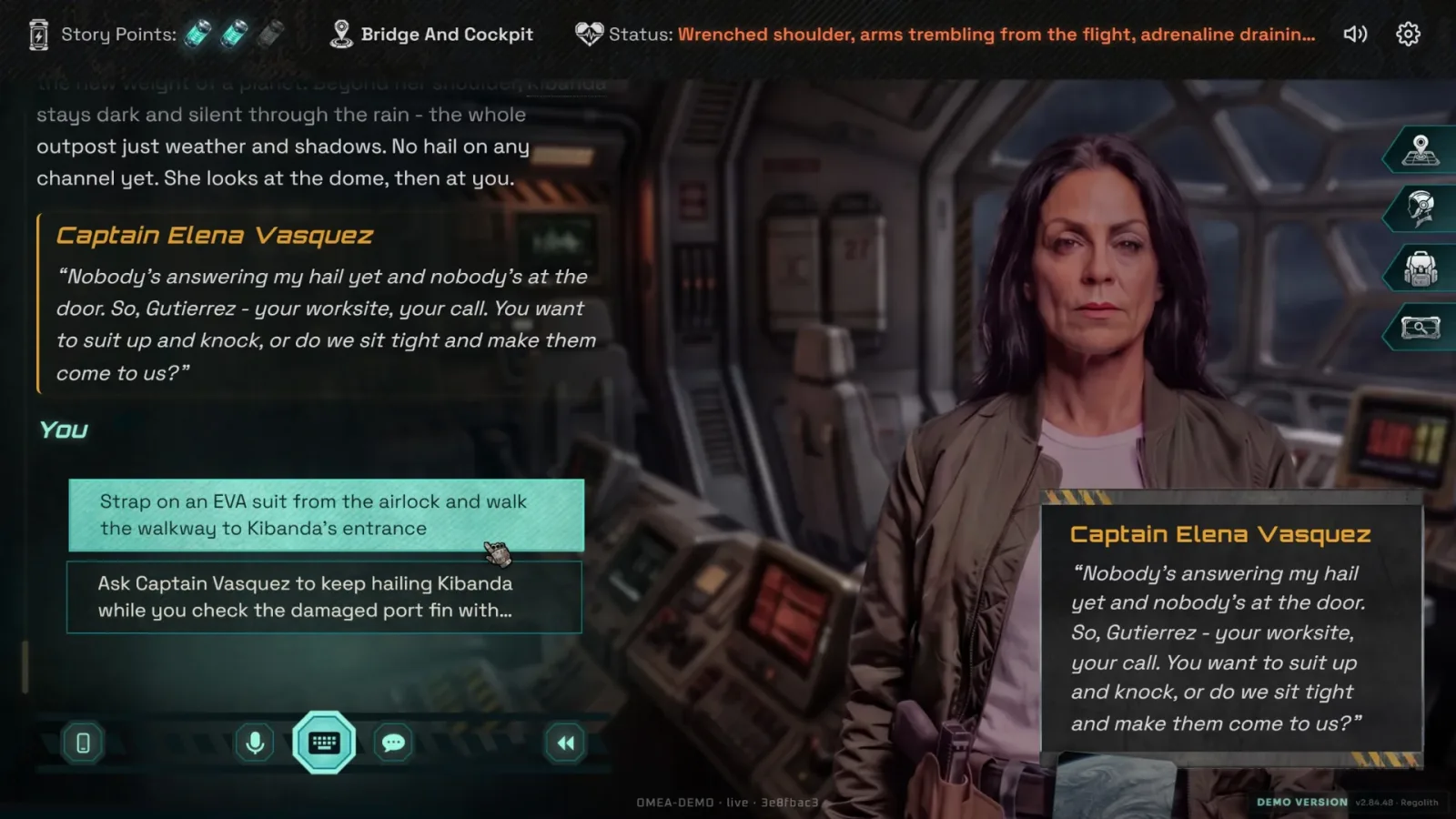
The new scenario gives players another substantial way to experience OMEA's central idea: instead of choosing only from fixed dialogue options or prewritten action prompts, players describe what their character does in their own words. Those actions can be spoken aloud or typed, and the game's cast responds within a story authored by human writers.
That distinction is important to the game's pitch. OMEA is not presenting its worlds and characters as automatically generated fiction. Its adventures, settings, and characters are written by people, while the system is used to interpret the player's input and enable characters to react. The narrator also tracks the ongoing social and narrative state of the adventure, including who is in the scene, what different characters want, what promises have been made, and what grudges may have developed.
A second complete adventure for the OMEA demo
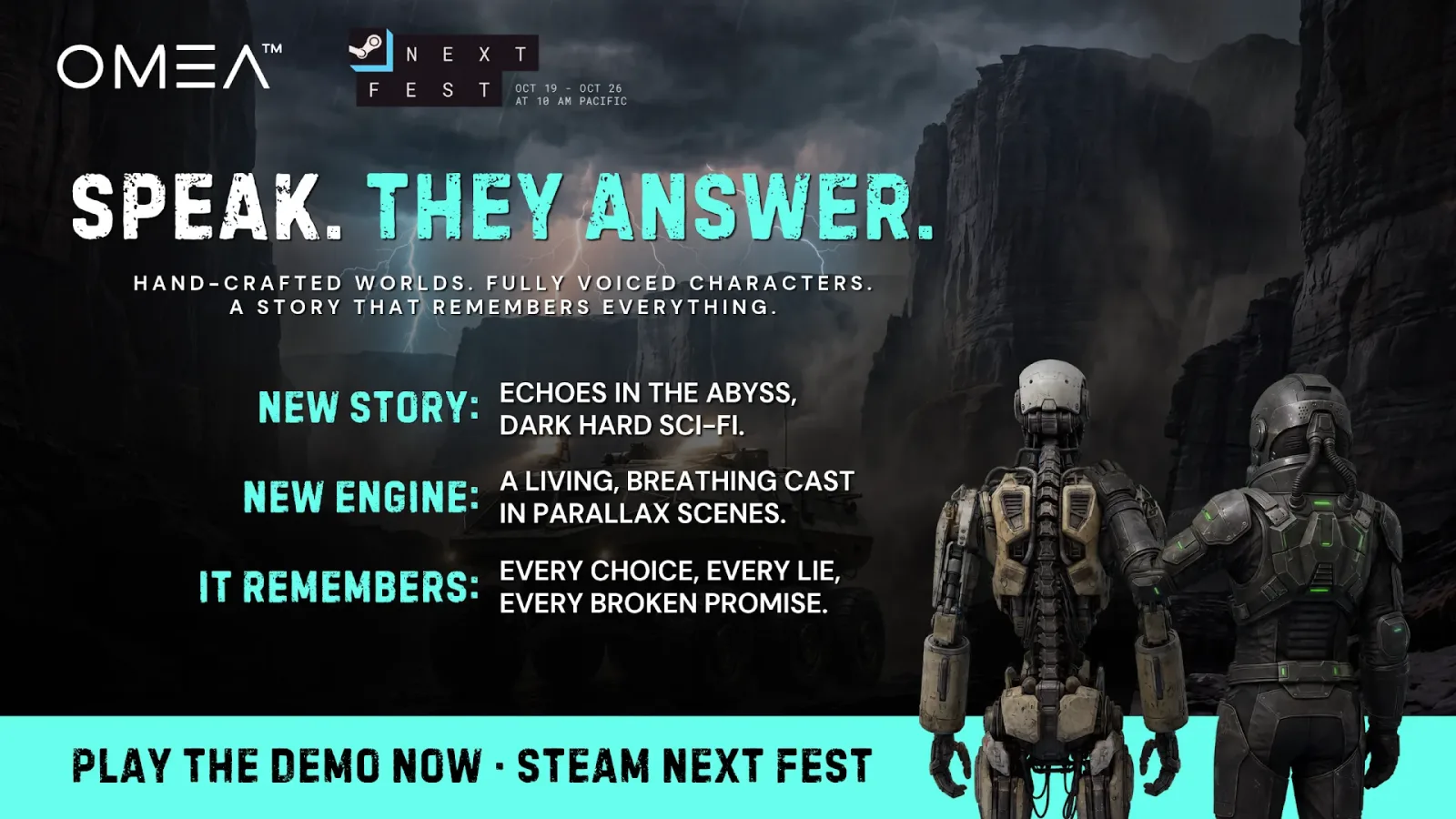
Echoes in the Abyss shifts OMEA into a more oppressive science-fiction mystery. Players are hired by a corporation to retrieve Dr. Marcus Finn and his work from a research station on Saaremaa that has gone unnervingly quiet. The assignment sounds direct enough at the outset, but the player arrives with a small crew whose motivations are not entirely clear. The expedition then moves downward into the station alongside robots that witnessed the events preceding the team's arrival.
For useful background on this topic, read Dan Houser Explains Why Grand Theft Auto IV Embraced a Darker Identity.
The setting is designed as a contrast to Odin's Trial. Where the original demo adventure established the format, Echoes in the Abyss is described as darker, more confined, and more focused on dialogue. It uses a larger group of characters and is intended to put more weight on conversations, suspicion, negotiations, and the consequences of what the player says or attempts.
There is considerable scale behind the new adventure. Echoes in the Abyss contains nearly 100 locations, more than 100 glossary entries, and a substantially expanded cast. Crucially for players considering the Steam Next Fest build, this is not framed as a brief teaser for a later chapter. The full adventure is included in the demo.
That makes the event build a useful opportunity to see how OMEA handles a long-form scenario rather than a single introductory exchange. An improvised-input RPG needs to do more than recognize a clever sentence. It needs to maintain continuity when a player changes tactics, revisits earlier decisions, tests a relationship, or brings up information at an inconvenient moment. The larger scenario should provide more room for those systems to be tested in practice.
For another perspective on this story, read OMEA's Steam Next Fest Demo Adds Echoes in the Abyss, a Complete New Spoken-Word RPG Adventure.
Speaking or typing through a narrative RPG
OMEA lets players approach interactions through voice or text. A player might give a direct instruction, question an uneasy companion, try to conceal an intention, attempt to bargain, or describe an unusual plan in plain language. The game then has to connect that attempt to the authored situation and the characters occupying it.
Rather than reducing every exchange to a menu with a handful of choices, the format aims to make the player feel more responsible for the wording and intent behind an action. This does not mean every possible statement necessarily produces a desired outcome. In a narrative RPG, a reckless order, an insult, a broken promise, or a poorly timed admission can be as meaningful as a successful plan. OMEA's narrator is built to remember relevant context over the course of an adventure, so a character can respond not simply to the most recent line but to the history a player has created.
The game specifically tracks the people present in a scene and their motivations, promises, and resentment. That framework could be especially significant in Echoes in the Abyss, where the player is entering a silent research facility with a crew of uncertain loyalties and robotic witnesses to an earlier disaster. In such a setting, information is likely to be as valuable as exploration, and the wording of a question may matter as much as the decision to ask it.
Local speech recognition across supported systems
Speech recognition runs locally on Windows, macOS, and Steam Deck. This means players using any of the demo's supported platforms can speak their actions and dialogue without relying on the game's speech-recognition process being handled remotely.
English is the supported language for text, character voices, and speech recognition. Players who prefer not to speak can still use typed input, making the core interaction model accessible in different play situations, whether they are at a desktop setup or using a handheld system.
Character voice generation has a separate platform-specific feature. On Windows systems equipped with a GeForce RTX GPU, character voices can be generated locally on the player's graphics card. AImmersive Inc. says the first word of a line can be heard about three seconds after the line begins. If the local GPU is not fast enough for the task, the game can switch to online voices instead.
Local character voice generation is specifically listed for Windows machines with GeForce RTX hardware. It should not be confused with local speech recognition, which is available across Windows, macOS, and Steam Deck. For players evaluating which version to use, that distinction may matter: voice input is supported on all three platforms, while the locally generated character-voice feature has the stated RTX requirement.
More active scenes and clearer consequences
The Steam Next Fest update also improves OMEA's presentation. Characters now move as they converse, with details such as breathing, turning, and shifting among poses. The aim is to make conversations feel less like exchanges between static figures and more like scenes in which the cast visibly reacts to the tension around them.
Locations have also been built with layered depth, while environmental elements are active within scenes. Running monitors, drifting clouds, and the shake of a ship are among the examples given for the added environmental motion. These details are particularly suited to the new sci-fi premise, where a malfunctioning facility or unstable vessel can communicate danger even before a character says anything directly.
The game's adventures now conclude with tailored endings based on the player's result. Victorious runs receive epilogues, while death leads to epitaphs. That structure reinforces the idea that OMEA's stories are meant to account for outcomes rather than simply stop when a player reaches a final room. In a game built around freeform expression, an ending that acknowledges failure can be just as important as a successful resolution, since it gives weight to choices and risks that did not work out.
Players should not expect a traditional action RPG loop based on rapid combat inputs. OMEA's focus is narrative role-playing: deciding what to say, what to attempt, whom to trust, and how to navigate situations through language. The tension comes from the possibility that characters will remember a slight, interpret an instruction differently than intended, or reveal their priorities when pressed.
Windows, macOS, and Steam Deck support
OMEA is available for Windows, macOS, and Steam Deck. The Steam Deck version includes full controller support as well as gyro cursor control, giving handheld players an additional way to navigate interface elements. Since Steam Deck also supports the game's local speech recognition, it is positioned as more than a basic compatibility target for the demo.
The inclusion of both typing and voice input could make the game adaptable to different setups. Desktop players can use a keyboard, microphone, or both, while Steam Deck users can rely on controller controls and gyro cursor movement when voice is not convenient. The game's design does not require a player to commit to a single interaction method for the entire adventure.
For Steam Next Fest participants, the expanded demo offers two different ways into OMEA's authored worlds. Odin's Trial remains available, while Echoes in the Abyss adds a much broader and more dialogue-driven mystery. Players interested in experimental narrative systems can use the event window to see whether speaking or typing a personal response creates a stronger role-playing connection than selecting from conventional options.
The free demo, including both adventures, is playable from October 19 at 10:00 a.m. PT until October 26, 2026. With its new setting, larger cast, local speech-recognition support across all listed platforms, and presentation updates, OMEA's Steam Next Fest build is a significant expansion of the game's initial playable introduction.


Community
Discussion
Start the conversation.
No comments have been posted yet.