

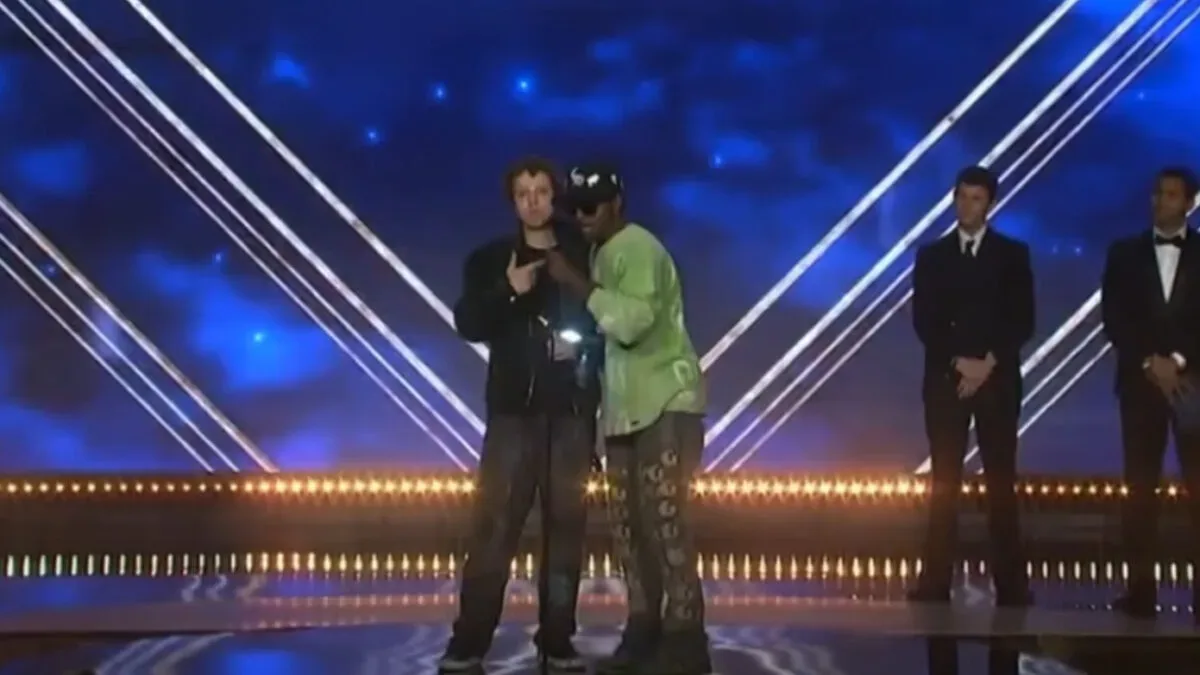
The 2026 Streamer Awards produced an awkward onstage moment when an unidentified attendee interrupted AriAtHome's acceptance speech for Best Music Streamer and declared that fellow nominee DDG was the more deserving winner. The intruder's remarks deliberately echoed Kanye West's infamous interruption of Taylor Swift at the 2009 MTV Video Music Awards, but the callback did not land well with much of the room.
DDG, whose real name is Darryl Dwayne Granberry, quickly addressed the incident after clips began circulating. In a public message directed toward AriAtHome, DDG said he did not approve of what happened and apologized for the fan's behavior. He also praised AriAtHome, saying the winner was talented and had clearly earned the award.
AriAtHome, the online name of Ari Miller, responded without escalating the situation. Miller answered DDG's apology with a brief message of support, writing that there was "nothing but love." The exchange helped prevent an uncomfortable interruption from turning into a broader dispute between two prominent creators and their communities.
Embedded X/Twitter post
Embedded X/Twitter post
A Best Music Streamer win interrupted
The sixth annual Streamer Awards took place in Los Angeles on Thursday night, recognizing online personalities and creators, with Twitch streamers forming a major part of the show's audience and nominees. Miller won the Best Music Streamer category over DDG, PlaqueBoyMax, and Bishu.
For useful background on this topic, read Grand Theft Auto's 13-Year Gap Shows How Dramatically Game Development Has Changed.
As Miller was partway through the acceptance speech, the unknown individual walked onto the stage and took hold of the microphone. The person said, "I'm sorry imma let you finish but DDG had the best music of all time," a clear recreation of the phrasing associated with West's 2009 awards-show moment.
At that ceremony, West took the microphone during Swift's speech to argue that Beyoncé should have won instead. It became one of the defining viral pop-culture clips of its era, and it has been referenced and parodied repeatedly in the years since. Recreating it at a live creator awards program, however, placed Miller in the uncomfortable position of having a victory speech briefly hijacked by somebody else's attempt at a joke or viral moment.
Miller appeared to handle the interruption calmly. Rather than engage in a visible confrontation, the winner nodded and allowed the intruder's moment to run out of momentum. The audience response was considerably less charitable, with crowd members jeering the stage crasher.
DDG moves quickly to distance himself
The interruption was framed as support for DDG, but there was no indication that DDG had arranged, encouraged, or endorsed it. His response made that separation explicit. Granberry apologized to Miller directly and stated that he did not co-sign what had happened.
That immediate clarification mattered because live awards shows can turn a single unscripted incident into a long-running online argument, especially when it involves creators with active audiences and an easily recognizable pop-culture reference. A stage interruption done in the name of a nominee can invite speculation about involvement even when the nominee has no connection to it. DDG's statement shut down much of that possible narrative before it could develop further.
Miller's cordial reply also kept the focus on the person who actually caused the disruption rather than on the nominees. The two creators did not turn the Best Music Streamer result into a public feud. Instead, they presented a united front: Miller accepted the apology, and DDG acknowledged that the award belonged to the winner.
The category itself featured a range of music-focused streaming talent. DDG's nomination placed him alongside PlaqueBoyMax and Bishu, while Miller ultimately took home the honor. Awards outcomes naturally create debate among fans, but the interruption demonstrated how quickly routine discussion over a result can be overshadowed when someone tries to force themselves into the show.
The stunt drew criticism beyond the crowd reaction
The individual who interrupted Miller reportedly wore smart glasses and streamed the incident through the device. The person was also described as wearing a long-sleeve shirt valued at roughly $700. Those details suggest that the interruption may have been intended not only as an in-room stunt but as content designed to spread online immediately afterward.
That approach has become a familiar part of major livestreaming and creator events. The boundary between attending an event and producing spectacle for an audience can become especially thin when participants arrive equipped to broadcast from the venue. A live-streamed disruption may offer the person behind it attention, clips, and reactions, but it also transfers the risk and embarrassment to the people onstage and to event staff.
As the person was leaving the stage area, streamer Marlon Lundgren Garcia confronted him verbally and called the stunt "corny as fuck." The blunt reaction matched the mood in the room. What may have been conceived as a recognizable reference instead came across to many attendees as an unnecessary intrusion into someone else's achievement.
The issue was not simply that the fan favored DDG. Viewers and creators regularly disagree over winners, nominees, and snubs, particularly at community-driven events. The larger concern was the choice to interrupt Miller's moment and use the award presentation as a vehicle for a performance that neither winner nor nominee had asked for.
Questions raised over event security
In the days after the ceremony, several streamers criticized the apparent ease with which someone was able to reach the stage. The incident raised questions about how access to the presentation area was controlled and how quickly staff could respond when an unauthorized person entered it.
Events built around online creators face an unusual challenge. Their appeal often depends on close contact between talent and fans, an informal atmosphere, and the feeling that an audience is participating in a shared internet culture rather than observing a distant traditional awards institution. But those same qualities can make boundaries difficult to maintain when a person decides that becoming part of the broadcast matters more than respecting the program.
The Streamer Awards were held during the same period as TwitchCon. The two events are not affiliated, though their timing naturally places them in the same broader creator-event conversation. TwitchCon has also faced criticism over safety and security concerns in prior years, including worries involving stalking and a hazardous ball-pit installation. Reports of low ticket sales have added another layer to discussions about the convention's recent difficulties.
The awards-show interruption does not establish that the same issues or organizers were involved. Still, it has contributed to a wider conversation about what safety procedures creator-focused events need, particularly when large crowds, public personalities, cameras, and audiences hoping for viral footage are all present in the same venue.
A visible stage barrier, clearer credential controls, more security staff near presenters, and faster intervention protocols are among the kinds of measures audiences frequently expect at a televised or livestreamed ceremony. Organizers have not been described as offering a detailed public explanation for how the interruption occurred. Until more is known, the most concrete takeaway is that an attendee was able to access a live stage and seize the microphone during an acceptance speech.
IShowSpeed takes the night's top honor
Elsewhere at the ceremony, IShowSpeed won Streamer of the Year. He was not in attendance, having missed his flight. The absence meant the event's biggest award did not have its winner onstage in person, an ironic contrast to the Best Music Streamer presentation, where an uninvited attendee managed to claim the spotlight briefly.
The show also sparked the usual discussion about which creators and communities received enough recognition. Among the reactions was support for the GoOffKings and their "DVD week," with some viewers arguing the group deserved more attention. That kind of debate is part of the normal aftermath of the Streamer Awards, where different corners of livestreaming culture bring passionate and often very different definitions of influence, entertainment, and achievement.
But the dominant viral moment from this year's event was not a winner's speech or a planned segment. It was a failed attempt to recreate an infamous interruption from nearly two decades earlier. The contrast between DDG's response and the fan's behavior was especially notable: while the intruder tried to manufacture controversy in DDG's name, DDG responded by recognizing AriAtHome's win and offering an apology.
For Miller, the night still ended with a Best Music Streamer trophy. For DDG, the rapid response avoided a needless rift with a fellow nominee. And for future creator events, the episode is likely to renew attention on a simple but increasingly important reality: in an environment built for clips, organizers must be ready for attendees who mistake disruption for participation.
Community
Discussion
Start the conversation.
No comments have been posted yet.