

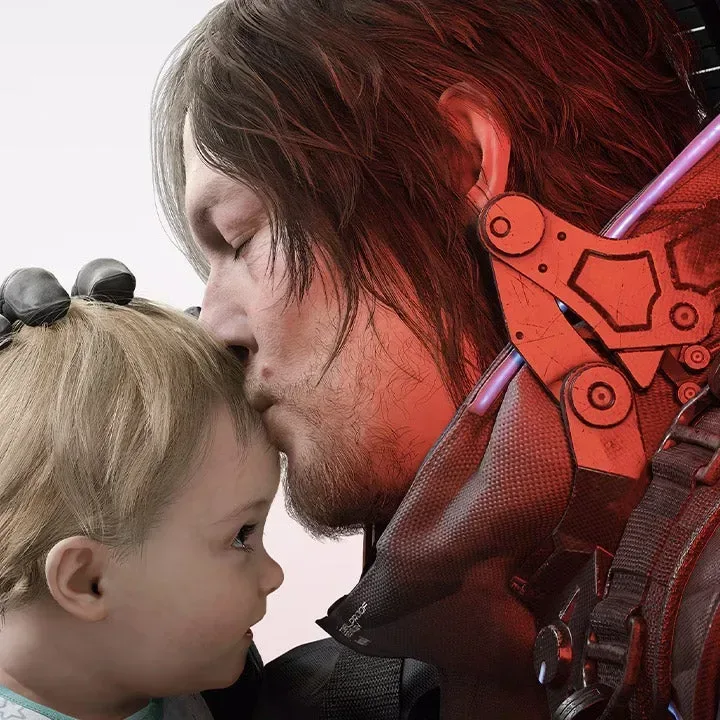
The Death Stranding movie is taking a more tangible step toward production. Director Michael Sarnoski has been location scouting in Iceland alongside cinematographer Pat Scola, offering an early glimpse at the type of real-world environments that may help bring Hideo Kojima's surreal, isolated game universe to the screen.
Sarnoski shared a selfie while wearing a Death Stranding shirt, while Scola posted footage of Icelandic scenery marked by sweeping moss-covered ground, waterfalls, and vast open space. There has been no confirmation that the precise place shown will appear in the completed movie. Still, the scouting trip matters because it indicates the filmmakers are actively translating the series' signature visual language into practical locations rather than simply treating the setting as something to be built entirely on soundstages or generated digitally.
That approach feels especially appropriate for Death Stranding. The games have always relied on landscapes as more than attractive backdrops. Mountains, rivers, rain, cliffs, empty roads, and fields all shape the journey of a courier moving through a fragmented America. Iceland's dramatic geography has a natural kinship with that imagery, even if the bright conditions seen during scouting differ from the ominous skies and supernatural weather that players associate with the first game.
Embedded X/Twitter post
Iceland's terrain fits the world of Death Stranding
Death Stranding is remembered as much for its atmosphere as its characters and mechanics. Players spend long stretches crossing hostile but beautiful terrain, weighing every route and every item against the dangers ahead. Its landscapes can feel peaceful one moment and deeply unsettling the next, particularly when the world is altered by Timefall or when spectral threats emerge.
For useful background on this topic, read Dungeons & Dragons and Magic Teams Seek Union Recognition, Citing AI Concerns.
The views shared from Iceland evoke some of those same contrasts. Waterfalls cut through rocky spaces, moss spreads across uneven land, and the horizon appears both inviting and difficult to cross. Such terrain could offer the movie an immediate physical scale that would be hard to duplicate convincingly through virtual backdrops alone.
Practical location work does not mean visual effects will have no role. A Death Stranding adaptation will inevitably need to depict ideas and phenomena that do not exist in the real world. The franchise includes the Beach, BTs, Timefall, unusual technology, and a civilization struggling with the consequences of the Death Stranding itself. But grounding scenes in real outdoor environments could help those strange elements feel more immediate. The central appeal of the games often comes from placing fantastical concepts against tactile mud, stone, rain, cargo, and human exhaustion.
It is also a promising sign for fans concerned about whether an adaptation can preserve the lonely, contemplative quality of Kojima's work. Shooting in locations where performers can physically move through difficult terrain may support the sense that travel has weight and consequence. In Death Stranding, reaching a destination is rarely just a cutscene transition. It is the story.
Filming is planned for Iceland and Northern Ireland
Sarnoski said earlier this summer that the production is planned to shoot next year in Iceland and Northern Ireland. The new scouting material reinforces that plan and suggests pre-production is continuing to take shape. Northern Ireland brings another set of striking natural environments into the mix, potentially allowing the film to create varied regions without losing the series' harsh and isolated identity.
Neither location has been tied to a particular sequence, character, or story point. The movie's plot remains under wraps, and viewers should not assume that every landscape visited during scouting will become part of the final production. Filmmakers routinely inspect multiple locations before deciding what best fits the script, the schedule, weather conditions, access requirements, and the demands of a shoot.
Even so, the choice to scout these regions aligns with the project's stated intent. Rather than retelling the games beat for beat, Sarnoski's film will tell a new original story within the Death Stranding world. That gives the movie room to introduce places players have not seen before, along with new delivery routes, settlements, threats, and communities shaped by the same fractured reality.
That decision may be important for both newcomers and longtime fans. A straightforward recreation of the first game would face the challenge of condensing a very long, highly unusual narrative into a single feature. An original story can use the setting's concepts while building a plot specifically for film. It can also leave room for the game's existing story to remain its own experience instead of being replaced by an abbreviated screen version.
Hideo Kojima remains involved with the project
The Death Stranding film has the backing and involvement of series creator Hideo Kojima, and it is being produced in conjunction with A24. That combination has fueled expectations for an adaptation willing to embrace the stranger, more emotional, and less conventional sides of the property.
Kojima's involvement is particularly notable because Death Stranding is a world with a dense internal mythology and a distinctive tone. Its ideas can be difficult to summarize: connection in an age of isolation, parenthood, grief, extinction, rebuilding, and the strange bonds that emerge between people who may never meet face to face. Any screen adaptation will need to find a way to communicate those themes without becoming overwhelmed by jargon or simply reproducing game exposition.
Sarnoski's original-story approach may offer a useful path through that challenge. The film does not need to explain every detail of the universe at once. It can focus on a smaller human story and allow the wider setting to emerge through action, travel, relationships, and the obstacles facing its characters. The landscape scouting suggests the team recognizes that place itself will be an essential storytelling tool.
The fact that the project is moving ahead during a broader expansion of the franchise also makes it significant. Kojima has said he is not interested in personally directing a third Death Stranding game, though he would allow someone else to make one based on a concept he created. At the same time, the universe is continuing in other forms, including a separate anime project. The movie is therefore not just an adaptation experiment; it is part of a larger effort to explore the setting beyond a single game format.
A new cast is expected, with room for familiar faces
Because the movie is telling a new story, it is expected to feature a new cast of characters. That does not necessarily rule out appearances from established figures. Sarnoski has indicated that familiar faces from the games could show up, leaving open the possibility of connections to characters fans already know.
No casting announcements have been made. Norman Reedus, who plays Sam Porter Bridges in the games, has already expressed interest in returning for the film, but his participation has not been confirmed. Until an official announcement arrives, fans should treat any assumptions about Sam's role, or the involvement of any other game performers, as speculation.
There are several ways a new story could accommodate recognizable characters without making them the sole focus. They could appear in supporting roles, provide a link between different regions, or simply reinforce that this story exists in the same continuity and under the same rules as the games. Equally, the film could prioritize entirely new people whose lives have been shaped by the Death Stranding in different ways.
That flexibility is one of the project's most intriguing strengths. Death Stranding's premise is broad enough to support stories about porters, isolated survivors, scientific researchers, settlement leaders, people seeking reunion, or those trying to exploit the changed world for their own ends. The next major update may reveal which corner of that world Sarnoski intends to explore.
No release date has been announced
There is currently no release date for the Death Stranding movie, and cast information remains undisclosed. With filming planned for next year, a 2028 release is possible depending on when production begins and how extensive the film's post-production work becomes, but that has not been officially announced.
For now, Iceland scouting is a meaningful but early milestone. It does not reveal the story, confirm a cast, or guarantee that any specific vista will reach theaters. What it does show is that the production is looking beyond abstract concept art and moving into the real environments that could define its visual identity.
For a series built around difficult journeys through extraordinary terrain, that is an encouraging development. The Death Stranding movie still has many unanswered questions ahead of it, but its creative team appears to be starting with one of the franchise's most vital ingredients: a world that audiences can believe people have truly struggled to cross.
Community
Discussion
Start the conversation.
No comments have been posted yet.