

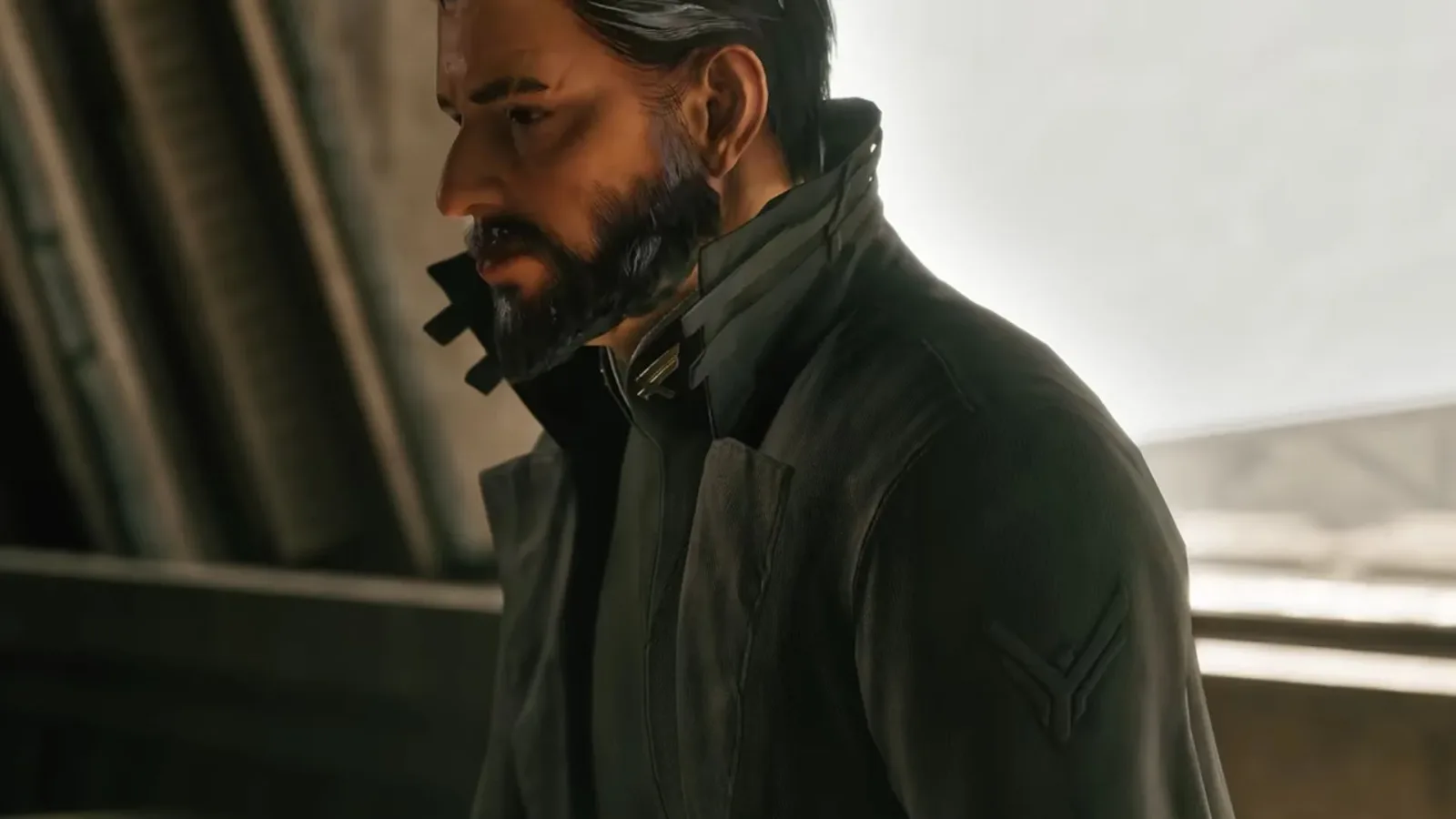
Dune: Awakening has spent its first years asking players to survive the brutal sands of Arrakis, contend with its shifting political and environmental dangers, and, naturally, ride enormous sandworms. But before players ever reached the desert, Funcom had to navigate a different kind of challenging terrain: the approval process that comes with adapting one of science fiction's most closely guarded worlds.
Jon Bylos, Funcom's chief creative officer, has discussed how the studio works with the people responsible for overseeing the Dune screen license and the wider legacy of Frank Herbert's novels. The process is largely streamlined now, he says, but it has occasionally involved direct guidance from Herbert's estate and from filmmaker Denis Villeneuve himself.
One memorable piece of feedback concerned the game's own name. Villeneuve reportedly felt that Dune: Awakening "could be a little too close to Star Wars." Funcom ultimately continued with the title, which now identifies a game entering its second year with a community built around life on Arrakis.
A Name With Heavy Science-Fiction Associations
It is easy to see why a title containing "Awakening" might invite comparisons to another massively recognizable science-fiction franchise. The word has a prominent recent association with Star Wars, and Dune's modern film revival has often been discussed alongside other major cinematic genre properties. Still, Dune itself predates Star Wars by decades: Frank Herbert's landmark novel was first published 61 years ago.
For useful background on this topic, read Blizzard Removes Gold From World of Warcraft: Forever Beta Player Amid RMT Concerns.
The concern was not presented as a demand that forced an immediate change. Instead, it stands as an example of the kind of discussion that can happen when a developer is working inside an established licensed universe. A name is more than marketing shorthand. It signals the intended tone of the project, frames players' expectations, and must sit comfortably beside the identity of a property that has existed across novels, film, television, games, and other media for generations.
Funcom pressed ahead with Dune: Awakening, and the title reflects a game built around the idea of an Arrakis that is active, dangerous, and always in motion. Its survival-game framing also gives "awakening" a different context from a purely cinematic adventure: the phrase can suggest emerging into a hostile new world, discovering its systems, and finding a place within the power struggles surrounding spice.
How Funcom Handles Dune Approvals
Bylos described a workflow centered on Jira, the widely used project-management software. Rather than relying exclusively on lengthy meetings and calls for every question, Funcom can submit material through tickets for review by Legendary, the company holding the license connected to the Dune films. The system includes an expected time frame for approvals, with escalation when a response is needed to keep work moving.
That may sound mundane, but a reliable approval pipeline is vital for a large licensed game. Development teams make countless decisions involving visual direction, terminology, story elements, gameplay concepts, promotional materials, and additions that may affect how a fictional setting is represented. If every one of those choices requires a slow chain of discussions among several groups, the creative process can become difficult to manage.
Bylos characterized the current arrangement as generally automated and dependable. Most proposed additions can be sent directly for a clear response, allowing the teams to move forward without turning each routine decision into a major administrative hurdle. In the context of a property as recognizable as Dune, that is an important practical advantage.
Legendary has produced both of Villeneuve's Dune films based on Herbert's work to date, making it a crucial partner for a game that draws upon the contemporary screen interpretation of Arrakis. Yet there are cases in which questions go beyond the regular approval channel. Funcom may be directed to Herbert's estate, or to Villeneuve, when their particular perspective is needed.
The title discussion is therefore notable not because it reveals a broken process, but because it illustrates how multiple custodians can participate in protecting a franchise. A developer is not simply borrowing names and imagery. It is contributing new material to a setting with a long history, passionate audiences, and several stakeholders who each have an interest in preserving its character.
Trust Matters More Than Procedure
For Bylos, the key change over time appears to be trust. Once a development studio has shown that it understands the setting and takes the intellectual property seriously, every interaction does not need to be defined solely by formal process. The mechanics of ticket submissions and escalation paths remain useful, but confidence in the people making the game becomes just as important.
"When you've established that trust, the processes aren't necessarily as important: it's more about just knowing that the other people have the IP's back," Bylos said.
That is a significant point for any long-running game, especially one intended to keep expanding. The more content a live project creates, the more opportunities there are to introduce something that clashes with the source material's tone or creates uncertainty about what belongs in the world. Strong communication and mutual confidence can help teams identify those problems early without making every creative idea feel impossible to pursue.
Dune is also a particularly demanding universe to adapt because its identity is not limited to surface-level iconography. Sandworms, spice, stillsuits, and the deserts of Arrakis are immediately recognizable, but they are tied to themes of ecology, power, religion, colonialism, survival, and prophecy. A game can include the familiar pieces and still miss what makes the setting feel like Dune. Funcom's need to establish itself as a responsible caretaker is therefore about more than winning approval for individual assets.
Arrakis Is Not a Straightforward Solo Adventure
Dune: Awakening is now moving into its second year, with players continuing to make their way across Arrakis and engage with its survival-focused structure. Its continued growth will depend on keeping that community invested while expanding an experience shaped by the social possibilities of an MMO.
That MMO identity has been an important part of setting expectations. The game's lead has said that it can be a "really great" experience for solo players, but has also cautioned that people expecting something comparable to The Last of Us may be looking in the wrong place. The comparison highlights the difference between a structured, cinematic single-player action game and a persistent online world where players can pursue their own paths while existing alongside others.
For solo-minded players, the appeal can come from exploring, surviving, building an understanding of Arrakis, and choosing how deeply to engage with the game's larger social systems. For those looking for a world shaped by competition, cooperation, and a wider player community, the MMO structure offers a different kind of Dune fantasy. Neither approach changes the fact that the planet remains unforgiving.
That tension is fitting for the franchise. Arrakis is never merely a scenic backdrop; it is a force that demands preparation and respect. The sandworm rides may be among the most immediately memorable images associated with the game, but they sit alongside the broader challenge of existing in a place where resources, travel, and alliances carry weight.
The Spice Must Continue to Flow
The story behind Dune: Awakening's name is a small but revealing glimpse into the realities of licensed development. Even a phrase chosen to represent a new game can prompt debate when it belongs beside a cultural institution as large as Dune. Villeneuve's concern about a possible Star Wars resemblance did not stop Funcom from moving ahead, but it shows that the game's identity was considered carefully before it reached players.
More broadly, Funcom's account suggests that its relationship with Dune's rights holders has matured into a collaborative one. Formal review remains part of the work, as it should for a property with this much history. But the studio's ability to work efficiently depends on the belief that it understands what it is handling and intends to protect it.
As the game enters its second year, that foundation may matter as much as any individual feature. Arrakis offers an enormous space for a survival MMO to evolve, but every future addition must still feel at home beneath its blazing sun. Funcom has already navigated questions as fundamental as what to call the game. The next test is sustaining its world, its players, and its sense of Dune for the long journey ahead.
Community
Discussion
Start the conversation.
No comments have been posted yet.