
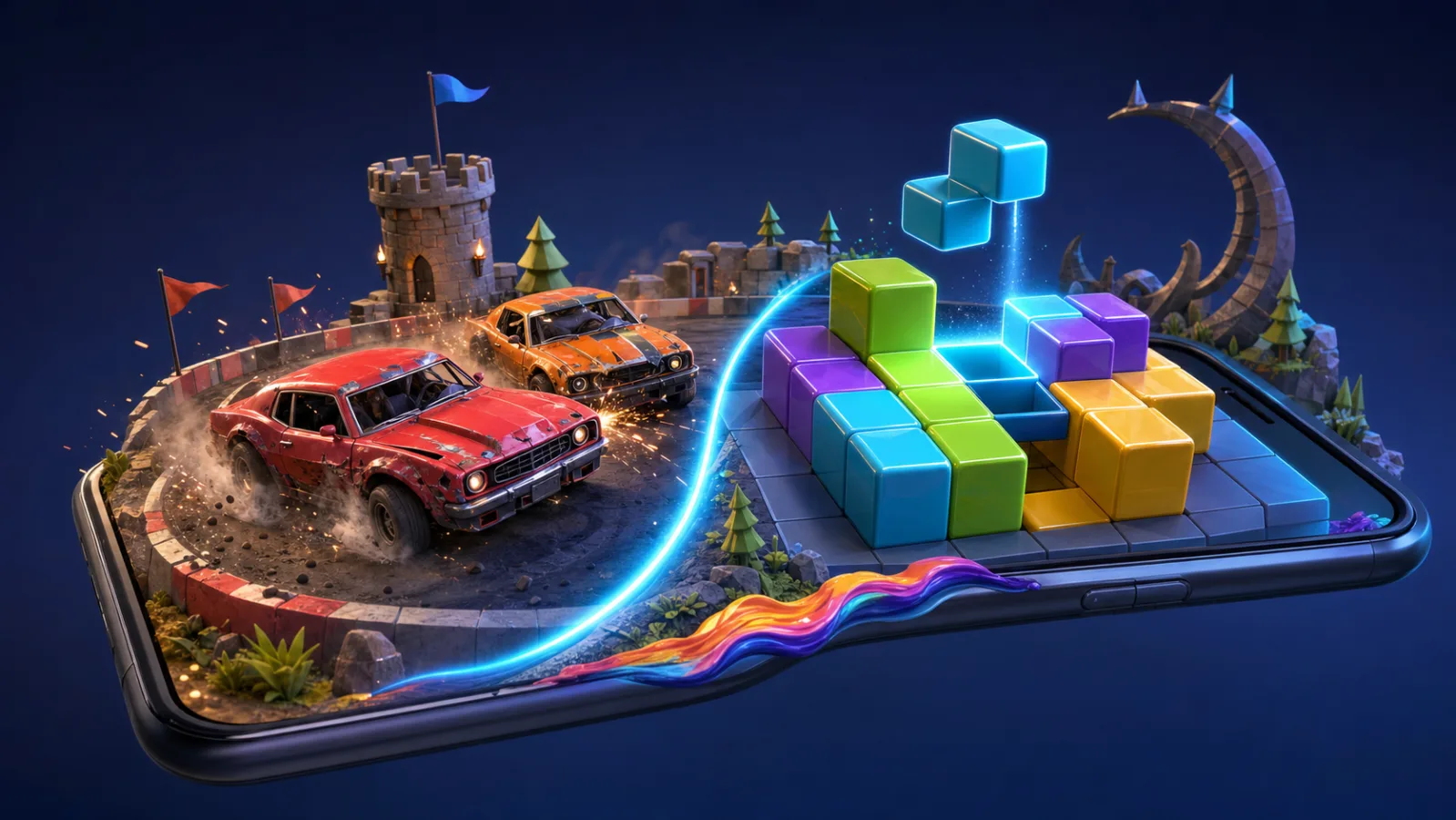
Destruction Derby and Denki Blocks! make a surprisingly useful comparison because they represent two almost opposite ideas of what a portable-friendly game can be. Destruction Derby is loud, immediate, and physical: a racing game where crashing into rival vehicles is not merely permitted, but central to scoring. Denki Blocks! is deliberate and spatial: a puzzle game about sliding colored blocks across a board, joining them into shapes, and thinking several moves ahead.
Both have appeared on mobile-oriented platforms, including Android, while Denki Blocks! is also listed for iOS. Yet their shared mobile category does not mean they serve the same player. One asks for fast reactions and a willingness to take risks in an arena full of cars. The other rewards patience, planning, and the satisfaction of seeing a difficult board finally click into place. Their original design eras also matter. Destruction Derby arrived in 1995, while Denki Blocks! followed in 2001, and each carries a different strain of classic game design into a modern portable context.
If you are deciding between them, the important question is not which game has more action or which has more strategy. It is whether you want a session driven by impact and momentum, or a session driven by arrangement and problem-solving. This comparison looks at gameplay, platform fit, longevity, and the kinds of players each game suits best.
The short verdict
Choose Destruction Derby if you want arcade aggression. Its premise is easy to understand: drive, collide, damage opponents, and pursue higher-scoring wrecks. Head-to-head competition and the all-out Destruction Derby arena create a direct, energetic experience that is ideal for players who want a classic racing game with combat at its core.
Choose Denki Blocks! if you want a calmer but more cerebral challenge. Sliding colored blocks together to build required shapes gives every move a purpose. Its Puzzle Island setting and blend of puzzle, strategy, and adventure framing make it a stronger fit for players who enjoy studying a board, experimenting with layouts, and improving through understanding rather than speed.
Neither game replaces the other. Destruction Derby is the better pick for a quick burst of chaotic competition. Denki Blocks! is the better pick for focused solo play when you want to engage your brain without depending on reflexes. If your ideal mobile game is one you can think through at your own pace, start with Denki Blocks!. If your ideal session involves turning the whole arena into a metal-crunching contest, start with Destruction Derby.
Gameplay comparison: collision scoring versus shape-building
Destruction Derby makes wrecking the point
Destruction Derby combines racing with vehicle-wrecking challenges. That distinction is crucial. In a conventional racing game, a collision is usually a mistake that costs speed or position. Here, damaging opponents earns points. The game specifically rewards spectacular impacts more than straightforward collisions, so sending a rival car into a 360-degree spin is more valuable than simply bumping into it.
This changes how players read the road and the arena. Rather than treating every other car as an obstacle, you are encouraged to see rivals as opportunities. Positioning matters because the quality of an impact matters. Timing matters because an opponent that is moving in the right direction can be turned into a more dramatic crash. The game's action and racing genres meet in a simple but forceful loop: drive into danger, create damage, and chase the biggest possible reward.
The available modes reinforce that focus. Head-to-head strips the contest down to two cars, placing emphasis on a direct contest with a single opponent. Destruction Derby begins with every car around the edge of a large arena before the drivers collide in an all-out crash battle. The first mode highlights rivalry; the second emphasizes crowd chaos. Both are immediately legible, which is one reason the game's core idea remains easy to appreciate.
Its appeal is not built on a complicated rulebook. It is built on the pleasure of controlled mayhem. Players who like to improvise, take risks, and react to rapidly changing traffic will find a natural fit here. Players who prefer careful optimization may still enjoy learning how to earn better impacts, but Destruction Derby is fundamentally at its best when it feels unruly.
Denki Blocks! turns movement into a puzzle language
Denki Blocks! has a very different relationship with movement. Players slide blocks around a board and join colored blocks together to create shapes and solve puzzles. Instead of interpreting velocity, collision angles, and opponent behavior, the player reads the current arrangement of pieces. Every slide affects what can happen next.
That makes the game more strategic than it may initially appear. A block moved into a convenient position can also block an important route. A group joined too early may create an awkward shape. A promising plan can fail because there is no longer enough room to reposition the pieces. The central tension is not whether you can act quickly enough; it is whether you can preserve enough options to reach the required solution.
The Puzzle Island setting gives this puzzle structure an adventure context, but the real star is the board design. Color, shape, and placement are the vocabulary. Players learn by observing how pieces interact, testing routes, and recognizing patterns. That learning process is satisfying because progress is visible. A formerly confusing layout becomes understandable, and a solution emerges from a sequence of intentional choices.
Denki Blocks! therefore offers a more contemplative kind of satisfaction than Destruction Derby. There is no need to chase a moment of impact. The key moment is the realization that a board can be solved, followed by the execution of the necessary moves. For players who enjoy clean systems and self-contained challenges, that is a powerful loop.
Mobile and platform fit
For a mobile comparison, control demands are the biggest practical divide. Destruction Derby is listed on Android alongside DOS, PlayStation, PlayStation 3, PlayStation Portable, Sega Saturn, and Sony PlayStation. Denki Blocks! is listed on Android and iOS, as well as Game Boy Advance, Game Boy Color, PlayStation 3, and PlayStation Portable.
Those platform histories say something useful about each game's character. Destruction Derby comes from a lineage associated with larger-screen racing and console play, while Denki Blocks! also has roots in Game Boy Advance and Game Boy Color formats. That does not establish a universal best way to play either game, but it does highlight a meaningful difference: Denki Blocks! is naturally built around board-scale decisions, while Destruction Derby relies on active driving and rapid reactions.
On a mobile device, a board puzzler has an inherent advantage in readability and interruption tolerance. Denki Blocks! presents a discrete problem. You can look at the board, make a move, reconsider the next move, and step away without losing the thread of the experience. The value of the session comes from analysis, not sustained momentum. That makes it well suited to short, fragmented play windows.
Destruction Derby asks more from a player's immediate attention. Racing, targeting other cars, and aiming for high-value damage are all actions that feel strongest when the player is engaged moment to moment. That does not make it unsuitable for mobile play; it makes it a different kind of portable game. It is better approached as a concentrated arcade session than as something to play while distracted.
There is also a display consideration. Denki Blocks! is centered on a puzzle board, so visual attention is directed toward a compact play space. Destruction Derby deals with moving cars and broad arenas, and the player needs to process motion quickly. Anyone especially sensitive to small-screen visual clutter may find the slower, clearer decision structure of Denki Blocks! more comfortable.
Challenge, accessibility, and learning curves
Destruction Derby is easy to grasp, harder to master
The accessible part of Destruction Derby is its fantasy. Most players understand instantly why driving into opponents might be fun. The scoring rule is also clear in spirit: greater damage and more spectacular impacts lead to better rewards. That immediate clarity helps the game get moving quickly.
Mastery, however, is more nuanced. An effective player cannot simply crash without thought. The desire for higher-scoring impacts encourages better timing, better approach angles, and more awareness of the behavior of other vehicles. Head-to-head play can put this skill difference in sharp relief, because there is nowhere to hide when the whole contest revolves around one rival.
This means Destruction Derby works for beginners who want uncomplicated action, but it has greater depth for people who enjoy refining aggressive driving. It rewards instinct first and craft second. The emotional response is usually immediate: a successful hit looks and feels like an event.
Denki Blocks! is welcoming, then demanding
Denki Blocks! is similarly understandable at the basic level. Slide blocks. Join colors. Build shapes. The complication comes from the consequences of each move. Puzzle games often create their most memorable challenges from simple rules, and this game's strategic layer is found in the fact that arranging a board is never just about the current move.
For new players, that can feel more demanding than Destruction Derby's direct action. A mistake is not always dramatic, but it can leave a layout in an unhelpful state. The response is not faster reflexes; it is a revised plan. That makes Denki Blocks! especially appealing to players who enjoy failure as information. When a solution does not work, the board itself becomes a lesson about what must change.
Its challenge is therefore less about pressure and more about perspective. Some players will find that relaxing. Others will miss the rush of immediate action. The best choice depends on what you want a game to ask of you after the first few minutes.
Longevity: replayable chaos or enduring puzzle focus?
Longevity is not only about the amount of content a game contains. It is also about whether its core activity stays appealing. Destruction Derby and Denki Blocks! both have durable central ideas, but they create repeat play for different reasons.
Destruction Derby's replay value comes from variability. Crashes do not unfold in exactly the same way every time, particularly in the large arena-based Destruction Derby mode. Different encounters can produce different collisions, spins, and opportunities to chase points. The head-to-head mode also gives the game a clear competitive identity. Players who return to games for unpredictable moments and the chance to improve their performance in the heat of action will get the most from it.
Denki Blocks! creates longevity through mental engagement. Puzzle-solving has a naturally persistent appeal because each layout asks to be understood. The reward is not just completion but the gradual development of better habits: noticing available space, anticipating the result of a slide, and avoiding commitments that trap important blocks. Its strategic element means that thoughtful players can return for the pleasure of solving rather than merely repeating.
For long-term portable play, Denki Blocks! may be the more dependable companion for solo players who prefer a measured pace. It asks little more than attention and a desire to solve. Destruction Derby may have the stronger pull when you are in the mood for an energetic release. Its sessions are driven by adrenaline, not contemplation, and that can make it the more memorable choice for a short burst of play.
Which players should choose Destruction Derby?
- Arcade racing fans: The game's blend of driving and vehicle damage is designed for players who want racing to feel combative rather than orderly.
- Players who enjoy spectacular outcomes: Higher rewards for dramatic damage, including 360-degree spins, make every well-placed hit feel meaningful.
- Competitive players: The two-car Head-to-head mode gives the game a direct rivalry format.
- Fans of arena chaos: The Destruction Derby mode begins with cars around a large arena and turns that space into a crash battle.
- People seeking immediate action: Its central goal is easy to understand and delivers quick, physical excitement.
It may be a weaker fit for players who dislike pressure, dislike driving games, or want to pause frequently to consider each decision. Destruction Derby thrives on movement. Its strategy exists inside the action, not apart from it.
Which players should choose Denki Blocks!?
- Puzzle enthusiasts: Sliding and joining colored blocks into shapes is the heart of the experience.
- Strategy-minded solo players: The game rewards planning, spatial awareness, and the ability to think ahead.
- Portable puzzle fans: Its board-focused structure is naturally compatible with short, thoughtful play sessions.
- Players who value calm concentration: The challenge comes from solving layouts rather than maintaining racing speed.
- Fans of classic handheld-style design: Its Game Boy Advance and Game Boy Color platform history aligns with its compact, system-driven approach.
It may be a weaker fit for players who need constant motion or want every minute to include dramatic audiovisual action. Denki Blocks! asks for patience. Its best moments are quiet ones, when a difficult arrangement becomes clear.
Final decision: two classics, two completely different moods
Destruction Derby versus Denki Blocks! is not a contest with a universal winner. They solve different needs with impressive clarity. Destruction Derby is a 1995 action-racing game that turns reckless contact into the main event. Its scoring celebrates damage, its modes frame direct competition and arena-wide mayhem, and its appeal comes from fast decisions made amid collisions.
Denki Blocks!, released in 2001, is a puzzle-strategy game that transforms a simple sliding-block concept into a shape-building challenge. Its appeal comes from structure, experimentation, and the gradual discovery of solutions. Where Destruction Derby makes you react, Denki Blocks! makes you reflect.
For the better mobile-minded choice, begin with your usual gaming mood. Pick Destruction Derby when you want a concentrated rush of aggressive arcade driving. Pick Denki Blocks! when you want a smart, self-contained puzzle that rewards deliberate play. The strongest library has room for both: one for the moments when you want to smash through the problem, and one for the moments when you would rather solve it.
Community
Discussion
Start the conversation.
No comments have been posted yet.