

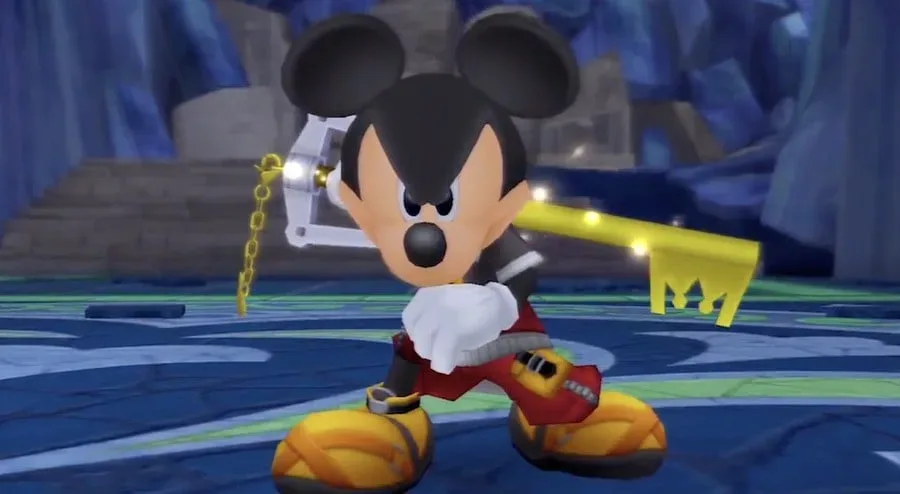
Long before Disney Infinity made it routine to see characters from entirely different Disney worlds sharing the same toy box, Disney explored a much more direct kind of crossover: a fighting game built around collectible-style action figures. The project, known as Disney's Action Figure Face Off, never advanced beyond the prototype stage, but its concept was strikingly clear. Disney heroes from properties including Tarzan, The Lion King, and Treasure Planet would have become action figures and battled one another in a format inspired by the multiplayer chaos of Super Smash Bros..
New details about the abandoned game come from Ken Christiansen, a former Disney Interactive concept artist whose portfolio had previously revealed artwork from several unrealized Disney projects. Christiansen has now discussed the thinking behind Action Figure Face Off, explaining that the game emerged after Kingdom Hearts helped change internal attitudes toward allowing Disney's separate worlds to collide.
It is a revealing bit of history for Disney games. A crossover fighter may sound like an obvious fit in the present day, especially after games and media franchises have spent years embracing giant shared universes. But Disney's path to that point was not necessarily straightforward. In Christiansen's recollection, simply putting familiar characters from different films in the same game was once a major point of hesitation.
Kingdom Hearts helped make crossover thinking possible
Christiansen was credited as one of two senior artists on the first Kingdom Hearts, alongside Mary Ann Ramirez, who died in 2017. He has been clear that Ramirez had the larger role on the game, while his own contributions were more limited. His work included costume ideas for Donald and Goofy, as well as concept art connected to the Monstro world.
For useful background on this topic, read BIRDCAGE Takes Its Bullet-Hell Conflict to PlayStation, Xbox and Switch on September 23.
Even with that more focused contribution, Christiansen saw some of the creative and corporate challenges involved in getting the crossover role-playing game moving. Disney was reportedly reluctant about the prospect of its characters and settings crossing into one another's worlds. The idea of a Lion King character existing alongside material associated with The Little Mermaid, for instance, was difficult for parts of the company to accept.
"One of the reasons Kingdom Hearts was so difficult to get started was because Disney was so reluctant to have that possibility of crossing over The Lion King into The Little Mermaid world," Christiansen said. "That was the main hangup for Disney America. They couldn't get over that."
For artists, producers, and other creative staff working around the project, the reaction was apparently very different. Christiansen recalled broad enthusiasm for the central premise: if Disney owned this enormous range of worlds and characters, why not let them meet? Kingdom Hearts ultimately proved that the concept could work commercially and creatively, even while its original crossover came wrapped in Square Enix mythology, original leads Sora, Riku, and Kairi, and a distinct action-RPG structure.
For another perspective on this story, read Disney's Lost Action Figure Face Off Was a Prototype Crossover Fighter With Smash Bros. Ambitions.
Its success had an effect beyond that one series. Christiansen said Disney became more receptive to internal concepts involving its properties interacting outside their individual film settings. That shift opened the door to ideas that could be more playful, more toy-like, and more immediately focused on the appeal of seeing recognizable characters together.
A Toy Story-style explanation for Disney battles
The solution proposed for Disney's Action Figure Face Off was to treat the cast as action figures. That framing would have given the project an in-universe reason for otherwise incompatible characters to throw punches, leap across stages, and compete against one another. It also echoed the premise associated with Toy Story, in which toys gain personality and agency when people are not looking.
Christiansen described the pitch as a "Smash Brothers kind of thing," with action-figure versions of Disney characters drawn from multiple properties. The concept's title leaves little doubt about its intended appeal. It was meant to foreground a face-off between Disney icons rather than keep each franchise separated into its own licensed game.
That makes the project especially interesting in retrospect. Disney would later release games built around inter-franchise interactions, including Disney Infinity, whose figures and play sets turned crossover collecting into the heart of the experience. Yet Action Figure Face Off appears to have been pursuing a more focused competitive game years earlier. Rather than positioning toys primarily as an expansion format, it seemingly aimed to make them the fiction supporting a platform-fighter-style contest.
No full playable build, roster, stage list, combat system, or story outline has been publicly detailed. As a result, it would be premature to assume it would have played exactly like Nintendo's fighting series. "Smash Bros.-style" is best understood as a description of the pitch's broad crossover-brawler ambition. Still, the premise alone makes it easy to imagine why the team thought it had potential: Disney's catalogue offered a deep bench of visually distinct heroes, villains, sidekicks, and settings.
Big pitch boards and a prototype that went no further
Christiansen's account also provides a glimpse at how such ideas were sold inside Disney Interactive. Teams would make huge visual presentation boards, sometimes six to eight feet long and roughly four feet high, mounted on thick foam core. These boards were filled with artwork, logos, and other material intended to make an immediate impression while executives were guided through a game proposal.
That process was not purely speculative. Christiansen noted that comparable pitch work could lead to released games. One example was Disney's Extreme Skate Adventure, a game associated with Ramirez that did make it to market. The difference for Action Figure Face Off was that its journey stopped at the prototype phase.
Disney ultimately chose not to move forward with the fighter. Christiansen said the company favored safer projects, particularly games tied to films and television programs. This matched a broader pattern from his four years at Disney, where he worked on numerous concepts that did not become finished games. Licensed projects connected to existing releases or established screen properties had clearer marketing hooks and a more obvious business case.
Among the projects and properties Christiansen recalled carrying through were Treasure Planet, Atlantis, Peter Pan 2, Kim Possible, Buzz Lightyear, and Monsters, Inc.. Those were the kinds of recognizable, directly marketable brands that could secure funding. The more open-ended question of how to combine Disney's vast catalogue into an original game concept remained a recurring subject of internal discussion, but it did not always result in a green light.
Christiansen characterized the eventual all-in crossover approach as something that felt obvious to the creatives involved, even if approval required persistent persuasion. In that light, Disney Infinity can be viewed as a later answer to a question Action Figure Face Off had already tried to tackle: what should Disney do when it has so many properties and wants to let them coexist?
Activision links and uncertain target platforms
There are indications that Activision may have been attached to the project. Former Activision staff members Peter Walsh, a software engineer, and Lara Sweeney, an associate producer, have referenced Disney's Action Figure Face Off in their professional histories. That association would make sense in context, as Activision was also responsible for bringing Disney's Extreme Skate Adventure to life.
However, the available references do not provide a completely settled picture of the game's planned systems. One profile lists PlayStation 2 and PC as potential platforms. Another points to PlayStation 2, Nintendo GameCube, and Xbox. The disagreement means no definitive platform lineup can be confirmed. It is safest to say that the prototype was apparently considered for some combination of the major sixth-generation home consoles and PC, rather than declare that every listed version was formally in development.
That uncertainty is common for cancelled games, especially ones that disappear before a public announcement. Early platform plans can change, prototypes may be built on a single machine, and resume entries may reflect intended targets rather than completed versions. What is much clearer is the game's central creative hook: an early-2000s Disney crossover fighter, using action figures as the bridge between otherwise separate franchises.
A compelling "what if" for Disney gaming
Disney's Action Figure Face Off joins a long list of projects that are fascinating precisely because they never reached players. It was conceived at a transitional moment, after Kingdom Hearts had demonstrated that Disney crossovers could succeed but before Disney fully committed to a toy-based crossover platform of its own. Its use of action figures suggests an idea that was commercially aware, visually flexible, and prepared to turn Disney's breadth into a competitive-game advantage.
Whether it could have become a lasting rival to other platform fighters is impossible to know. The game did not receive the time, funding, or public release necessary to prove itself. But the prototype's existence shows that Disney's eventual crossover ambitions had roots deeper than many players may realize. Before Infinity, before later multiverse-style entertainment became familiar, there was a pitch where Tarzan, Simba, and Treasure Planet characters could have settled the question in an action-figure arena.
Community
Discussion
Start the conversation.
No comments have been posted yet.