

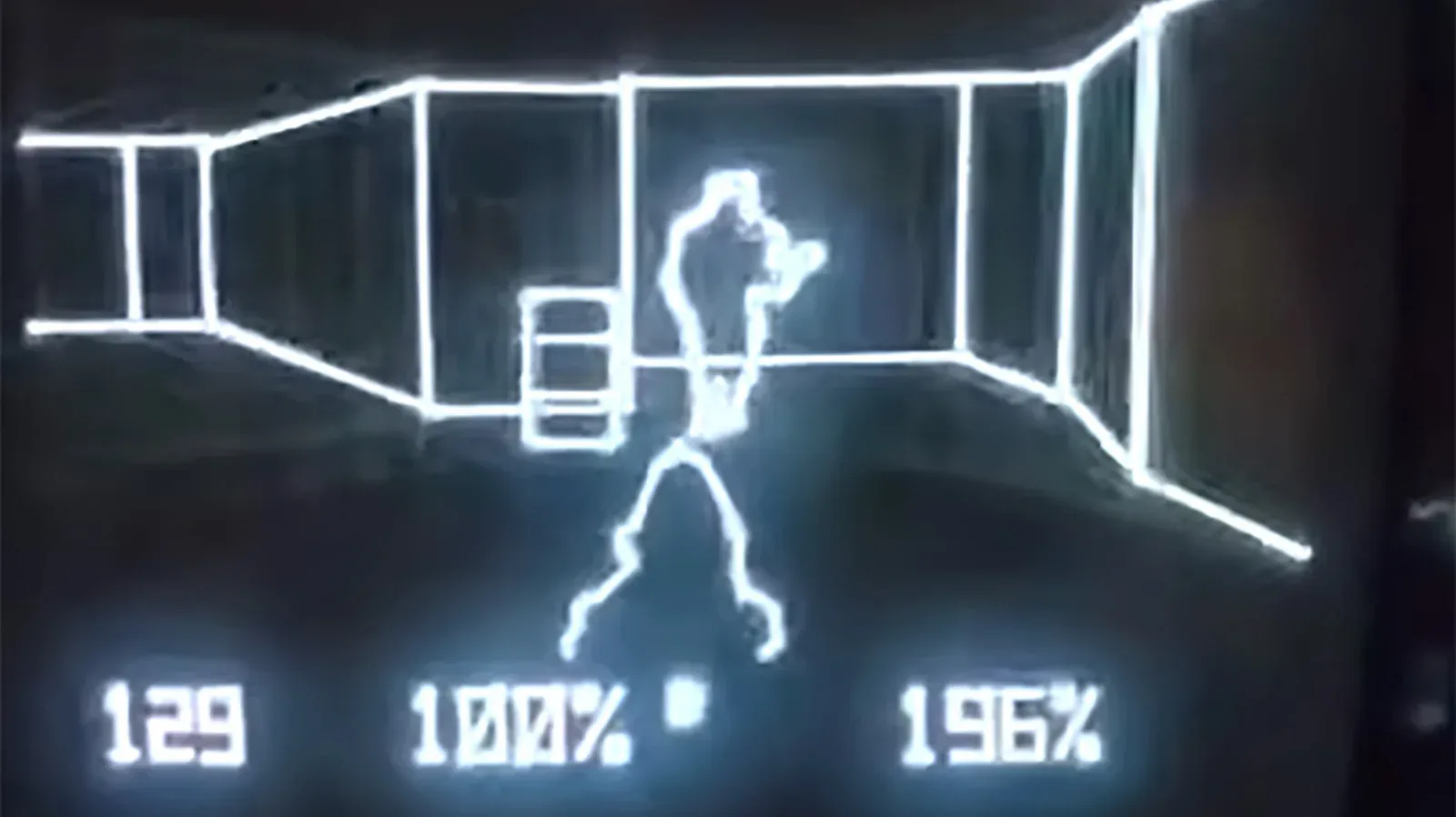
Doom has made a career out of appearing where nobody expects it. The landmark 1993 shooter has surfaced on everything from calculators and music players to kitchen appliances, but a new Vectrex demonstration stands apart from the usual novelty-port conversation. Rather than merely proving that Doom can be made to run on unusual hardware, this project changes how the game looks at a fundamental level.
Presented through the Vectrex's built-in vector display, Doom becomes a web of bright, sharply drawn lines. Corridors, enemies and environments are rendered in a style closer to vintage arcade vector games and the glowing digital imagery associated with Tron than the textured, pixel-driven presentation players know from id Software's original. It is an eye-catching use of a machine that arrived in 1982, 11 years before Doom's debut.
There is an important technical qualification: this is not Doom running natively on the stock internals of the Vectrex. Modder Jason Kopp, also known as ArcadeJason, created the demo around the Ultimate Vectrex Multicart 2, or UVMC2. That cartridge supplies the substantial processing needed for the project, effectively acting as a compact plug-in PC while the Vectrex itself serves as the display platform. Even so, the result is a fascinating meeting of modern tinkering, retro hardware preservation and one of gaming's most frequently reinterpreted classics.
A Doom Port That Looks Unlike Other Doom Ports
Most unusual Doom versions are compelling because of the device that hosts them. A calculator port is amusing because a calculator was never designed to be a first-person shooter system. A toaster running Doom is memorable for much the same reason. The Vectrex project has that same experimental spirit, but it also produces a visual result that cannot simply be replicated by putting the game on another small screen.
For useful background on this topic, read Xbox CEO Says the Company Is Returning to Growth Amid Continuing Reset.
The Vectrex is historically distinctive because it remains the only home console built around vector graphics. Instead of composing each image from a fixed grid of pixels, its CRT directs an electron beam to draw lines directly on the screen. That difference has a major effect on the final image. Lines can look remarkably clean and luminous, while the display avoids the conventional rasterized appearance associated with televisions, monitors and nearly every later console.
For Doom, that means walls and enemy silhouettes read as angular strokes of light rather than textured surfaces. The geometry of the game becomes the star. Doom's familiar first-person spaces were always built around lines, rooms, doors and shifting floor plans, so the format makes the shooter's architecture immediately recognizable even when its usual visual details are stripped away.
The effect is not simply a low-resolution version of Doom. It is better understood as a reinterpretation. The Vectrex image turns the game into something that feels part arcade cabinet experiment, part technical art piece. The stark presentation gives players a new way to appreciate the original game's level construction and enemy forms, precisely because the standard color, texture and lighting information is no longer doing the same work.
How the Vectrex Demo Works
The central piece of hardware is Kopp's Ultimate Vectrex Multicart 2. As its name suggests, the UVMC2 is more than a conventional game cartridge. In this Doom setup, it handles the computation that the 1982 console could not realistically perform by itself. The cartridge is essentially a small PC connected through the Vectrex cartridge slot, using the original system's CRT as the output device.
That arrangement is why the project should not be described as a native Vectrex conversion. Doom was designed for far more capable hardware than the Vectrex, and the performance demands of rendering a navigable first-person world would be far beyond what the unmodified console was built to manage. The cartridge's additional hardware is doing the heavy lifting.
However, calling it only an external-computing demonstration would miss the point. The Vectrex is not functioning as an incidental shell or a generic monitor. Its unique display technology is what gives the project its identity. The UVMC2 may make the software possible, but the console's vector CRT is responsible for the presentation that makes this version of Doom notable.
Sound is also handled outside the original console's usual path. Audio comes from a separate 3.5mm output on the cartridge. That is another reminder that the hardware setup is a hybrid, combining the historic Vectrex display with added processing and audio capabilities. It is an inventive approach that respects the unusual strengths of the old machine rather than pretending its original specifications can do something they were never intended to do.
The demo also makes use of an SDK created by modder Daniel Ferrer Guerrero. Work like this depends on more than a single clever hardware modification. Development tools, community documentation and specialized knowledge are all vital when enthusiasts are creating software for systems that have been out of mainstream production for decades.
Why Vector Graphics Still Matter
Vector graphics were once a notable part of the arcade landscape. Games built around directly drawn lines had a visual crispness that set them apart from their raster-based contemporaries. But the technique gradually gave way as pixel displays became cheaper, more flexible and better suited to detailed artwork, scrolling environments and color-rich games. By the time Doom arrived in 1993, textured raster graphics were firmly established as the dominant visual language for PC and console games.
That history makes the Vectrex Doom demo especially interesting. It places a game synonymous with the rapid advance of early 3D action into a display format that was already a niche curiosity by the time Doom was released. Instead of creating a mismatch, the collision of those eras reveals something new. Doom's world is reduced to the lines and motion that underlie its maps, while the Vectrex's screen turns those lines into an intense, glowing image.
The setup also demonstrates why the Vectrex still has an active enthusiast following. The console was commercially short-lived, but its unusual technology gave it a character that is difficult to emulate fully through ordinary screens. Modern displays can imitate vector-style visuals, yet seeing a CRT physically trace out the artwork carries a different kind of appeal. It is tactile, mechanical and unmistakably tied to the hardware itself.
For preservation-minded players and developers, projects like this keep that identity visible. They do not need to argue that older technology is superior to contemporary hardware. Instead, they show that a discontinued platform can still offer creative possibilities that newer systems do not naturally provide.
The Technical Asterisk Does Not Diminish the Experiment
There will always be a debate around what counts as a true hardware port. If most of the processing comes from a modern component housed in a cartridge, some will reasonably argue that the Vectrex is displaying Doom rather than running it in the conventional sense. That distinction is worth making, particularly because it explains how a console released more than four decades ago can present such a demanding game.
But the asterisk does not make the achievement less interesting. The goal here is clearly not to claim that an unmodified Vectrex has suddenly become a 1990s PC. The accomplishment is in building a bridge between new processing hardware and an old vector display, then tailoring Doom's presentation to take advantage of what that display does best.
In fact, the transparency of the approach makes it more compelling. Kopp's UVMC2 does not conceal the need for added power; it embraces the cartridge as a platform for experiments that would otherwise be impossible. The result is a project that is both a celebration of the Vectrex and an example of how retro hardware can be extended without losing the qualities that made it special.
Another Chapter in Doom's Long Afterlife
Doom remains a favorite target for hobbyist developers because it sits at the intersection of technical accessibility, cultural recognition and enduring game design. Its legacy has grown far beyond the original release, and each unconventional adaptation asks a slightly different question. Can the game fit on this device? Can it be controlled this way? Can its visuals be transformed into another medium?
The Vectrex demo answers that last question with unusual confidence. Its value is not just that Doom appears on an old console. It is that Doom is made to look as though it belongs to a different lineage of games altogether: one defined by dark screens, electric linework and the mesmerizing motion of a vector beam.
For anyone interested in Doom's endless modding legacy, the continuing life of the Vectrex, or the visual history of arcade and home-console technology, this is the kind of experiment that rewards a closer look. It is a processing-assisted project rather than a native port, but it is also one of the most distinctive presentations the classic shooter has received. The Vectrex may be decades removed from its commercial moment, yet this glowing interpretation proves it can still make familiar games feel startlingly new.
Community
Discussion
Start the conversation.
No comments have been posted yet.