

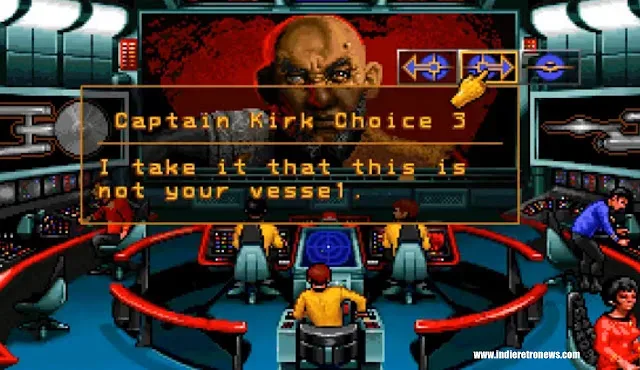
Star Trek: Judgment Rites, the adventure-game sequel that bypassed the Amiga during its original 1990s release period, has now been made playable on the platform through a newly released custom interpreter. The community project gives Amiga enthusiasts a route to run the original game's code decades after the game arrived for MS-DOS and Macintosh systems, filling a conspicuous gap in the library of classic Trek games.
The news is particularly notable because Judgment Rites followed a game with a much more direct Amiga connection. Star Trek: 25th Anniversary received an official Amiga AGA version in the 1990s, allowing players on Commodore's hardware to join Captain Kirk, Spock, Dr. McCoy, Scotty, Uhura, Chekov and Sulu on a collection of interactive missions. Its successor, despite being one of the era's most admired licensed adventures, never received the same treatment. Until now, Amiga users seeking to experience it on their preferred system had no native-era release to turn to.
A Long-Delayed Mission for Amiga Fans
The new interpreter was created by nexusle and is designed to make the original 1993-95-era game code function on Amiga systems. Rather than presenting a newly remade version of the game, the project provides the software layer needed for compatible Amiga configurations to run the original game. That distinction matters for preservation-minded players: the goal is to bring the existing adventure to another vintage platform while retaining its original content and identity.
Judgment Rites occupies a special place among Star Trek games from the period. Like 25th Anniversary, it combined point-and-click investigation, dialogue choices, shipboard sequences and away-team missions built around the original television series. It also had the difficult task of living up to a predecessor that had already shown how well the Star Trek format could fit an adventure-game structure. The absence of an Amiga edition remained unusual given the earlier game's appearance on the system and the platform's strong audience for graphical adventures.
For useful background on this topic, read Doom Reimagined on Vectrex in Striking Neon Vector Display Demo.
Now, roughly 34 years after 25th Anniversary first reached Amiga players, that missing sequel can be added to the machine's practical software catalog through community development. It is a reminder that retro platforms are not static museum pieces. New ports, interpreters, drivers and compatibility projects continue to expand what can be experienced on original hardware and on modern setups built around it.
Support for AGA, RTG and AHI
The interpreter supports enhanced AGA graphics, making it relevant to owners of later Amiga models and AGA-equipped systems. It also supports RTG video cards, an important feature for users whose Amiga configurations have been expanded with more modern graphics solutions. RTG support offers flexibility for enthusiasts who use upgraded machines rather than strictly period-standard displays and hardware arrangements.
Audio has not been overlooked. The project includes support for AHI audio, the widely used Amiga audio system that can provide cleaner and more flexible sound handling on compatible setups. For an adventure game where dialogue, atmosphere and presentation are central to the experience, this is more than a technical footnote. The original Star Trek cast connection and the game's audiovisual character are a major part of what makes Judgment Rites memorable, so broad audio support is valuable for anyone assembling an Amiga version of the experience.
These options also mean the interpreter is not aimed at only one narrow kind of Amiga owner. A player with an AGA machine can pursue a presentation suited to that hardware, while users with RTG-equipped systems have another path available. The ability to accommodate different display and audio configurations reflects the varied nature of the Amiga scene today, where unexpanded vintage machines sit alongside heavily enhanced desktops and accelerator-equipped setups.
Lower Requirements Than the Original Macintosh Version
One of the most interesting aspects of the interpreter is its approach to performance requirements. The original Macintosh release of Star Trek: Judgment Rites called for relatively substantial hardware, including a 68040 processor. By comparison, the Amiga interpreter has been optimized to scale down much further. With the appropriate software settings, it can run on a 68ec020 CPU with FastRAM.
That does not mean every Amiga setup will provide the same experience or that configuration is entirely automatic. The project's behavior can be adjusted through the software's tooltypes, and those settings are part of reaching the lower-end hardware target. Still, the prospect of getting the game running on a 68ec020-based configuration is a significant achievement. It opens the door to a wider range of machines than a straightforward requirement for high-end 68040-class hardware would allow.
For retro-computing fans, optimization of this kind is often as exciting as the game support itself. Classic systems have firm limitations in processor speed, memory, storage and graphics capabilities. A carefully written interpreter can make the difference between a project that is technically impressive but limited to top-tier upgraded systems and one that more people in the community can realistically try. In this case, scaling down to a 68ec020 with FastRAM makes the project feel much closer to the broader Amiga ecosystem.
Why an Interpreter Matters for Preservation
Projects such as this one demonstrate an important side of game preservation. Preserving software is not solely about storing original disks, manuals and executable files. It is also about ensuring that software can still be meaningfully experienced as hardware ages, fails or becomes difficult to obtain. An interpreter can act as a bridge between historical game code and hardware that never officially received the game in the first place.
That bridge is especially meaningful for the Amiga, a family of computers with a passionate user base and an enduring culture of technical experimentation. The platform's history includes major commercial releases, independent software, demo-scene achievements, accelerator upgrades and a modern hobbyist community that still develops tools for it. Bringing Judgment Rites to the machine aligns naturally with that tradition.
It also gives players another option beyond experiencing the game only on the systems it originally targeted. The MS-DOS and Macintosh editions remain central to the game's history, but an Amiga-compatible route lets users enjoy the title within a computing environment closely tied to its predecessor. For those who played 25th Anniversary on an Amiga AGA system in the 1990s, the new interpreter offers an opportunity to continue that journey on the same platform family, even if the sequel did not commercially arrive there at the time.
A Significant Addition to the Amiga Adventure Library
The arrival of an Amiga interpreter for Star Trek: Judgment Rites is a win for several overlapping communities: Star Trek fans, classic adventure-game players, preservation advocates and Amiga hardware enthusiasts. It addresses a historical omission without pretending that omission never existed. The game was not officially released for Amiga in its original window, but contemporary community work has now created a way to make it playable there.
Users interested in trying the project should pay close attention to the required original game data, compatible system configuration and the available tooltype settings. The project's AGA, RTG and AHI support, together with its ability to target hardware as modest as a 68ec020 processor with FastRAM after adjustment, gives players considerable room to tailor the setup to their machine.
More broadly, the release is another encouraging example of what dedicated retro developers can achieve. Decades after Judgment Rites first invited players onto the bridge of the Enterprise, its mission list has expanded to include an unlikely new destination: the Amiga. For a sequel once absent from the platform, that is a fittingly belated but welcome final frontier.
Community
Discussion
Start the conversation.
No comments have been posted yet.