

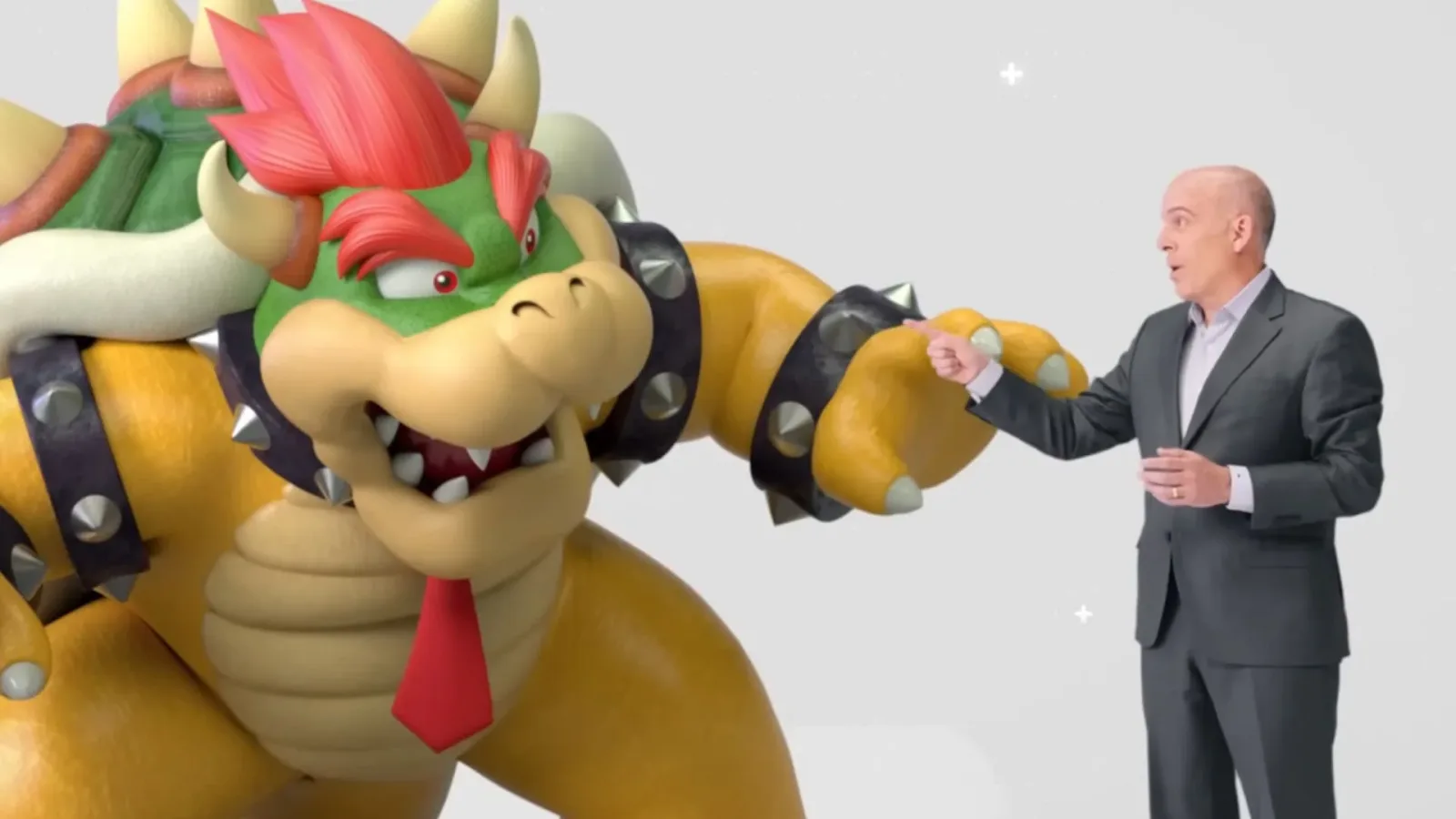
Former Nintendo of America president Doug Bowser has addressed criticism over an AI-generated Thanksgiving image he shared on social media, apologizing to people who were offended while standing by the holiday sentiment behind the post.
The image, which was subsequently deleted, depicted Bowser seated at a Thanksgiving table alongside Nintendo characters Bowser and Donkey Kong. It quickly attracted negative reactions from players and artists, with commenters pointing to the distorted, artificial-looking qualities commonly associated with generative AI imagery. The response was not limited to the visual flaws, however. Many people were disappointed that a former executive closely linked to one of gaming's most creatively celebrated companies would choose to circulate AI-made art rather than work created by an artist.
In a follow-up message, Bowser said,
"Apologies if I offended people with my AI generated post. It was sent to me by a friend and it made me smile."
He also addressed those criticizing the post as "haters," adding that the central message had not changed: he wished people a happy Thanksgiving. That wording became a major point of contention in the replies. Some users felt that describing critics as haters undercut the apology, particularly when much of the criticism focused on concern for artists and on the use of generative AI in creative spaces.
For useful background on this topic, read GTA 6 Escape Goes Wrong After a Bike Explosion Leaves a Player Facing a Gator.
A Holiday Post Becomes a Broader AI Debate
What might once have been dismissed as an awkward holiday social-media post has become part of a much wider discussion around generative AI and the game industry. AI-made images are increasingly visible online, often spreading rapidly through social platforms because they are easy to create and can depict recognizable characters, public figures, or familiar settings with very little effort. At the same time, their use has drawn persistent objections from artists, developers, and fans who believe such tools can devalue creative labor or rely on training data gathered without meaningful permission.
That larger context is important in understanding the intensity of the reaction to Bowser's post. Nintendo has a public identity built around distinctive visual design, closely protected characters, and games that are routinely praised for art direction and imaginative worlds. Seeing a former leader of Nintendo of America share an image that appeared to imitate that kind of creative output through generative AI struck some critics as especially incongruous.
One response argued that Bowser had been the head of the American branch of an especially art-focused AAA game company, calling both the image and his response tone deaf. Another focused specifically on the language of the apology, arguing that people who identified the image as AI-generated should not be dismissed as haters. Those comments reflect a divide that has become familiar whenever public figures engage with generative AI: an individual may see a harmless novelty or a funny image, while critics see an endorsement of a technology with potentially serious consequences for working artists.
Why the Image's Quality Was Part of the Reaction
The visual shortcomings of AI-generated images have long been a source of jokes online. Strange hands, inconsistent objects, warped faces, unintelligible details, and characters that do not quite resemble themselves remain common markers, even as image-generation tools continue to improve. The Thanksgiving image reportedly displayed several of those obvious signs, making it immediately recognizable to viewers as generated rather than drawn, photographed, or professionally composed.
For some commenters, that apparent lack of polish made the image feel particularly out of place when attached to Nintendo characters. Nintendo is well known for strict control over how its properties are presented, from official game art and promotional campaigns to collaborations and merchandise. The company's characters are among the most recognizable in entertainment, and the care placed into their visual representation is part of their commercial and cultural value.
Bowser's post did not represent an official Nintendo announcement or campaign. He stepped down as president of Nintendo of America in 2025 and no longer holds that role. Even so, his years as one of the company's most visible executives mean that his public activity can still attract attention from Nintendo fans. The reaction illustrates how difficult it can be for a former executive to be viewed as entirely separate from the institution with which they are strongly associated.
Bowser's Nintendo of America Tenure
Doug Bowser became president of Nintendo of America in 2019, following the retirement of Reggie Fils-Aimé. His arrival placed him at the helm of Nintendo's North American organization during most of the Nintendo Switch era, a period in which the hardware achieved enormous mainstream success and Nintendo released a steady run of major games across its established series.
During that period, Nintendo's recognizable creative output was central to its success. Franchises such as Super Mario, The Legend of Zelda, Animal Crossing, Pokémon, Splatoon, Kirby, Fire Emblem, and Donkey Kong remain closely associated with a particular level of artistic care and brand consistency. That history helps explain why the post's critics framed their objections not simply as displeasure with one low-quality image, but as disappointment involving the values they associate with Nintendo itself.
Bowser departed the Nintendo of America presidency in 2025. Devon Pritchard was named his successor and currently serves as president of Nintendo of America. The Thanksgiving controversy therefore concerns Bowser's personal social-media activity rather than a statement of policy from Nintendo or its current leadership.
The Limits of an Apology Framed Around Intent
Bowser's response centers on intent: the picture came from a friend, it made him smile, and it was meant to convey holiday goodwill. That explanation may be understandable to people who view AI images primarily as casual internet content. Generative pictures are frequently sent among friends and relatives in the same way as memes, greeting-card images, or novelty edits. A Thanksgiving scene combining a person's name with the Nintendo villain Bowser and Donkey Kong is the kind of pun-driven post designed to be lighthearted.
But intent does not always resolve concerns about impact. Critics who object to generative AI tend to focus less on whether an individual post was malicious and more on the normalization of the tools behind it. From that perspective, sharing an AI image can still signal approval of a system that may be trained on creative work without artists' consent, even if the person sharing it did not generate the image personally and did not intend to cause harm.
The reference to "haters" further complicated the message because it suggested an adversarial framing. An apology is generally expected to acknowledge why people were upset, while the label can imply that objections are bad-faith hostility rather than criticism made in good faith. That is why several responses concentrated on the wording rather than merely repeating concerns about the image's quality.
A Continuing Issue for Games and Creative Communities
The debate surrounding AI-generated art is unlikely to fade soon, especially in video games. Game development depends on the work of artists, animators, writers, performers, designers, musicians, and many other creative specialists. As AI tools become more capable and more accessible, discussions about attribution, consent, compensation, job security, and the role of human authorship will remain significant.
There is also a distinct emotional dimension when generative AI is used with beloved game characters. Fans often view those characters not as interchangeable content, but as the result of years of artistic decisions made by specific teams. An imperfect generated imitation can therefore feel less like a harmless joke and more like a reduction of a carefully crafted work into a disposable prompt.
Bowser has apologized for offending people and reiterated his Thanksgiving wishes, but the online response shows that the disagreement is about more than one deleted image. For critics, the episode is another example of why prominent figures should think carefully before sharing AI-generated artwork, especially when their public legacy is tied to a company celebrated for human creativity. For others, it is a reminder that even a seemingly small social-media post can carry a larger meaning once it enters an already contentious conversation.
Whatever the intent behind the original holiday greeting, the reaction has made one point clear: AI-generated imagery remains a highly sensitive subject among game fans and artists, and association with a major creative brand can make that sensitivity even sharper.
Community
Discussion
Start the conversation.
No comments have been posted yet.