
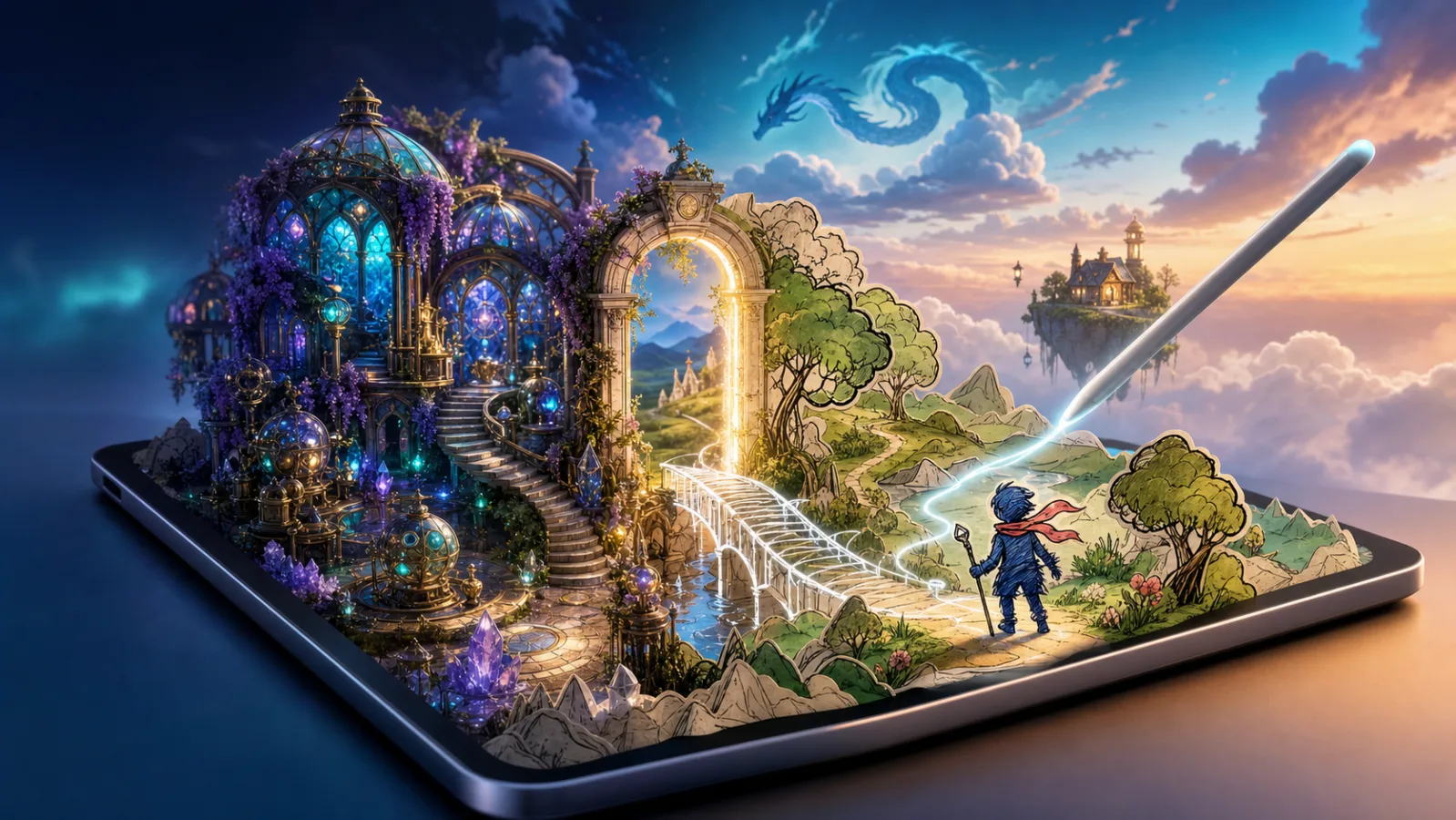
Dream Chronicles and Drawn to Life share a few useful traits for players browsing older touchscreen-friendly adventures. Both pair an accessible fantasy premise with direct interaction, both appeared on iOS as well as Nintendo DS, and both ask the player to take an active role in restoring a threatened community or loved one. Beyond that surface overlap, though, they are fundamentally different experiences.
Dream Chronicles is a first-person puzzle adventure about attention, observation, and steady progress through a magical mystery. Its heroine, Faye, wakes to discover that her husband Fidget has been taken by the fairy Lilith while the rest of the kingdom lies asleep under a spell. The journey proceeds through 18 self-contained chapters, each a single location full of puzzles, objects, and hidden jewels.
Drawn to Life is a platform adventure whose main appeal is authorship. Players draw their hero and contribute designs for objects, accessories, vehicles, weapons, and platforms while working to free a cursed village from encroaching darkness. Traditional side-scrolling movement, a top-down village, and a creation tool all sit at the center of its identity.
So this is not simply a contest between two games with touch controls. It is a choice between a guided mystery and a playful creative adventure. Dream Chronicles is the stronger fit for someone who wants to scrutinize a scene, think through a puzzle, and absorb a fairy-tale atmosphere. Drawn to Life is the better match for the player who wants action, customization, and the satisfaction of seeing their own rough sketch become part of the game world.
The quick verdict
Choose Dream Chronicles if you want a focused point-and-click puzzle game with a clear chapter structure, hidden-object-style observation, inventory tasks, logic challenges, and a story told through visions, diary entries, and Faye's responses. It is best approached as a deliberate solo experience where careful looking matters as much as puzzle logic.
Choose Drawn to Life if you want a brighter, more active adventure where drawing is not decoration alone. It suits players who enjoy platforming but also want to make a protagonist and shape pieces of the world around them. The creative component gives it a more personal flavor than a conventional action-platform game.
Neither game is automatically better in every category because they are chasing different goals. Dream Chronicles has the more concentrated mystery-and-puzzle loop. Drawn to Life has the more flexible, expressive premise. Your tolerance for missed collectibles, your appetite for action, and your interest in freehand design should decide the matchup.
Premise and atmosphere: enclosed fairy-tale mystery versus community-focused creativity
Dream Chronicles makes its world a puzzle box
The defining feeling in Dream Chronicles is isolation. Faye moves through a kingdom held in magical sleep, trying to find Fidget and undo Lilith's spell. Every chapter presents one location from a first-person perspective using pre-rendered 3D stills. That structure gives the game a contained, scene-by-scene rhythm: arrive, inspect, understand what the space is hiding, solve what blocks the way, and continue.
This is an effective format for players who enjoy settings that reward lingering. The narrative does not rely solely on a constant stream of action. It comes through visions, diary entries, and the heroine's comments, allowing the setting and the small discoveries within it to carry much of the mood. Rather than presenting a broad world to roam at will, Dream Chronicles asks players to make sense of each carefully framed place.
The rescue plot is clear and easy to follow, but the appeal is in the mystery surrounding it. A player who likes fairy-tale imagery, magical spells, secretive antagonists, and environmental clues will likely find more to enjoy here than someone looking for kinetic momentum. The atmosphere and puzzle format support each other: because the world is strange and still, stopping to examine it feels natural rather than disruptive.
Drawn to Life turns imagination into the adventure's hook
Drawn to Life also begins with a village facing darkness, but its tone is more outward-looking. The central appeal is not simply discovering what the world has concealed. It is contributing to that world through drawing. The player creates a usable hero, then makes designs that extend to objects, accessories, vehicles, weapons, and platforms.
That premise changes the emotional relationship to the game. A standard platform game can make players feel as though they are guiding an established character through authored levels. Drawn to Life invites them to bring a character of their own making into the adventure. Even a simple design can give the journey a personal stamp, while players who enjoy drawing can make the hero and other creations more elaborate.
The village serves as a top-down central space, giving the adventure a home base between platforming sequences. This helps distinguish the game from a pure level-to-level action game. The platforming delivers forward movement and challenge, while the village and drawing systems keep the player connected to the larger effort to save the community.
Winner for atmosphere: Dream Chronicles for players seeking a hushed magical mystery; Drawn to Life for players who want warmth, invention, and a stronger feeling of personal ownership. The better choice depends entirely on whether you prefer to uncover a world or help create its identity.
Gameplay comparison: solving scenes versus moving through levels
Dream Chronicles rewards patient observation
Dream Chronicles combines inventory-based tasks with mathematical and logic puzzles. Its chapters are individual locations rather than freely revisitable regions, so the core challenge is usually rooted in noticing useful details and connecting them to the problem in front of you. A player may be looking for an item, determining where it belongs, reading a visual clue correctly, or working through a more explicitly logical challenge.
The hidden jewels deserve special attention because they shape how completion-minded players should approach the game. Jewels do not solve the chapter's puzzles. Instead, they can reveal more of the story and improve the final score. Completion time also affects scoring. This creates a tension between a relaxed first pass and a score-conscious approach: rushing can overlook details, but taking too long has its own consequence within the scoring framework.
The game also makes progress feel consequential. A chapter must be completed before the next one opens, chapters cannot be revisited, and jewels missed in a completed chapter are permanently unavailable. This is not an ideal design for every player, but it gives close observation weight. When a chapter ends, it is truly behind you.
Players should understand this before starting. If the primary pleasure comes from solving the central puzzles and seeing the story, the one-way structure may feel like a clean, purposeful journey. If the primary pleasure comes from perfect collection and leisurely cleanup, it may feel restrictive. The best mindset is to examine each location thoroughly before committing to a final solution that advances the chapter.
Drawn to Life mixes platforming with creation
Drawn to Life has a broader mechanical palette. Its action-adventure platforming asks players to navigate levels directly, while the drawing features provide a creative layer that is inseparable from the game's personality. Instead of being a menu-bound cosmetic extra, the player's work helps define the hero and a range of gameplay-related objects.
This means the game appeals to two kinds of engagement at once. First, there is the immediate pleasure of getting through a platforming section: moving, reacting, and pressing onward. Second, there is the slower satisfaction of designing something and then seeing it appear in play. The latter can be especially appealing to younger players, families playing together, or anyone who likes a game to leave room for self-expression.
The trade-off is simple. Players who want every moment to be a tightly constructed puzzle may find the platforming and creation split less focused than Dream Chronicles' chapter-by-chapter investigation. Conversely, players who find static-screen investigation too slow may appreciate that Drawn to Life keeps the adventure physically active.
Winner for pure puzzle focus: Dream Chronicles. Winner for varied interaction: Drawn to Life. Dream Chronicles asks you to think your way through contained scenes. Drawn to Life asks you to draw, travel, and platform through an adventure built around expression as well as progression.
How well each game suits touchscreen play
Both games have a natural connection to stylus and touchscreen hardware, but they use that connection differently. Drawn to Life was originally released for Nintendo DS and explicitly uses the DS stylus and Touch Screen. That origin is visible in its design: drawing a hero and other elements makes direct touch input feel central, immediate, and intuitive. The action of making a line or shape has a visible effect on the adventure, which is exactly the sort of interaction a touchscreen can make memorable.
Dream Chronicles is also a sensible fit for touch-oriented play because its point-and-click structure centers on selecting details within a scene, managing inventory tasks, and inspecting clues. Its first-person still locations invite tapping through a visual space at a measured pace. It does not need fast action to justify the interface; the point is precision and observation.
The distinction is not about which game uses touch more often. It is about what touch means. In Dream Chronicles, touch is a tool for investigation. In Drawn to Life, touch is part of the player's creative voice.
For players considering the Nintendo DS versions specifically, this contrast remains clear. Dream Chronicles benefits from the deliberate rhythm associated with point-and-click puzzling. Drawn to Life gains an especially direct relationship between the stylus and the player-made art. For iOS players, the same broad comparison applies: one game asks you to search and solve; the other asks you to sketch and act.
Structure, pacing, and commitment
Dream Chronicles is concise in structure but demanding of attention
Eighteen chapters provide Dream Chronicles with a defined route. Each location is one chapter, and each must be completed to continue. That makes it easy to understand where you are in the overall adventure, even when an individual puzzle requires time and thought. The game is well suited to players who enjoy stopping after resolving a meaningful unit of progress rather than leaving in the middle of a sprawling open area.
Its pacing can become demanding when a clue is elusive, because progress is gated by chapter completion. Yet that is also where its satisfaction comes from. The game does not dilute the central activity with unrelated systems. You are there to rescue Fidget, break the spell over the kingdom, and solve the spaces placed between Faye and that objective.
Drawn to Life offers more room for playful detours
Drawn to Life is likely to feel less austere because its platforming, village exploration, and drawing elements provide different forms of engagement. A player can enjoy making a character before ever treating the next obstacle as the main attraction. The creative process itself becomes part of the pacing.
This makes Drawn to Life the friendlier recommendation for someone who prefers an adventure to feel like a toy box as well as a challenge. It gives the player something expressive to do between and around the more conventional action. The top-down village also supports the sense that the platforming is part of a larger restoration effort, not merely a sequence of disconnected tests.
Best for short, concentrated sessions: Dream Chronicles, especially if you enjoy working through one puzzle location at a time. Best for players who want activity and customization in the same session: Drawn to Life.
Replay value and the kind of satisfaction each game offers
Replay value means different things in these two games. Dream Chronicles has scoring pressure built into its jewels and completion time. Since jewels can reveal more story and improve the final score, players who want a stronger result have a reason to be attentive. The fact that missed jewels cannot be recovered after leaving a chapter makes that first run significant.
However, this is not carefree replay value. It is precision-oriented. A player returning to Dream Chronicles is likely doing so to notice what was missed, improve performance, or experience the mystery again with better awareness of how chapters work. Those who enjoy optimizing a completed route will appreciate the focus. Those who dislike permanently missable content should make peace with the possibility of an imperfect initial playthrough.
Drawn to Life offers a more personal kind of replay appeal. Because players can draw their own hero and various other elements, a new run can look and feel different even if the broad adventure remains the same. The invitation is not solely to perform more efficiently. It is to imagine a new character or take a different approach to the game's visual identity.
That does not mean one form of replay is deeper by default. It means they satisfy different instincts. Dream Chronicles speaks to the collector and puzzle perfectionist. Drawn to Life speaks to the maker who enjoys seeing new ideas come alive.
Platform fit and what to expect from the available versions
Both games are associated with iOS and Nintendo DS, making them natural points of comparison for mobile and handheld players. Drawn to Life is limited in the supplied platform list to iOS and Nintendo DS. Dream Chronicles reaches more broadly, with versions listed for iOS, Mac, Nintendo DS, PC, PlayStation 3, and Xbox 360.
That wider platform history does not change Dream Chronicles into an action game or Drawn to Life into a conventional desktop platformer. The underlying recommendation still comes down to play style. Dream Chronicles is especially appropriate wherever you can give visual clues your full attention. Drawn to Life remains most distinctive where its drawing-based design can feel direct and personal.
Availability can change over time across storefronts and hardware ecosystems, so players should confirm their preferred version and device compatibility before making plans around a specific platform. The enduring comparison, though, is stable: Dream Chronicles works as a puzzle-first fantasy adventure, while Drawn to Life works as a creation-first platform adventure.
Who should choose Dream Chronicles?
- Point-and-click fans who enjoy inspecting scenes, gathering useful objects, and linking clues to inventory solutions.
- Puzzle players looking for a mix of logic, mathematics, and observational challenges rather than reflex-heavy stages.
- Fantasy mystery fans drawn to an enchanted kingdom, a sleeping populace, diary fragments, visions, and a rescue story.
- Completion-minded players who like scores, hidden collectibles, and the pressure to look carefully before moving on.
- Players who enjoy a defined path with 18 sequential chapters and no need to manage a large roaming world.
Skip it, or at least set expectations carefully, if permanently missable jewels and non-revisitable chapters are likely to frustrate you. Its design asks for commitment to each scene before you close the door on it.
Who should choose Drawn to Life?
- Creative players who want to draw a playable hero and see their designs influence the adventure.
- Platforming fans who prefer movement and action to static-scene investigation.
- Players who like customization in the form of accessories, vehicles, weapons, objects, and platforms.
- Families and collaborative players who may enjoy discussing or creating designs together before returning to the adventure.
- Players who want a village-centered quest that combines a top-down hub with platforming progress.
It is the stronger choice when self-expression is as important as beating the next level. A player who has no interest in drawing may still appreciate the action-adventure structure, but they would be bypassing the feature that most clearly separates Drawn to Life from other platform games.
Final recommendation: pick the adventure that matches how you like to participate
Dream Chronicles and Drawn to Life are both approachable fantasy adventures, but they invite participation in opposite ways. Dream Chronicles wants you to slow down and pay attention. Its magic lies in examining a location until its logic becomes clear, while the search for Fidget and the fate of the sleeping kingdom give each puzzle a narrative purpose. The chapter system and missable jewels make it particularly rewarding for observant players who enjoy deliberate progress.
Drawn to Life wants you to leave a mark on the adventure. Its platforming provides momentum, but the drawing features are the heart of the proposition. Creating a hero and other elements turns the player from a visitor into a contributor. The cursed village becomes more meaningful because your own designs help carry the effort to save it.
If you are choosing only one, use this simple test: do you want to solve a magical world, or draw your way into one? Choose Dream Chronicles for the former and Drawn to Life for the latter. Both remain worthwhile examples of how touchscreen and handheld-friendly design can support more than quick distractions: one uses direct input to make mysteries inviting to investigate, while the other uses it to make creativity part of the adventure itself.
Community
Discussion
Start the conversation.
No comments have been posted yet.