

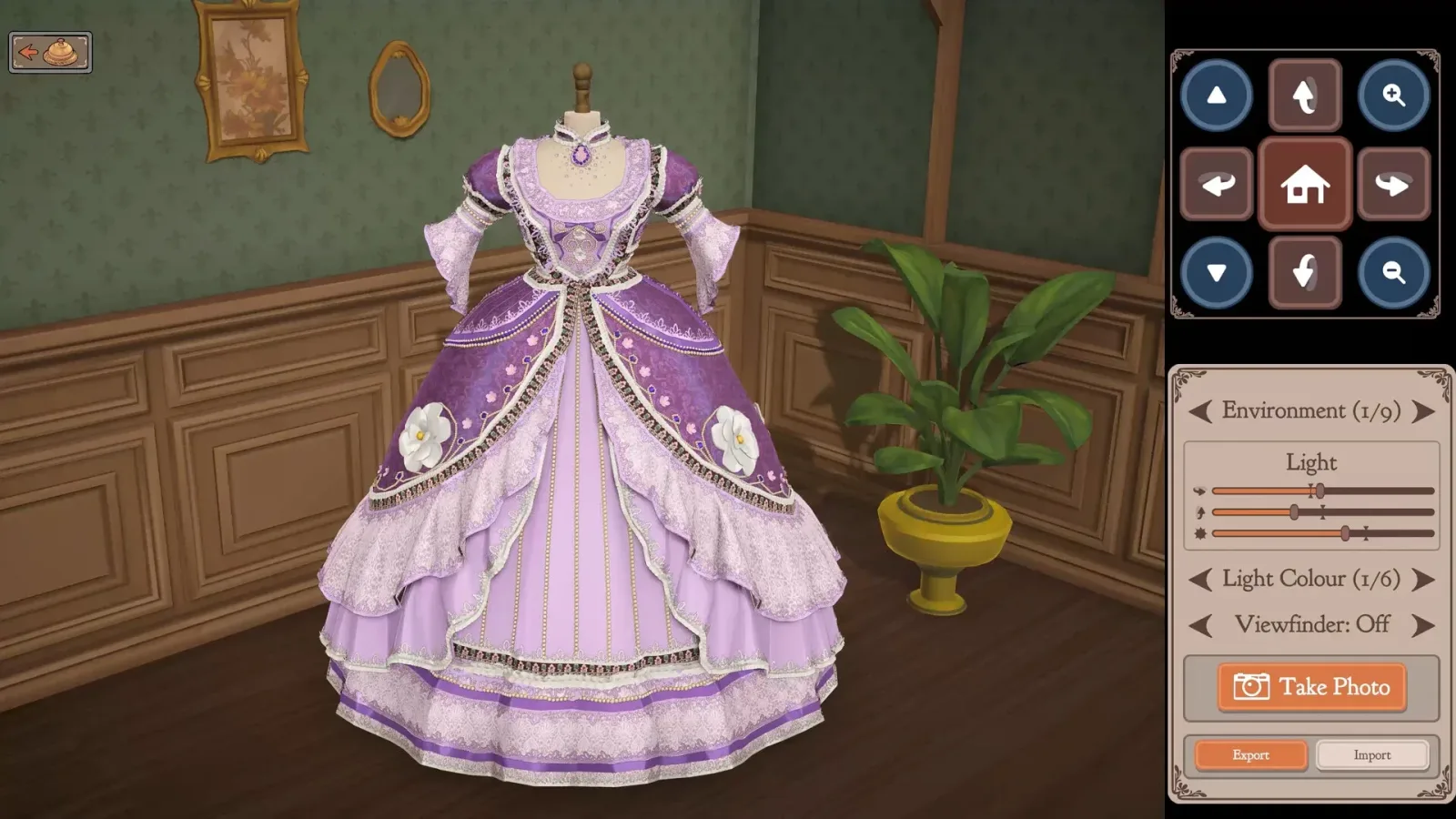
Dressmaker may ask players to satisfy customers with the right colors, fabrics, and stylistic requirements, but its community has quickly demonstrated that those practical goals are only the beginning. Players are already using the game's dress-building tools to create designs that range from charmingly silly to startlingly intricate, with fashion inspired by major works of art, animals, animation, fantasy games, and real-world couture.
That contrast is part of what makes the emerging gallery so enjoyable. It is entirely possible to approach Dressmaker as a cozy challenge game: fulfill a brief, choose material that fits the request, assemble a wearable garment, and move on to the next client. A dress does not need to be runway-ready to succeed within that framework. Strange fabric combinations, awkward silhouettes, and unconventional color matches can all be part of learning the system and having a good time.
Then there are players who appear to have arrived with an eye for composition, color theory, texture, and theatrical costume construction. Their dresses are not merely compliant with in-game requests. They are designed around deliberate visual ideas, often using the shape of a skirt, the placement of a pattern, and the contrast between materials to evoke something much larger than a standard outfit.
Embedded X/Twitter post
Embedded X/Twitter post
Classic art finds a new canvas
One especially striking shared creation transforms a dress into an homage to The Great Wave off Kanagawa. The famous wave imagery is arranged across the garment in a way that makes the dress itself feel like a moving canvas. It is the kind of idea that immediately makes players reconsider the potential of a fashion-creation system: instead of simply decorating a gown, the creator has used the entire silhouette to carry a recognizable artwork.
For useful background on this topic, read 007 First Light's Free Extended Operations Update Adds New Game Plus and TacSim Missions.
The same creator has also explored other famous art pieces, suggesting that Dressmaker can support an ongoing series of museum-inspired looks rather than a one-off novelty. That is a particularly impressive direction for community creations because it demands more than reproducing an image. A flat painting must be adapted to a fitted bodice, flowing skirt, seams, layers, and a character model. The design needs to remain readable while bending around clothing.
That effort is visible throughout the wider collection of player posts. The most successful designs understand that a dress has movement and structure. Patterns are not just stamped onto fabric; they can be positioned to frame the wearer, create a focal point, or guide the viewer's eye from the neckline down toward the hem.
Nature, glass, and underwater color palettes
Animal-inspired outfits have also become a standout part of the community's work. One monarch butterfly dress uses the insect's immediately recognizable orange, black, and pale detailing to produce a bold, high-contrast look. Butterfly patterns are a natural fit for fashion, but translating those wing markings into dress panels still requires a strong sense of balance. The result feels decorative without losing the visual identity that makes a monarch unmistakable.
Several fish-themed dresses show a different use of color and pattern. A playful fishy dress leans into aquatic motifs, while a koi fish dress brings together the ornamental appeal of koi with a flowing garment shape. Koi imagery has long been associated with decorative art, water gardens, and textile design, so it makes sense that it can produce a vivid and elegant Dressmaker creation when handled well.
A stained-glass collection takes another route entirely. Stained glass is defined by segmented color, graphic outlines, and the sensation of light shining through small, carefully bounded panels. Recreating that effect on a digital gown is an ambitious task, especially because clothing is softer and more organic than a window. Yet the collection demonstrates how far a player can push Dressmaker's materials and patterns toward a more architectural, ornamental style.
These natural and decorative designs make a strong case for the game as a place where players can experiment with visual themes rather than simply imitate existing outfits. A butterfly dress does not need to be a literal costume. A fish dress can prioritize color, scale, and movement. A stained-glass look can turn a formal silhouette into something that resembles wearable fantasy art.
Costume references and fictional fashion
Other players are using Dressmaker to pay tribute to recognizable costumes and fictional clothing. One creation for Edith draws inspiration from Leon Bakst's costume work for The Firebird. Bakst's designs are celebrated for their rich color, theatricality, and bold decorative language, all qualities that make them a challenging but rewarding starting point for an in-game gown.
The result matters not only as an homage, but as an example of the depth already appearing in Dressmaker's community. This is not just a matter of reproducing a popular character's outfit from a current franchise. It is a design informed by historical costume art, adapted through a game's available options into a new garment for a specific character.
More familiar fictional inspirations are represented too. One player has put together a look resembling Mirabel's dress from Encanto, complete with the broad, material-heavy skirt that makes the garment feel appropriately festive. The creator noted using a great deal of fabric for the skirt, and that sense of volume is central to the result. Some references can be conveyed through a color palette; others require the right proportions before anything else works.
An Alice in Wonderland-inspired dress takes a more stylized approach, aiming for a cel-shaded appearance. That is a clever challenge in a fashion game because cel shading is usually associated with illustration and animation rather than cloth. To sell the effect, the outfit needs strong boundaries and intentional areas of apparent shadow and highlight. It turns a dress into something that seems to have stepped out of a drawing.
There is also a recreation of Zelda's dress from The Legend of Zelda: Twilight Princess. Fan fashion often succeeds or fails based on whether it captures the reference's key visual signals without needing every tiny detail. Here, the recognizable color choices and overall form do much of the work, making it clear what the design is reaching for even within Dressmaker's own tools and materials.
Not every great idea has to be solemn
The community's creative energy is not limited to elaborate gowns and painstaking references. A cat-inspired dress shows how a single appealing theme can become an outfit with plenty of personality. Animal fashion is flexible by nature: ears, paw-like details, color blocking, and a carefully chosen pattern can suggest the source without turning the character into a full mascot costume.
Elsewhere, a radish dress proves that a memorable concept can begin with something wonderfully ordinary. There is a special pleasure in seeing a fashion system used for ideas that are knowingly absurd. A vegetable-inspired outfit might not carry the grandeur of an art homage or a historical costume study, but it uses the same creative principles: select a theme, identify its defining shapes and colors, then find a way to make those elements work on a person-shaped silhouette.
Another shared design is presented with a deliberately self-deprecating description. That kind of post is an important reminder that community galleries do not have to be competitive showcases of technical perfection. Dressmaker has room for jokes, experiments, happy accidents, and garments made solely because the idea made someone laugh. The fun of seeing exceptional work does not erase the value of making something weird.
Tools, progression, and the gap between good and spectacular
It is worth remembering that some of the biggest and most complex dresses likely depend on later-game materials and patterns. Players who are still early in Dressmaker may not yet have the resources needed for enormous ballgowns, specialized visual effects, or particular textile combinations. That can make the gap between a functional early outfit and a community showpiece seem intimidating.
But the strongest posts also reveal something more encouraging: access to materials is only one part of the equation. Unlocks expand what is possible, yet the ideas behind these creations come from the players. A limited palette can still be used well. A simple shape can still make a clear reference. A humorous concept can still land perfectly. The difference between an acceptable dress and an unforgettable one often comes down to observation, experimentation, and a willingness to try an unexpected combination.
For new players, the gallery can therefore work as inspiration rather than a standard they need to meet immediately. Looking at a koi dress may spark an interest in arranging patterns diagonally. A stained-glass outfit might encourage someone to explore contrasting sections of color. An art-inspired gown could lead to a simpler experiment with one recognizable motif. Even a radish dress can be a lesson in committing to a theme.
A community built for showing off ideas
Dressmaker's early creations suggest that the game has found an audience eager to share process, references, and visual jokes as much as finished outfits. That is a healthy sign for a design-focused game. When players begin posting collections, recreations, themed garments, and unusual experiments so quickly, they help establish a creative vocabulary for everyone else.
There will always be people who can seemingly produce astonishing work the moment they receive a set of digital fabric tools. Their creations can make the rest of us feel as though we are still tying together mismatched scraps. But Dressmaker's community is already showing that there is room for both approaches: polished wearable art on one side, odd little outfits made for the joy of it on the other.
Whether players are chasing the elegance of a butterfly, the drama of theatrical costume, the recognizable charm of a beloved character, or the sheer nonsense of vegetable couture, the early work makes one thing clear. Dressmaker is giving fashion-minded players plenty of reasons to keep stitching, sharing, and occasionally making a dress that is intentionally, gloriously ridiculous.
Community
Discussion
Start the conversation.
No comments have been posted yet.