

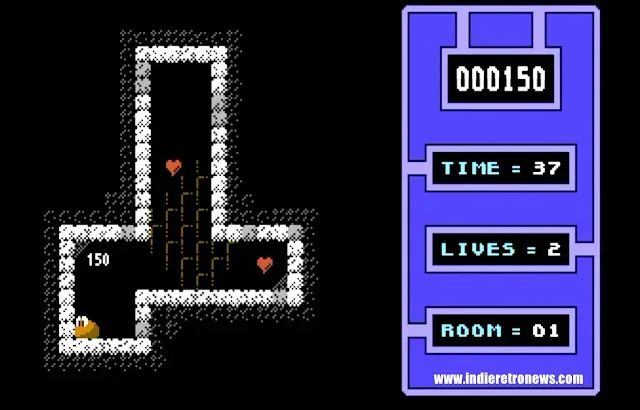
Commodore 64 owners have another original adventure to put through its paces. EyedBall, the newest game from LC-Games, is a puzzle-platformer that pairs an intentionally cute presentation with a considerably more threatening premise: a peaceful population has been abducted, imprisoned in a fortress, and converted into the hearts that keep a villainous kingdom alive.
The player takes control of the game's round-eyed hero and heads into the stronghold of the antagonist Horloth. The task is not simply to reach the end of a level. Every room demands that players recover the imprisoned inhabitants in their transformed heart form, avoid the many dangers spread around the stage, and find an exit before a strict timer expires. The defining trick is EyedBall's magical power to rotate the surrounding world, changing the layout's usable routes without giving the hero a conventional weapon.
That combination makes EyedBall a notable addition to the continuing C64 homebrew scene. It is designed around the strengths of the platform: compact, individually constructed challenge rooms; immediate arcade-style score incentives; and a central mechanical idea that can become more demanding as players learn the rules. LC-Games is also a familiar name to retro players through unofficial adaptations including H.E.R.O. Is Back, Lock'n'Chase, and Dig Dug. With EyedBall, the developer is presenting a new fantasy scenario and an original puzzle-platforming setup for the classic machine.
A Rescue Mission Inside Horloth's Fortress
EyedBall begins after Horloth attacks what had been a carefree land. Rather than merely locking away the people he captures, the dark ruler subjects them to a grim transformation. Their life force is drained and they become beating hearts used to fuel his domain. The stakes behind the cheerful-looking protagonist are therefore unusually dark for a game built around dropping between platforms and navigating compact screens.
For useful background on this topic, read Delta Plans Dedicated iPhone Duo Support for Nintendo DS Emulation.
The rescue premise gives a clear purpose to each room. The hearts scattered throughout the fortress are not generic collectibles in the story's context; they represent EyedBall's fellow inhabitants and must be recovered before the hero can move on. This structure means the exit is only part of the solution. Players need to understand how to reach the full set of objectives, then escape efficiently enough to beat the clock.
There are 45 distinct rooms to navigate. That count suggests a deliberately paced campaign built from many short, focused encounters rather than a handful of large exploration areas. In puzzle-platformers, room-by-room construction can be especially effective because every screen can introduce a fresh positioning problem, a dangerous enemy arrangement, or a new way to make use of the main movement mechanic.
Rotation Is the Hero's Main Tool
EyedBall does not arm its protagonist with a sword, gun, or projectile attack. The absence of standard combat is central to the game's challenge. Hostile creatures and stage hazards must be avoided rather than defeated, requiring players to read movement patterns, judge falling paths, and decide when it is safe to make a move.
Instead, EyedBall can use magic to rotate the entire surrounding environment. This is the game's essential puzzle-solving ability. A platform that was formerly unreachable may become accessible after the room is turned. A dangerous arrangement may gain a safer route. Conversely, rotating at the wrong moment could place the hero on an unhelpful path or create a more difficult approach to a heart or exit.
Rotation-based mechanics work best when players must stop seeing platforms as fixed objects. In EyedBall, the useful question is not only, "Can I get there from here?" It is also, "What does this room become if I turn it?" A ledge might become a landing zone, an obstruction might become a bridge, and a previously safe drop may become a route directly into danger. Since the hero is described as descending from platform to platform, vertical planning should be just as important as deciding when to alter the room's orientation.
The magical ability also gives the game a distinct identity amid C64 platformers. The hardware has a deep catalogue of fast arcade games and character-action challenges, but a single-screen puzzle design built around global environmental rotation has the potential to make each screen feel like a self-contained spatial riddle. The core idea is easy to explain, yet it can support increasingly elaborate scenarios as the fortress progresses.
Hearts, Hazards, Teleporters and Time Pressure
Every room combines several pressures. Players must collect all available hearts, reach the exit, avoid spooky enemies and environmental threats, and do all of it before time runs out. A level is therefore not just a test of survival. It is a test of sequence. Taking the most obvious route first may not always be the best choice if another heart becomes inaccessible after a drop or if a rotation is needed to preserve the safest escape path.
Teleporters add another layer to the room design. These devices can move EyedBall across the screen in an instant, potentially opening routes that cannot be reached through ordinary falling and rotation alone. Teleporters may offer a lifeline when a direct path is unavailable, but they also call for careful route awareness. In a timed puzzle stage, using a teleporter at the incorrect point could cost precious seconds or place the player on the wrong side of the screen for the next required collectible.
The time limit should ensure that experimentation has a cost. Early attempts are likely to involve learning where each heart lies, observing how a room changes after rotation, and discovering the intended order of operations. Once the layout is understood, the player can aim for cleaner, faster runs. That is a familiar and satisfying structure for retro game design: initial confusion gives way to recognition, then recognition turns into execution.
Because enemies cannot be removed with a weapon, movement discipline becomes even more important. Players will need to identify safe gaps, resist rushing into an apparently open lane, and account for where EyedBall will land after a drop. The system's tension should come from committing to an action while knowing that the room can be physically reconfigured, sometimes for the better and sometimes not.
Classic Score Incentives Encourage Longer Runs
EyedBall also uses a traditional score-driven extra-life system. An additional life is awarded when the player reaches 20,000 points. After that first milestone, another bonus life is earned for every 30,000 points accumulated. This makes score more than a decorative number on the display. Strong performance can directly extend a run through the fortress.
For players who enjoy chasing high scores, the thresholds provide a reason to master rooms beyond simply completing them. Efficient heart collection, survival, and steady progress can all contribute to reaching the next life award. The system also helps make a difficult multi-room game feel more approachable: even after mistakes, skilled play has a route to replenishing the life supply.
This approach fits the Commodore 64's arcade heritage. Many beloved games on the system encourage players to learn repeated patterns, improve their responses, and push further through a game as knowledge accumulates. EyedBall applies that philosophy to a more puzzle-led framework. Instead of firing through waves of enemies, players earn their progress by understanding the geometry of a room, exploiting rotation intelligently, and maintaining composure under the countdown.
An Original Challenge for C64 Players
LC-Games' earlier work will be of interest to players who follow modern releases for vintage hardware, particularly those who have spent time with the developer's unofficial takes on well-known arcade-style games. EyedBall stands apart by focusing on a new character, a new setting, and a mechanic tailored to its own level structure rather than recreating an established classic.
The premise may be charming on the surface, but the rescue mission, threatening fortress, unforgiving hazards, and countdown-driven objectives point toward a game that expects focused play. Its 45 rooms should give puzzle-platformer fans plenty of chances to test their ability to visualize a changing level and execute a route before the clock expires.
For Commodore 64 enthusiasts, EyedBall is another reminder that the machine continues to receive games that are not merely nostalgic curiosities. New releases can still build fresh ideas around the limitations and character of the hardware. Here, the result is a compact-looking adventure where every platform, enemy, teleporter and rotated room may determine whether EyedBall can bring Horloth's victims home.
Community
Discussion
Start the conversation.
No comments have been posted yet.