

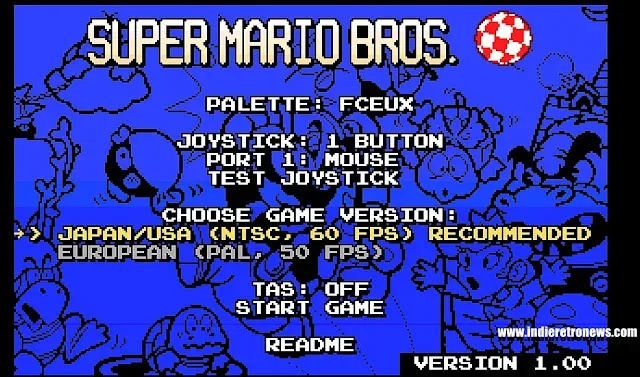
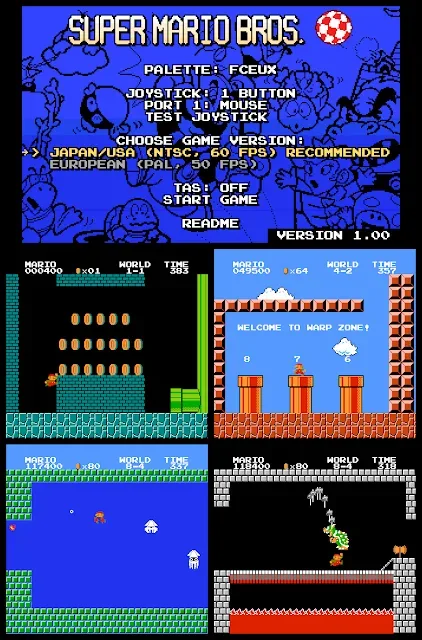
Super Mario Bros. has made an unexpected new stop on its long retro-gaming journey. An unofficial conversion is now available for Commodore Amiga systems, bringing the original 1985 platformer to the classic home computer through a project credited to Agnus Copperfield^SSB.
This is not presented as a loose reinterpretation of Mario's first NES adventure. The project's stated goal is a highly faithful conversion of the original game, rebuilt in native Motorola 68000 assembly language for Amiga hardware. It is designed to fit on a single floppy disk and, notably, can run on an Amiga equipped with only 512 KB of chip RAM.
For a machine with a devoted preservation and homebrew community, the release is a major technical curiosity. The Amiga received countless platform games during its commercial lifetime, but translating a landmark NES title to the system while targeting very modest base hardware is a challenge with far more moving parts than simply drawing familiar sprites on-screen. Movement, collision behavior, object handling, scrolling, sound, display timing, memory limits, and controller responsiveness all matter when the target is a game remembered as precisely as Super Mario Bros.
A familiar adventure on very different hardware
Super Mario Bros. needs little introduction, even four decades after its debut. Nintendo's side-scrolling adventure put players in control of Mario as he runs and jumps through the Mushroom Kingdom, stomping Goombas, kicking Koopa shells, breaking blocks, collecting power-ups, and attempting to rescue Princess Toadstool from Bowser. Its basic controls are famously approachable, but the game's stages have continued to reward practice, route planning, and exact timing for generations.
For useful background on this topic, read Everything is Crab's Free Tide Turner Update Rebuilds the Water Biome.
The original NES release is also a product of very specific hardware. Its visual effects, level behavior, enemy logic, and tight feel were built around Nintendo's 8-bit console architecture. Porting that software to the Amiga does not mean moving the original program over unchanged. Instead, the conversion's creator says the NES code was translated into native Motorola 68000 assembly language, allowing the game to operate directly within the Amiga's very different environment.
That distinction matters. The Motorola 68000 processor is fundamentally unlike the NES CPU, while the Amiga's custom chipset has its own graphics and memory model. The computer is capable in areas where the NES is constrained, but that does not automatically make an accurate conversion simple. Matching another system's software behavior can be more demanding than creating an original game that merely resembles it.
The Amiga port is said to support both of the display standards closely associated with the machine's international audience: PAL and NTSC. That is an important inclusion for a game whose play feel depends heavily on speed and frame timing. PAL and NTSC systems traditionally operate at different refresh rates, and poorly handled conversions from the era could run too slowly, too quickly, or otherwise feel unlike their originals. Native support for both formats suggests that display timing was treated as a central concern rather than an afterthought.
For another perspective on this story, read Super Mario Bros Reaches Commodore Amiga in New Agnus Port.
Built to fit on one floppy disk
The project's modest hardware target is one of its standout details. The complete game reportedly fits on a single floppy disk and requires only 512 KB of chip RAM. Chip RAM is the portion of Amiga memory accessible to the system's custom graphics and audio hardware, making it a particularly meaningful limitation for a game that needs to continually display scenery, sprites, effects, and sound.
Many Amiga owners used expanded configurations over the years, whether through additional memory, accelerator cards, hard drives, or newer machine models. But aiming for a 512 KB chip-RAM setup keeps the conversion within reach of a much broader range of classic systems. It also places the project closer to the constraints that define much of the platform's early software library.
There is an appealing historical symmetry to that decision. Super Mario Bros. itself came from an era when developers had to be extraordinarily careful with storage and memory. Its worlds feel large and varied, yet the original game was made under strict cartridge-space limits. Reproducing it in a compact Amiga release therefore reflects some of the same economy and technical discipline that made the NES original possible.
For collectors and users of real hardware, the single-disk format may be especially welcome. It gives the port a period-appropriate character, whether it is used from a physical disk setup or through modern storage and floppy-emulation solutions commonly used with vintage Amiga machines.
Frame-by-frame verification on a massive scale
The most striking claim surrounding the conversion is the extent of its quality-control process. To compare its behavior against the NES game, the developer reportedly tested the Amiga engine with 163 recorded gameplay movies. Across those tests, the verification work covered 5,249,323 individual frames and execution steps.
That figure points to an unusually methodical approach. A frame-by-frame comparison is not simply about checking whether Mario reaches the flagpole or whether a level can be completed. It can reveal tiny but important discrepancies: an enemy moving one frame too early, a jump rising differently, a collision registering at a slightly altered point, a timer-related event occurring at the wrong moment, or a scrolling transition failing to align with the original.
Those details are a major part of why Super Mario Bros. remains satisfying to play. The acceleration of Mario's run, the height and arc of a jump, the bounce after defeating an enemy, and the timing of moving hazards all combine into a recognizable rhythm. A version can look close to the NES release and still feel wrong if those systems drift apart. The stated aim here was to match the target hardware's output frame for frame, including its mechanics, physics, and timing.
That does not eliminate the value of hands-on testing, and players will naturally want to judge the final result themselves. Still, the scale of the reported automated or recorded-playback checking is noteworthy. It moves the project beyond a visual homage and toward a serious compatibility-minded recreation of a classic game's behavior.
Why the port is significant for Amiga fans
Unofficial conversions occupy a special place in the retro community. They can celebrate older platforms, expose overlooked technical possibilities, and invite comparisons between systems that did not receive the same software during their original commercial lifetimes. They also give long-time owners something new to run on machines that might otherwise be limited to their established libraries.
In this case, the appeal comes from more than playing Super Mario Bros. in another format. The NES original is one of the best-known games ever made, and its design has been studied, replayed, speedrun, modified, and reissued extensively. That familiarity makes technical accuracy especially visible. Anyone who knows World 1-1, the underground stages, or the game's later obstacle courses can quickly notice whether a conversion has captured the intended cadence.
The Amiga also has a rich identity of its own. Its users often remember it for colorful graphics, distinctive audio, demo-scene experimentation, adventure games, arcade conversions, and European computer gaming culture. Seeing one of Nintendo's foundational console games rebuilt for the platform creates an intriguing meeting point between two very different branches of 1980s gaming history.
It is worth stressing that this release is described as unofficial. It is a fan-made technical project rather than a newly announced official Nintendo product. As with many community-created ports involving major commercial properties, interested players should understand that distinction and should consult the materials included with the release for information on its requirements and operation.
Technical notes are included with the download
Players who want more than a quick run through the Mushroom Kingdom will reportedly find a detailed fact sheet inside the downloadable ZIP archive. That documentation should be particularly useful for Amiga enthusiasts interested in how the port approaches its memory budget, hardware compatibility, display handling, and comparison process.
Projects like this often become discussion points not only because of the game they deliver, but because of the techniques behind them. Assembly-language work for older computers can be difficult to study from the finished result alone. A technical fact sheet gives the creator an opportunity to explain design decisions and lets curious users better appreciate the engineering required to make the conversion function on baseline hardware.
For now, the key promise is straightforward: the original Super Mario Bros. experience has been adapted for the Commodore Amiga with a strong focus on matching the NES version's behavior, while remaining small enough for a single disk and accessible enough for a 512 KB chip-RAM machine. If the extensive verification translates cleanly to real-world play, this could become a particularly notable addition to the Amiga homebrew catalog.
It is another reminder that classic systems are not static museum pieces. Decades after their commercial peaks, new releases continue to test their limits, revisit gaming history, and give enthusiasts fresh reasons to connect their old hardware. In this case, one of the industry's most enduring platformers has found a new, unofficial home on an equally beloved retro computer.
Community
Discussion
Start the conversation.
No comments have been posted yet.