

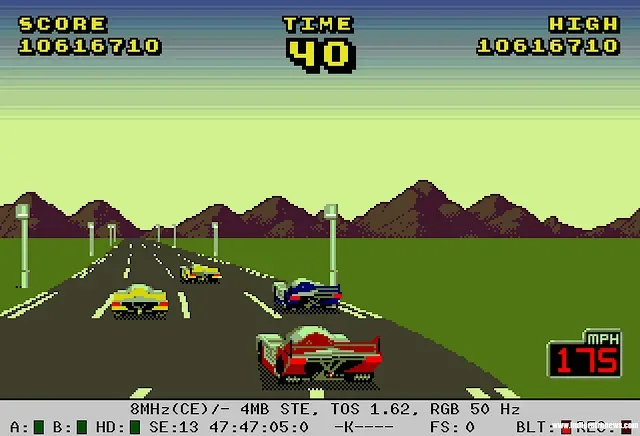
FASTER, the high-speed 2.5D racing game created by Jonathan Thomas, has made the jump from the Atari STE to the Commodore Amiga. The new Amiga release arrives on November 27, 2026, bringing a deliberately direct take on arcade driving to another beloved 16-bit home computer platform.
Built around speed, responsive-looking motion, and visual effects designed to make classic hardware work hard, FASTER is not attempting to be an enormous simulation or a feature-packed modern racer. Its identity is rooted in the immediate appeal of the 1980s arcade cabinet: get on the road, push forward, react quickly, and chase the thrill of the next bend.
That uncomplicated approach is central to the game's pitch. Thomas has described FASTER as an experience without sprawling mode lists, achievement systems, lengthy tutorials, or cinematic interruptions. The goal is pure arcade action, using contemporary development methods to create something that feels at home on vintage machines rather than simply imitating the look of an older game.
A racer built for instant action
Racing games on classic systems have always had to strike a careful balance between spectacle and performance. Fast road scaling, enemy vehicles, horizon movement, scenery, sound, and controls all compete for limited processing time. FASTER leans into that technical challenge with a 2.5D presentation intended to communicate a strong sense of velocity while retaining bold, colourful visuals.
For useful background on this topic, read Tyrian Returns to the Browser, Bringing a 1995 DOS Shooter Back Into Action.
The result is a game designed around the fundamentals that made arcade racers so enduring. Players are not asked to study complex car setups or navigate an extensive progression structure before getting to the fun. Instead, the emphasis is on readable roads, quick reactions, aggressive momentum, and the satisfaction of moving through a visually active course at high speed.
That philosophy also suits the Commodore Amiga especially well. The platform has a long history with arcade-style racers and technical demos that pushed its custom hardware in striking directions. FASTER enters that tradition not as a period release recovered from the past, but as a newly made game created specifically with retro hardware in mind.
From Atari STE competition winner to Amiga release
FASTER was originally created for the Atari STE, an enhanced version of the Atari ST line that offered improvements including a wider colour palette and hardware features prized by developers. The Atari STE edition earned first place in the Atari ST/STE games competition at Silly Venture 2024 WE, giving the project a notable accolade within the active retro development scene.
Its arrival on Amiga broadens the game's audience while preserving the core concept that earned attention on Atari hardware. The adaptation is particularly interesting because the Atari STE and Commodore Amiga occupy a closely connected place in computer gaming history. Both platforms were associated with colourful graphics, distinctive sound, and an era in which developers often had to make highly specific technical choices to get ambitious games running smoothly.
For enthusiasts, ports between the two machines can invite close comparisons. Hardware architecture, graphics handling, audio capabilities, and development tools all shape how a game ultimately performs and appears. FASTER's Amiga version gives players the opportunity to experience the same design on a platform with its own storied identity, rather than leaving the game as an Atari STE-exclusive curiosity.
50fps ambition on vintage hardware
One of FASTER's headline technical goals is a 50fps presentation. For a fast racer, consistent motion matters enormously: road movement must remain legible, approaching traffic needs to be visible in time for players to react, and the sensation of speed depends on the screen updating with confidence rather than stuttering under pressure.
The game is presented as delivering blistering racing action at 50 frames per second on an 8MHz Atari STE or Amiga. That is an ambitious target for machines from the 16-bit era, particularly when the screen is populated with large visual elements and active effects. While raw frame-rate figures never tell the whole story of how a game feels in play, the focus on smoothness is clearly at the heart of FASTER's appeal.
FASTER is also said to render more than 15 large, full-colour sprites on screen at once through use of the Blitter chip. In a racing game, that kind of sprite workload can help populate the action with vehicles and visual detail, making the roadway feel busier and making the player's high speed more tangible. It is a technical feature that supports the game's arcade priorities rather than existing as a number on a specification sheet.
On the Atari STE side, the game takes advantage of the system's expanded palette, with more than 30 colours displayed at a time. Rich colour use is important to the look of a racer that wants to project warmth, atmosphere, and motion rather than relying on a minimalistic road-and-sky layout. The Amiga release is presented alongside this broader technical showcase, though retro fans will naturally be interested in seeing how the visual approach translates across the two systems.
Day turns to night on the road
FASTER does more than put a car on a scrolling track. It includes a full 24-hour day-to-night cycle, adding changing light conditions to its races. A shifting time of day can transform the character of a course even when the underlying route remains familiar. Bright daytime colours can give way to darker scenes, altering the mood and reinforcing the impression that players are covering ground through an active world.
For a game so focused on uncomplicated arcade play, this is a meaningful flourish. It adds atmosphere without demanding additional management from the player. There is no indication that the day-night cycle is meant to turn FASTER into a simulation; instead, it appears to be another layer of visual motion and technical ambition surrounding the central act of racing.
The game also uses custom screen-shaking effects powered by Atari STE hardware scrolling. Screen shake has long been one of the most effective ways to add impact to retro action games, whether it is triggered by contact, rough driving, or other dramatic moments. In a high-speed racer, carefully used feedback can make the road feel more physical and reinforce the danger of losing control.
Engine noise, effects, and classic chip music
Audio is another major part of the FASTER package. The game combines digital engine sounds, sound effects, and a classic YM soundtrack at the same time. That layered approach matters because racing games depend on constant sonic feedback. The engine needs to sell acceleration and urgency, sound effects need to make encounters feel consequential, and the music needs to maintain energy as players concentrate on the road.
The YM reference will be especially familiar to Atari enthusiasts, as the Yamaha sound chip became a defining component of the ST family's audio character. Bringing digital engine roars and effects together with chip-based music reflects the same blend of old and new found elsewhere in FASTER: it is a modern project, but one that embraces the expressive limits and strengths of original vintage technology.
There is a particular charm to developers still exploring these systems decades after their commercial peak. Modern tools can make iteration, asset production, and debugging more practical, but the final game must still respect the capabilities of the target hardware. That constraint can encourage a clear design focus. Every effect, colour, sound, and update has to justify itself, especially in a game that makes fluid speed such a priority.
A welcome addition for Amiga players
The Amiga version of FASTER is a welcome expansion for players who continue to use original hardware, compatible setups, and modern retro-focused configurations. New releases are a reminder that these machines are not merely museum pieces. They remain platforms with communities, tools, competitions, and developers willing to build experiences around their distinctive capabilities.
FASTER's appeal will likely be strongest for players who value technical polish and concise arcade design. Its stated premise does not promise a vast package full of modes and unlockables. Instead, it offers the opposite: a concentrated racer built to make speed, colour, sound, and smooth motion the point of the experience.
That makes its move to Commodore Amiga fitting. The platform's library has always celebrated games that aim for immediacy and audiovisual flair, and FASTER arrives with both qualities front and centre. With its Atari STE competition win already behind it, Jonathan Thomas' racer now has a new lane to occupy in the continuing revival of freshly developed games for classic computers.
Community
Discussion
Start the conversation.
No comments have been posted yet.