

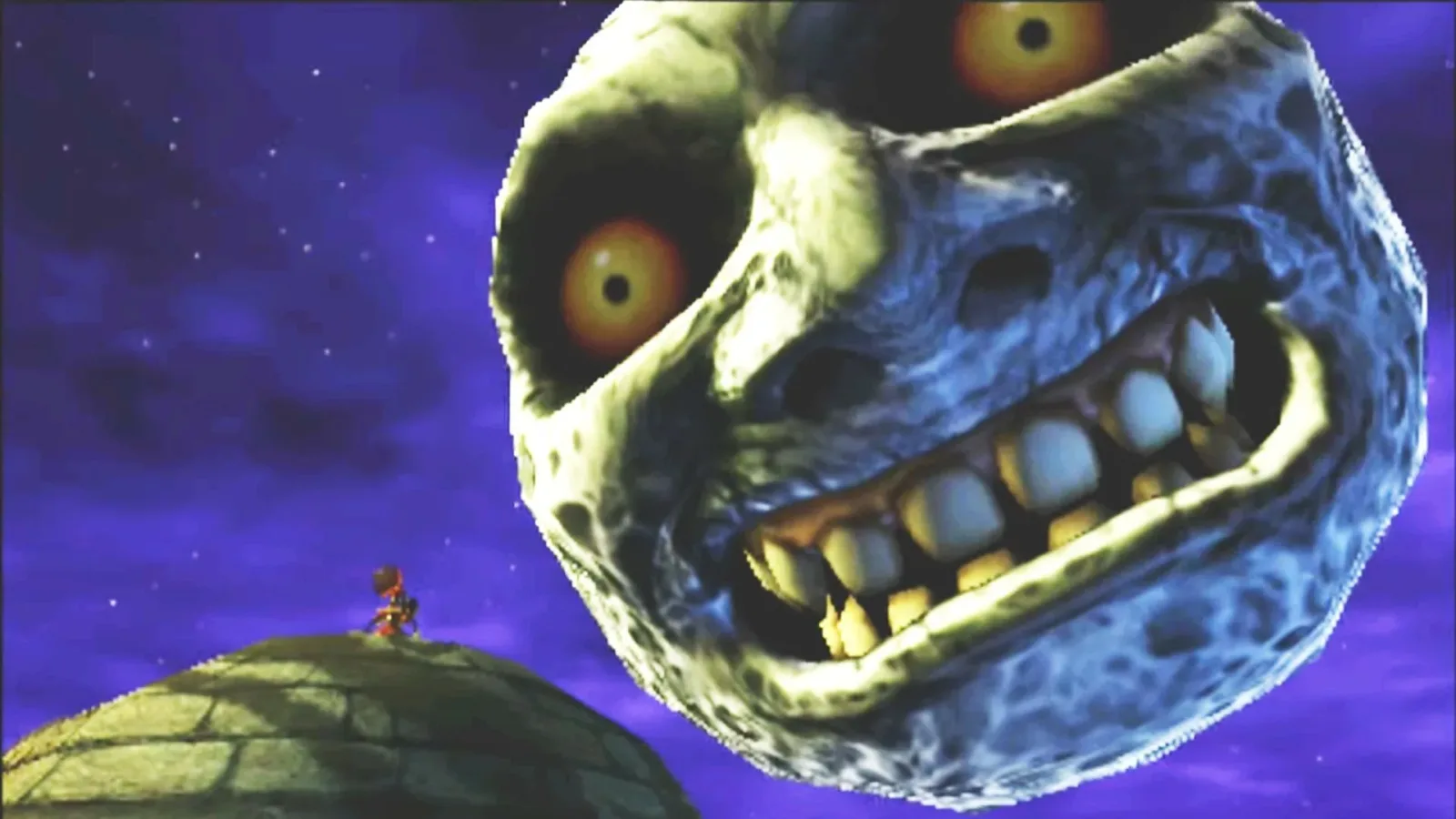
The extraordinary early success of The Legend of Zelda: Ocarina of Time on Switch 2 has naturally reopened one of the longest-running questions in Nintendo fandom: what happens to Majora's Mask? For former Nintendo of America marketing and public-relations leads Kit Ellis and Krysta Yang, the answer appears unusually straightforward. They believe a remake of the famously strange, time-loop-driven Nintendo 64 sequel is highly likely--and may already be in development.
That view follows the latest Ocarina of Time revival's remarkable commercial start. The game moved more than 5 million copies in its first four days earlier this month, giving Nintendo a substantial signal that there is a major audience for revisiting one of its most celebrated 3D adventures. Success on that scale does not confirm an unannounced follow-up, of course. Nintendo has not announced a new version of Majora's Mask. But Ellis and Yang argue that the company's history, development efficiencies, and broader Zelda release strategy all make the prospect difficult to ignore.
Why Majora's Mask is the obvious companion project
During a recent episode of their podcast, Yang said she still sees a remake as the probable outcome. In her view, Nintendo is unlikely to have remained undecided for long after committing to the modern return of Ocarina of Time. The argument is less about a formal announcement and more about practical logic: if the team has rebuilt the technology, design foundations, and visual language necessary for Hyrule, much of the groundwork for a return to Termina may already exist.
Ellis similarly cautioned that a Majora's Mask remake does not necessarily have to be Nintendo's immediate next Zelda release. It may not arrive within the next year or two. Still, he pointed to the same creative and technical reality that shaped the original pair of games: Majora's Mask was able to follow Ocarina of Time unusually quickly because it reused major systems, character models, and other assets from its predecessor.
That reuse was not merely a shortcut. It helped produce one of the most distinctive games in the franchise. While Ocarina of Time established a sweeping coming-of-age quest across Hyrule, Majora's Mask redirected its focus toward a compact world caught beneath an ominous moon. Its repeating three-day cycle, schedule-based NPC stories, transformations, and melancholy tone made it feel less like a routine sequel than a bold reinvention built from familiar tools.
A modern remake could potentially follow that historical pattern. The Switch 2 version of Ocarina of Time has already established a current technical baseline. If Nintendo has assets and systems compatible with a new Majora's Mask, that could allow a team to focus its time on the sequel's unique demands rather than rebuilding every foundational element from scratch.
A precedent Nintendo has used twice before
The connection between these games is not limited to their original Nintendo 64 releases. The first Majora's Mask launched less than two years after Ocarina of Time, an astonishing turnaround when viewed through the lens of modern big-budget development. Nintendo later revisited the pairing on Nintendo 3DS as well, with remakes that arrived relatively close together.
That history is central to the current speculation. Nintendo has demonstrated more than once that it sees value in keeping the two adventures linked. They share visual and mechanical DNA, but they also provide dramatically different experiences. A player moving directly from Hyrule to Termina would encounter familiar faces in altered roles, a smaller but denser setting, and a story with a much more uneasy emotional atmosphere.
For a publisher considering remake projects, that contrast could be valuable. A remake of Majora's Mask would not need to be sold simply as "more Ocarina of Time." Its structure gives it its own identity: the pressure of the falling moon, the time-management puzzle of the three-day cycle, and the emotional payoff of helping Termina's residents all set it apart from other Zelda entries.
Ellis argued that the game's potential has not reached its ceiling. That observation gets at why a remake could be appealing even after prior re-releases. Majora's Mask is frequently remembered for ideas that were ambitious for its era, and a newer version could offer Nintendo an opportunity to revisit those concepts with the benefit of present-day hardware and design lessons.
What Nintendo could gain from returning to Termina
There are important caveats to any discussion of a possible remake. Reusing a foundation does not make development effortless, and Nintendo could choose a completely different direction for Zelda next. The company is known for pursuing projects on its own timeline, often leaving gaps between related releases or surprising audiences with ideas that do not fit prevailing expectations.
Even so, the business case described by Ellis and Yang is understandable. Ocarina of Time has demonstrated significant demand on Switch 2, while Majora's Mask is both recognizable to longtime players and different enough to stand as a major release in its own right. It also carries the benefit of being a sequel with a built-in narrative connection. For newcomers, it can be positioned as the next chapter after Link's journey in Hyrule. For returning fans, it promises a fresh visit to one of Nintendo's most unusual worlds.
The notion of reusing production work should also not be mistaken for a lack of ambition. The original Majora's Mask used the constraints and materials available to it to pursue ideas that Ocarina of Time did not. Its clockwork world relies on observing routines, revisiting events with new knowledge, and deciding how to spend limited time. A remake would have to preserve that distinctive rhythm while determining how closely to follow earlier versions.
That is likely where the most interesting questions would emerge if Nintendo eventually confirms the project. Would the three-day cycle retain the same balance? How would the game's masks, transformations, and side stories be presented for a new generation? Could modern presentation sharpen the surreal tone without losing the uneasy charm that has defined Termina for decades? None of those questions currently has an official answer, but they help explain why the idea has generated renewed attention.
A potential place in a larger Zelda cadence
Ellis and Yang also discussed a broader possibility for the franchise: Nintendo could aim to maintain a more regular Zelda presence by rotating between new 2D games, new 3D games, and remakes. Such a plan would avoid asking one massive production to carry every release window while still giving fans different styles of adventure across the series.
Under that approach, a Majora's Mask remake would fit neatly between larger original projects. A new 3D Zelda typically carries enormous expectations and likely requires a lengthy development cycle. A 2D installment can offer a different scale and design philosophy. Meanwhile, remakes can revisit foundational games while introducing them to players who missed prior versions. The categories are not interchangeable, but together they could support a steadier release rhythm.
For now, that remains an informed theory rather than a revealed Nintendo roadmap. The only concrete recent development is the strong performance of Ocarina of Time on Switch 2. Still, the historical relationship between the two Nintendo 64 games makes the speculation unusually compelling. Nintendo has already transformed Ocarina of Time into the foundation for Majora's Mask once before--then repeated the pairing years later on 3DS.
With a new Ocarina of Time now finding a large audience on Switch 2, Termina's return feels less like a random fan request and more like a plausible continuation. Until Nintendo says otherwise, a remake is not official. But the combination of sales momentum, shared development foundations, and a clear historical precedent means the moon hanging over Majora's Mask is once again attracting a great deal of attention.
Community
Discussion
Start the conversation.
No comments have been posted yet.