

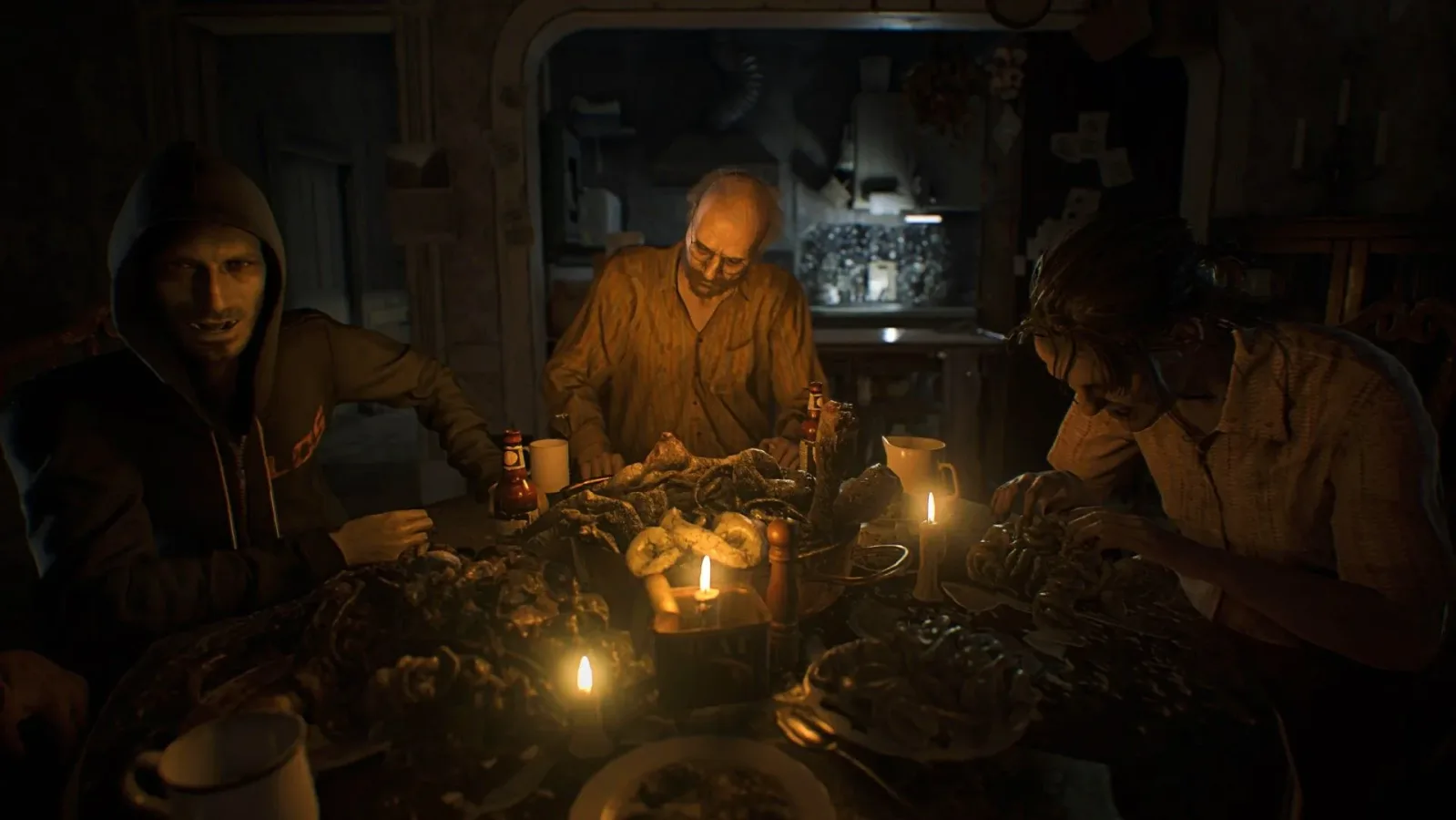
Resident Evil 7: Biohazard is now widely regarded as one of the most important modern entries in Capcom's long-running survival-horror series. Its shift to a first-person viewpoint, intimate Louisiana setting, and unnervingly grounded Baker family helped move Resident Evil away from the increasingly oversized action spectacle associated with some of its prior installments. But former Capcom producer Miguel Corti says the game's eventual success should not obscure the problems that were visible while it was being made.
In a lengthy social-media discussion marking roughly a decade of continued debate around Resident Evil 7, Corti reflected on the game's development, its connection to the reception of Resident Evil 6, and the internal changes that led to the project being rebuilt. His central point was direct: several of Resident Evil 7's shortcomings were not surprises discovered years later by critics or players. In his view, they were already apparent to people involved with development, yet were ultimately allowed to remain.
Corti's comments offer an unusually candid look at a game that is often discussed as a clean, decisive franchise turnaround. Resident Evil 7 did indeed become a major creative reset for the series, but his recollection paints a messier picture: competing goals, a project that was restarted, an audience initially uncertain of the new direction, and a reputation that continued to grow long after launch.
Resident Evil 6 Set the Stage for a Radical Change
The development story, as Corti describes it, begins with the complicated reaction to Resident Evil 6. That 2012 release was huge in scope, featuring multiple campaigns, numerous playable characters, elaborate set pieces, co-operative action, and a story that spread itself across a wide range of locations and threats. Its reception among critics and longtime fans was far more divided than Capcom may have hoped.
For useful background on this topic, read Helldivers 2 Scope of Authority Warbond: Every Weapon, Armor Set and Unlock Revealed.
Internally, however, Corti says Capcom leadership was satisfied with Resident Evil 6. That apparent satisfaction did not necessarily match the feelings of developers who wanted the franchise to receive the kind of widespread critical praise being earned by other major games. Corti suggested that this was especially notable because many contemporary games were visibly drawing from ideas Resident Evil had helped establish over the years.
He specifically pointed to The Last of Us as an influential point of comparison, saying Resident Evil 7 went through several iterations that took inspiration from Naughty Dog's game. That does not mean Resident Evil 7 simply followed The Last of Us' formula. Their final forms are quite different. Still, the comparison helps explain the atmosphere around the project: Resident Evil had long been a foundational series in horror gaming, while newer titles were receiving acclaim for their own interpretations of tension, vulnerability, character-focused storytelling, and survival.
For a franchise that had become increasingly associated with bombast and globe-spanning biohazard disasters, the desire to return to a more focused kind of fear was understandable. Resident Evil 7's final structure reflects that ambition. Instead of immediately presenting players with an international crisis and a cast of established heroes, it begins in a confined, decaying house with Ethan Winters searching for his missing wife, Mia. The threat is personal before it becomes wider.
An Earlier Resident Evil 7 Was Reportedly Much More Complicated
Corti says the original concept for Resident Evil 6's sequel was not a straightforward corrective. Rather, it was initially headed toward another highly complicated direction. He described the early plans as so scattered that he lost track of how many versions there were.
That detail is significant because it challenges the convenient idea that Resident Evil 7 was always conceived as the lean, first-person horror experience players eventually received. If Corti's account is accurate, the version remembered today emerged only after the project was substantially reconsidered. The decision to start again did not merely refine a mostly completed vision; it changed the game's identity.
A broader reorganization at Capcom was the turning point. Corti says a directive came down to redo Resident Evil 7 from scratch, with a new development team and director attached to the project. He described the new leadership as deeply involved in the work and credited that hands-on approach with helping bring about the idea that would define the game: shifting Resident Evil into first person.
At the time, that was a daring choice. The mainline series had historically been associated with fixed camera angles, over-the-shoulder action, or more traditional third-person presentation. A first-person Resident Evil carried risks. Some fans worried the franchise might lose its identity, while others wondered whether the format was being chosen simply to chase the then-growing popularity of virtual reality and first-person horror games.
Instead, the perspective became one of Resident Evil 7's most effective tools. The close view made the Baker estate feel claustrophobic, transformed ordinary rooms into spaces of uncertainty, and made encounters with Jack Baker feel more immediate. It also let the game emphasize the physical discomfort of its horror: damp corridors, filthy kitchens, insects, gore, and enemies intruding into the player's personal space.
A Franchise Tradition of Unexpected Ideas
Corti characterized some of Resident Evil's stranger or more dramatic creative leaps as the result of someone on a team becoming excited about a particular concept and pushing it forward. That observation feels appropriate for a series that has always balanced carefully engineered horror with audacious, sometimes bizarre ideas.
Resident Evil has given players mansion puzzles, police-station survival, cult conspiracies, volcanic finales, towering villains, mutated monsters, melodramatic betrayals, and weapons capable of destroying seemingly impossible biological threats. Its identity has never been limited to one style. But the challenge has always been finding the right balance between horror, action, camp, and spectacle.
Resident Evil 7's first-person reinvention was one of those bold ideas that could easily have failed. Its success was not guaranteed simply because it was different. The game had to convince players that a new protagonist, a new visual perspective, and a smaller-scale opening could still feel recognizably like Resident Evil. For many players, the connection came through exploration, resource management, locked doors, grotesque enemy design, environmental storytelling, and the steady revelation that the nightmare in front of them was tied to a larger bioweapon conspiracy.
Visible Flaws and the Value of Development Friction
Despite its importance, Corti does not portray Resident Evil 7 as flawless. He says many of its issues were "vividly present" during production and were broadly ignored. He did not turn that statement into a detailed list of every specific problem, but the remark speaks to a familiar reality of game development: teams often know where a project is rough, inconsistent, or compromised long before players identify those same points.
In Resident Evil 7's case, discussion has long surrounded the contrast between its highly praised opening hours and later portions that lean more heavily into conventional action and series mythology. Some players have also debated its enemy variety, its final stretch, the handling of certain narrative elements, and the uneven transition between intimate housebound horror and a larger biological threat. Corti's comments suggest that internal awareness of imperfections did not always result in changes.
Yet he also argues that the difficult, iterative process was essential to the game's positive outcome. Corti connected that thought to his opposition to generative AI in game development. His point was not framed as a technical prediction or a claim that AI alone determines a project's quality. Instead, he emphasized the importance of back-and-forth creative development.
He argued that if the game's art director and executive producer had received every element they envisioned immediately, the result would have been terrible. The friction of revision, compromise, changing ideas, and responding to problems was part of what shaped Resident Evil 7 into something stronger than its earlier concepts.
That is an important distinction in debates about creative tools. Games are not only collections of assets or ideas awaiting rapid execution. Development also involves testing whether an idea works in motion, discovering weaknesses, cutting material, changing direction, and allowing unexpected solutions to emerge. Resident Evil 7's path from an apparently convoluted successor to Resident Evil 6 into a first-person survival-horror revival is a clear example of how that process can transform a project.
Initial Reception Was More Uncertain Than Its Legacy Suggests
Resident Evil 7 is frequently remembered as the game that restored Resident Evil's reputation, but Corti says its early commercial and audience response was more complicated. He noted that it initially underperformed when compared with Resident Evil 5 and Resident Evil 6, despite the criticism those earlier action-heavy entries received.
That gap underlines the difference between critical conversation and established audience habits. Resident Evil 5 and Resident Evil 6 were divisive, but they were also large, familiar productions built around recognizable characters and a style of cooperative action that had attracted many players. Resident Evil 7 asked people to accept a radically different tone and perspective.
As Corti recalls it, longtime fans were confused by the reinvention, while people outside the Resident Evil audience either avoided horror altogether or did not know what to make of the game. Capcom was disappointed by that early response. In other words, the game's current standing was not immediately secured by release-week enthusiasm.
Corti believes Resident Evil Village, along with the flood of memes generated around it, helped elevate Resident Evil 7's standing over time to something closer to the reputation enjoyed by Resident Evil 4. Village continued Ethan Winters' story while blending elements of Resident Evil 7's first-person approach with a more varied, action-forward structure. Its enormous visibility also encouraged more players to revisit the game that began Ethan's journey.
Resident Evil 7's legacy, then, was built gradually. Its importance came not only from what it achieved at launch, but from what it enabled afterward: the continued first-person storyline, a renewed willingness to reinvent the series, and a broader modern era in which Capcom has balanced remakes with new entries.
An Imperfect Reinvention That Changed Resident Evil
Corti's reflections do not diminish Resident Evil 7. If anything, they make its achievement more interesting. The game was not born as an obvious success story, and it was not polished into perfection by a development process that always knew where it was going. It was shaped by dissatisfaction with Resident Evil 6's reception, a major internal reset, uncertain creative experiments, visible flaws, and the willingness to keep revising.
That history helps explain why Resident Evil 7 still prompts debate. Its strengths are powerful enough to have redefined expectations for the franchise, while its rough edges are clear enough to remain part of the conversation. For a series that has survived by changing forms across decades, that may be the most fitting legacy possible: an imperfect game that took a real risk, divided some fans at first, and ultimately helped give Resident Evil a new future.
Community
Discussion
Start the conversation.
No comments have been posted yet.