

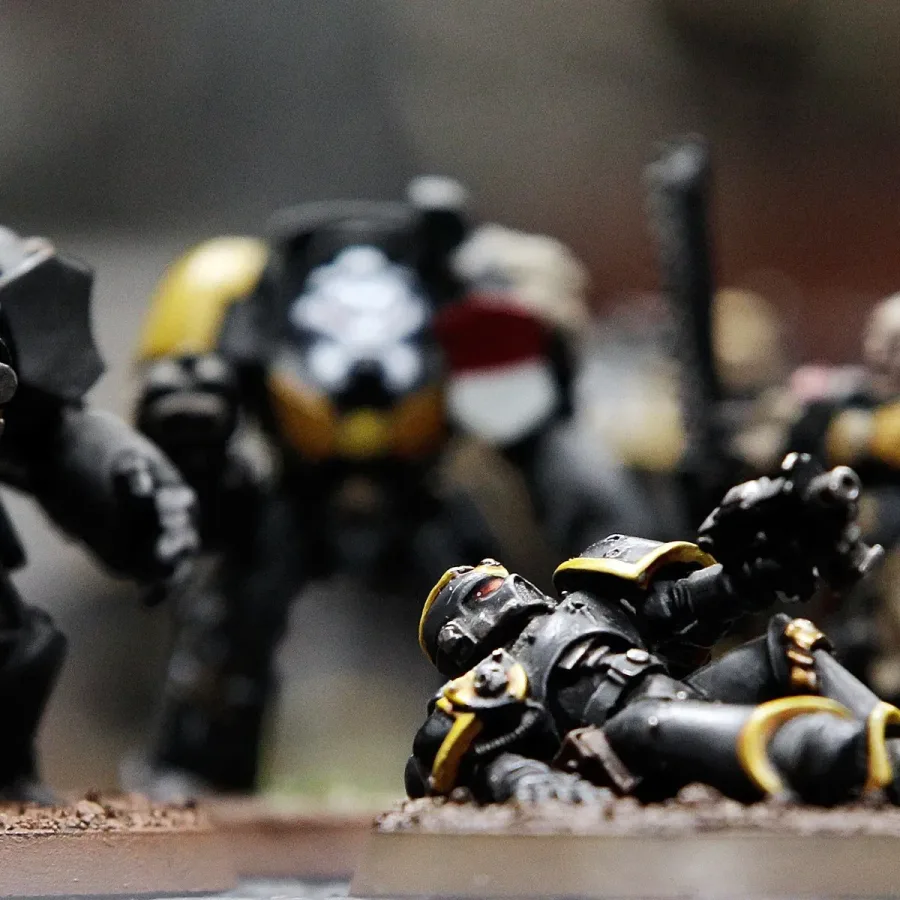
Games Workshop, the company behind Warhammer 40,000 and a sprawling catalogue of miniature tabletop games, is facing fresh attention after its share price declined even while the business continues to report record profits. The contrast has understandably created confusion among fans: how can a company enjoying strong financial results suddenly be discussed as though it is in danger?
The short answer is that a falling share price does not automatically mean a company is failing. Investors do not value a business only on what it earned yesterday or what it is earning today. They are also making judgments about what it may earn in the years ahead. In Games Workshop's case, the current discussion appears to be centered on whether its remarkable growth can continue at the same pace while costs rise, consumer budgets tighten, and the company releases an increasingly large volume of premium-priced products.
That distinction matters. There is currently no clear indication that Games Workshop is in immediate financial distress. Its broader performance remains a major success story, and its stock had risen by more than 70% across the previous five years before this recent period of weakness. Still, the company's share price fell 13.76% over six months, removing hundreds of millions of pounds from its market value and encouraging intense speculation over what may be happening behind the scenes.
Strong results do not eliminate worries about future growth
Games Workshop has achieved something many hobby-focused companies struggle to do: it has turned a niche, complicated, and often expensive product category into an increasingly mainstream entertainment brand. Miniatures, paint, books, licensed games, stores, and an expanding media presence have helped Warhammer reach far beyond long-standing tabletop players.
For useful background on this topic, read Pixel Blade codes for October 2026: Class Dice, Coins, a Wish and Golden Cod.
Yet that success creates a difficult question for investors. When a company has been growing rapidly for years, expectations rise with it. Maintaining growth becomes harder because the business is measured not simply against its past, but against the ambitious forecasts built into its valuation. A company can post impressive profits and still disappoint investors if those investors had anticipated even faster expansion.
Games Workshop has recently faced the kinds of pressures that affect many physical-goods businesses. Manufacturing and logistics costs have risen, and miniature wargaming depends heavily on producing, shipping, and distributing physical kits worldwide. These are not digital products that can be duplicated at nearly no marginal cost. Every boxed army, paint pot, rulebook, and terrain set must be manufactured, packed, transported, stocked, and sold.
At the same time, the broader cost-of-living environment has made discretionary spending more difficult for many customers. Warhammer has always had a premium reputation, but an audience under financial pressure may delay a new army, choose a smaller purchase, buy second-hand, or simply spend less often. That does not require an abrupt collapse in demand to affect the growth assumptions investors use when assessing the company.
Retail performance has become a focal point
One notable concern is retail growth per store. In the second half of Games Workshop's 2026 financial year, retail growth per location reportedly turned negative for the first time since the pandemic. That is a meaningful data point because the company's physical stores are more than ordinary shops. They are also recruitment tools for the hobby, places for painting demonstrations and games, and an important entry point for newcomers.
Negative growth per store does not, by itself, establish a long-term trend. Retail figures can move because of product timing, regional conditions, comparisons with an unusually strong prior year, consumer confidence, or changes in where customers make their purchases. Still, it has provided investors with a concrete reason to ask whether Warhammer's retail engine is currently operating at peak capacity.
There is also a concern among parts of the community about product saturation. Games Workshop has released multiple expensive miniature kits in a relatively short period, particularly around its flagship Warhammer 40,000 line. Some players feel the pace can be difficult to keep up with, both financially and practically. Building and painting a collection takes time, and new releases compete not only with other entertainment purchases but with the unpainted miniatures many hobbyists already own.
That community sentiment should not be mistaken for confirmed sales evidence. Online discussion can make a concern seem universal even when it represents only a portion of the audience. Claims that the recently released 11th edition of Warhammer 40,000 has underperformed have circulated, but no official data has been presented to substantiate them. In a mid-September update covering trading through August 30, Games Workshop said performance was in line with its board's expectations for the current financial year.
That is important context. The company itself has not signaled that its current trading has unexpectedly deteriorated. Investors may be debating the scale of future opportunity, but that is different from Games Workshop telling the market that its plans are off track.
The mystery report adds to uncertainty
Concern intensified after financial reporting described a confidential document from Dragoneye, a research firm that takes short positions, as contributing to a sharp reduction in Games Workshop's market value. The reported document was said to focus on the possibility of slowing growth.
The contents of that document have not been publicly established, so it would be premature to draw firm conclusions from it. The identity of the firm is also relevant context: short-focused research companies generally profit when the shares they target fall. That does not automatically make their analysis wrong, but it does mean readers should understand the perspective and incentives surrounding such research.
In markets, uncertainty itself can drive movement. If investors hear that an unreleased or confidential report exists, some may reduce their exposure before they know its full argument. Others may interpret the discussion as a warning that better-informed market participants have spotted a problem. This can magnify short-term volatility regardless of whether the underlying business has changed materially.
For fans, it is worth separating stock-market turbulence from the health of the hobby. Share prices respond to expectations, sentiment, valuation models, and trading activity. They do not offer a simple weekly verdict on whether people enjoy playing Warhammer, whether a new miniature is well designed, or whether the company will still be producing games next year.
Warhammer has substantial opportunities beyond the tabletop
Even if miniature sales growth moderates, Games Workshop has several major avenues that could broaden the reach of its intellectual property. The company has spent years building Warhammer into a brand that can support video games, animation, books, partnerships, and other entertainment ventures. Those efforts are especially significant because they can introduce the setting to people who may never have entered a hobby store or assembled a miniature.
Upcoming video game projects include Total War: Warhammer 40,000 and Space Marine 3. Neither should be treated as a guaranteed financial cure-all for any concern about the core tabletop business, and their eventual impact will depend on their quality, reception, and commercial performance. But they underline the scale of Warhammer's current ambitions. A successful game can create new interest in factions, characters, and worlds that later feeds back into miniatures, novels, and licensed products.
The planned Warhammer 40,000 screen universe being developed for Amazon with Henry Cavill is another potentially transformational opportunity. Bringing the setting to a large entertainment platform could expand awareness enormously. It also remains a long-term project with the normal uncertainty attached to major adaptations; development alone does not guarantee a finished production or a particular release schedule. Nevertheless, it is evidence that Games Workshop's future is not tied exclusively to selling the next plastic box.
What the share decline means now
The current picture is best understood as a debate over sustainability. Games Workshop has been highly successful, but investors are questioning whether growth can remain exceptional amid higher operating costs, cautious household spending, a demanding release cadence, and signs of softer store-by-store retail growth.
Those are reasonable issues to examine for a company selling premium hobby products. They are not, based on the information currently available, proof that Games Workshop is in serious trouble. The business has continued to report record profits, has said trading is aligned with board expectations, and retains some of the most valuable fantasy and science-fiction brands in gaming.
At the time of the latest discussion, Games Workshop's share price had also moved up 1.22%, a reminder that daily market moves can be noisy and should not be overinterpreted. For Warhammer players, the more useful things to watch will be future trading updates, the company's retail and revenue trends, how customers respond to major releases, and whether its expanding entertainment projects convert brand recognition into durable new audiences.
For now, the story is not one of an empire falling overnight. It is a successful company encountering the pressure that comes when investors wonder how much further success can grow.
Community
Discussion
Start the conversation.
No comments have been posted yet.