

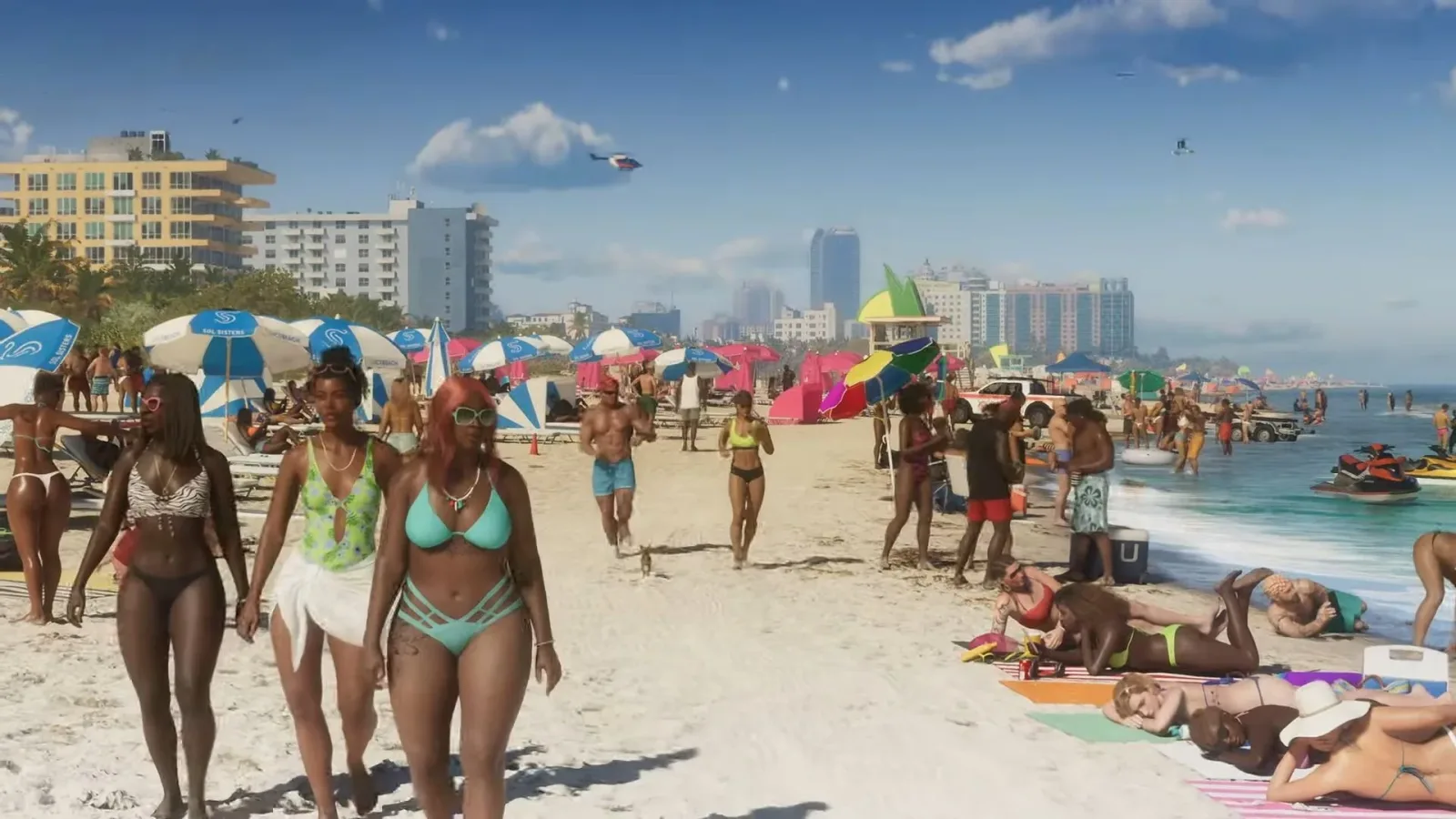
Grand Theft Auto 6 is being built with a level of attention aimed well beyond its headline missions, major characters and high-speed chases. Rockstar Games has revealed that it has dedicated writing teams focused on the details players may only hear in passing: pedestrians talking in the street, fictional advertising, and comedy spread throughout the world.
The comments offer a useful look at the scale of Rockstar's ambitions for its next open-world crime game. Rather than treating ambient dialogue as a final layer of noise added to fill quiet spaces, the studio's narrative leadership describes it as a central part of creating a believable city. The idea is that a player moving through a crowded street should hear a convincing rush of overlapping lives, while a player who stops to listen closely should still find a moment that feels authored and specific.
Speaking to Love magazine, Rockstar senior vice president of narrative Rupert Humphries said the company has "an amazing team of writers and creatives" working on the material that might casually be called background noise. That label does not reflect how the team itself views the work. For Rockstar, those small details are part of the world's larger texture and a major contributor to the feeling of inhabiting its version of a busy, unpredictable place.
Pedestrian conversations are getting their own writing team
Humphries explained that GTA 6 has a specific pedestrian-dialogue writing team in Los Angeles. Separate advertising and comedy writers are spread across New York, Los Angeles and London. That structure suggests Rockstar is treating several forms of incidental world-building as distinct creative disciplines rather than assigning all ambient content to one general narrative group.
For useful background on this topic, read Marvel Tokon Year One DLC Adds Venom, Mighty Thor, Jubilee and Phoenix Cyclops.
Pedestrian dialogue in an open-world game has a difficult job. It needs to be brief enough that it does not delay the player, flexible enough to work in many locations and situations, and varied enough that it does not become repetitive after hours of exploration. It also needs to sound natural when only a fragment reaches the player's ears. In a dense urban environment, a line may be heard from a passing car, through a shop door, from a nearby sidewalk, or while players are already focused on something else entirely.
That makes the work more complicated than simply writing isolated jokes or generic reactions. Conversations must help sell the impression that pedestrians existed before the player arrived and will continue with their own concerns after the player leaves. A random NPC may only be on screen for seconds, but those seconds can shape whether the city feels like a stage set or a place with its own momentum.
Humphries said the writers and creatives involved come from many different backgrounds and walks of life. What connects them, he said, is a shared sense of humor and an interest in having fun with the absurd sides of people, media and advertising. That approach fits a series long associated with satire, but the comments indicate that GTA 6 intends to embed that perspective throughout the world rather than reserve it exclusively for story scenes and major scripted characters.
Advertising and comedy are part of the city's identity
Fictional advertising has long been one of Grand Theft Auto's most recognizable tools for establishing tone. It can turn a drive through the city, a radio listen, or a glance at a sign into another chance to understand the world's culture and its targets for satire. Rockstar's confirmation of dedicated advertising and comedy writers shows that these elements are being approached with considerable intent for GTA 6.
Advertising is especially useful in an open-world setting because it can communicate character without demanding the player's full attention. A billboard, radio spot or other promotional message can be funny on its own, but it can also imply the social habits, commercial pressures and media environment of the world around it. The result can make even areas without a mission objective feel more defined.
The presence of comedy writers across three cities may also reflect the unusually broad amount of material required. Open worlds demand content that can support many different player paths. Some players speed from mission to mission. Others wander, test systems, listen to radio broadcasts, revisit neighborhoods, or stop to observe people. Material designed for those quieter moments has to reward curiosity without becoming essential homework for players who choose not to linger.
Humphries stressed that Rockstar does not see any of this as a secondary task. In his view, it belongs to the complete "tapestry" of the game and to the experience of living in its wild world. The phrasing points to an important distinction: background material may not be the focus of every player's session, but it can still be foundational to the world's overall credibility.
Rockstar says scale cannot replace specificity
Open-world writing director James Horton expanded on that philosophy by saying Rockstar "dreamed a lot bigger" for this project. He described the process as one that requires teams and resources for details that may be regarded as afterthoughts in other games. The challenge, as Horton framed it, is not merely to make a world that is large or stuffed with activities. It is to make every part feel true, including the places and people players may inspect most closely.
"There are no shortcuts when it comes to building a world like this," Horton said, describing the need to give the right people the resources to create something both vast and varied, with small details that stand up to scrutiny.
That is a demanding promise for any open-world production. Players often test a game's illusion in unexpected ways. They might follow an NPC, replay a section at different times, listen for repeated dialogue, or simply pause during a chaotic moment to see whether surrounding activity continues to make sense. A city can look enormous from a distance while still feeling thin if its people, voices and media are too obviously recycled.
Horton's description of the desired effect focuses on two opposing but equally important experiences. First, GTA 6 needs to work when a player is sprinting through a packed street and catches pieces of what seem like countless conversations. Second, it needs to remain persuasive when that player chooses one conversation and gives it their full attention. Ambient writing, in other words, must function as both atmosphere and close-up storytelling.
It is a standard that helps explain why a specialized pedestrian-dialogue group exists. A line that works as a quick fragment in a noisy crowd may need context and personality to remain interesting when heard in full. Developing material that succeeds at both scales requires planning, recording and implementation that account for player behavior rather than assuming everyone will experience the content in a single intended order.
"No background" when the player decides to look closer
Horton went further by arguing that GTA 6 has, in some respects, no real background at all. The line between foreground and background changes based on player attention. A passing NPC might be set dressing for one player and the center of a memorable moment for another. The same principle applies to a snippet of dialogue, a joke in an ad, or a detail found on a busy street.
"No one you meet is an extra," Horton said, adding that every person is the main character of their own story. It is a familiar storytelling idea, but it is particularly relevant to a series built around cities full of strangers. GTA's worlds are often remembered not only for their central casts, but for the impression that something amusing, strange or chaotic might happen just outside the player's immediate objective.
Of course, Rockstar has not said that every pedestrian will feature a fully developed narrative arc that players can follow. Horton's comments are better understood as a creative goal for how NPCs should feel in the moment. Even a short encounter can suggest an inner life, a relationship, an annoyance, a joke or a problem that does not exist solely to serve the player.
That philosophy can make a substantial difference in a game defined by freedom. The more players are encouraged to roam and improvise, the more important it becomes for unscripted spaces to hold their own. Mission design can direct attention with dialogue and spectacle; everyday city life has to earn attention through accumulated details.
What the approach could mean for GTA 6's world
Rockstar's comments do not reveal the full scope of GTA 6's pedestrian systems, nor do they explain exactly how often players will encounter unique dialogue or context-sensitive reactions. They do, however, establish a clear creative priority: the studio wants the game's incidental voices, satire and street-level encounters to carry as much care as the parts traditionally considered essential.
The company has also revealed that GTA 6's radio stations will include in-game podcasts for the first time in Grand Theft Auto history. Alongside the newly detailed work on pedestrians, ads and comedy, that news reinforces the sense of a world designed to communicate through many layers at once. Players may be following the main story, but the surrounding city will continue speaking through radio programming, commercial messaging and conversations that have nothing directly to do with the mission at hand.
For a series whose settings have always been inseparable from its identity, that investment makes sense. GTA 6's world will not be defined only by its map size or the number of major activities it contains. It will also be shaped by whether a crowded sidewalk sounds alive, whether a stray conversation feels worth hearing, and whether the jokes embedded in its media landscape make the city feel like it has a personality of its own.
Rockstar's narrative leaders are setting an ambitious expectation: the smallest pieces of GTA 6 are not simply there to fill space. They are meant to ensure that, wherever players decide to look, there is something that feels like it belongs there.
Community
Discussion
Start the conversation.
No comments have been posted yet.