

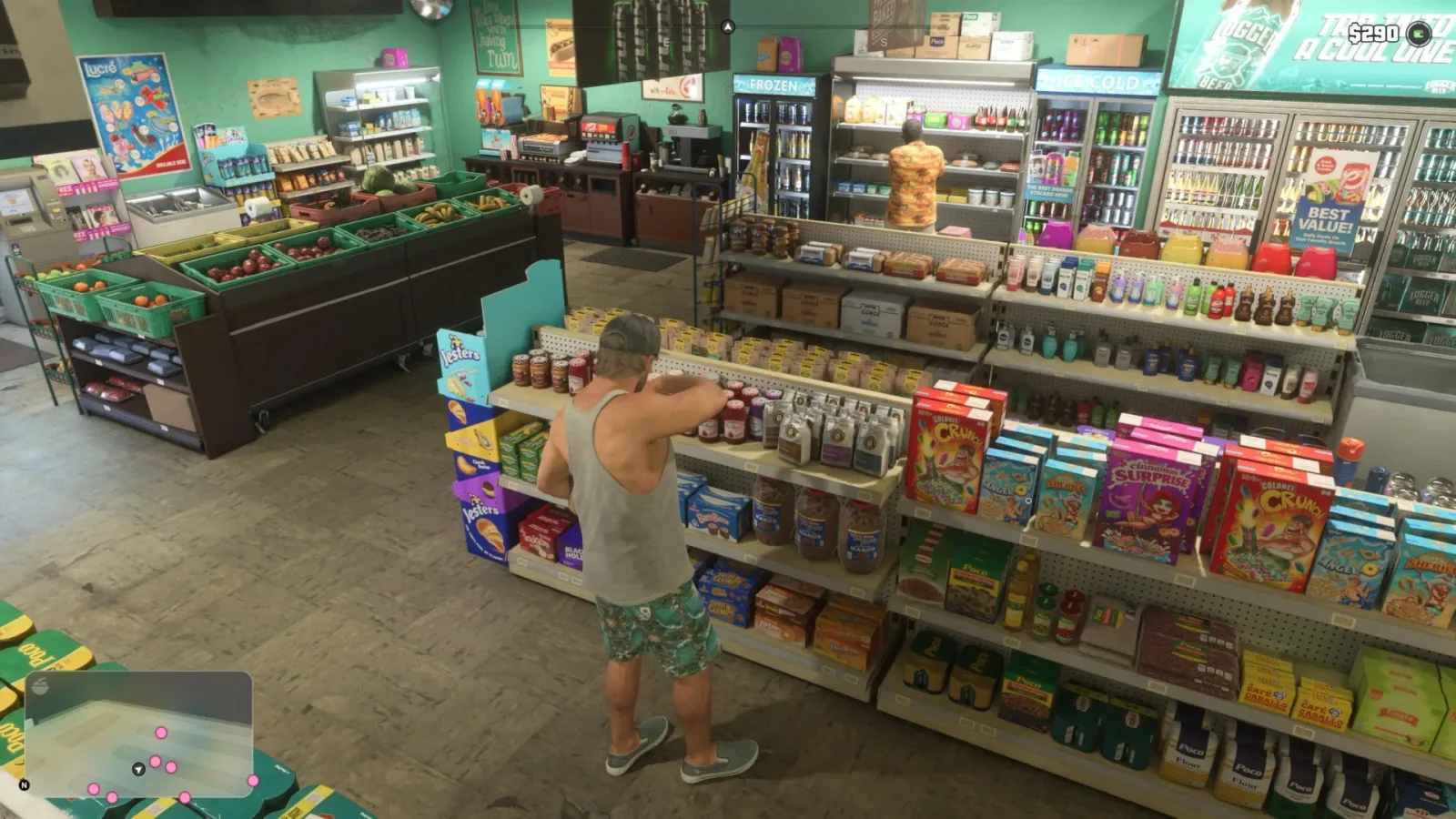
Grand Theft Auto 6 is taking a notably player-friendly stance on one small but surprisingly important piece of open-world simulation: store hours. Whether it is the middle of the afternoon or 3 a.m., players will be able to walk into businesses across the game world and use their services. That means a late-night haircut, a nail appointment, a coffee, an energy drink, a croissant, or a new hat will all be available without waiting for morning.
The decision applies across more than 700 stores in GTA 6. It is a major convenience feature in a game that otherwise appears highly committed to making its world feel responsive and lived in. Rather than encountering a locked door because a shop has closed for the night, players can go about their business whenever they choose. The only stated restriction is whether they have enough in-game money to pay for what they want.
It also has a more chaotic benefit that fits Grand Theft Auto particularly well: a business that is always open is also a business that can potentially be robbed at any hour.
A practical answer to an open-world problem
Many games leave shops open permanently, even when their worlds have day-and-night cycles. It is an accepted game design shortcut, but GTA 6's choice stands out because of the level of simulation attached to other parts of its setting. The game includes public transit that players may need to wait for, and transport can be delayed by incidents such as crimes or crashes. In that context, 24-hour barbers, cafés, clothing stores, and other services might initially seem less realistic than the rest of the experience.
For useful background on this topic, read GTA 6's Jason Duval May Be Hiding a Fantasy-Novel Obsession.
Rockstar Games design director for player systems and progression Katie Pica explained that the studio chose accessibility over strict realism. With such a large number of locations, arriving at a desired store only to find it closed became frustrating during development. Pica also pointed to the difficulty of establishing convincing closing schedules in Red Dead Redemption, which had fewer types of shops to manage than GTA 6.
That is a sensible concern. A large city-based game creates countless reasons for players to be moving around at unusual hours. They may be completing a mission that runs long, escaping police attention after a botched job, exploring a new district, or simply deciding to alter their character's look after an evening of free-roaming. In each case, a closed business can turn a simple activity into a delay with little meaningful payoff.
For a game built around player freedom, permanently accessible services remove an unnecessary point of friction. Players will not need to sleep, pass time, or travel back later simply because they wanted a haircut or needed to replenish an item at the wrong hour. That may sound minor in isolation, but minor inconveniences can accumulate quickly in a sprawling open world.
Late-night customization without the wait
The most amusing example is the ability to get a haircut at 3 a.m. Character customization has long been a familiar part of the Grand Theft Auto formula, and GTA 6 appears ready to make that system available whenever inspiration strikes. Players who decide their current style no longer fits their plans will not have to wait for a barber to report for work.
The same goes for beauty services and clothing. Hair and nail options can be accessed at any time, while a new hat or other item can offer a quick visual change. In a criminal sandbox, a new look can be about self-expression, but it can also have a more mischievous role. A player might want clothing after causing trouble, staging a robbery, or simply trying to create a different persona for their next excursion through the city.
Food and drink businesses will likewise remain usable overnight. Coffee, energy drinks, and pastries are among the examples highlighted for the always-open system. The detail supports a world where players are encouraged to keep moving on their own schedule rather than conforming to a business timetable.
It does not necessarily mean every business will feel identical. The available services, products, interiors, and surrounding activity can still give locations their own identity. But the operating-hours rule establishes a clear baseline: when players find a store, they should be able to interact with it.
More open stores mean more robbery opportunities
Pica's explanation also makes clear that this is not solely a quality-of-life decision. Keeping stores open supports crime gameplay. A closed location cannot offer much opportunity for a hold-up, but an open business can become a target at any time of day or night.
That matters because robberies are one of the most naturally replayable forms of open-world mischief. Their appeal comes from spontaneity as much as planning. A player may enter a shop intending to buy something, then decide to take the risk of demanding cash instead. They may be looking for a quick score while moving through a neighborhood, or they may want to trigger a confrontation and test how the wider world reacts.
Round-the-clock access means those moments are not limited by a schedule. A player roaming after midnight will not find an entire city of shuttered storefronts just as they decide to create trouble. The world remains full of possible interactions, victims, witnesses, and consequences.
Of course, the fact that a store is open does not imply that robbery will be easy. A business may still have employees, customers, security measures, or nearby police attention. The game's broader simulation systems could make the time of day meaningful in other ways, even if the shop itself never closes. A late-night robbery might encounter fewer people on the street, for example, while a daytime attempt could bring more witnesses. Those specifics have not been detailed, but the all-hours policy gives Rockstar more freedom to make criminal activity possible whenever players choose.
Realism is being used selectively
The store-hours system is a useful reminder that immersion does not always mean reproducing every inconvenience of real life. A convincing game world is often one that knows which details should be simulated and which should be streamlined. Waiting for transit can build atmosphere, especially if the world's events can affect arrivals. Being unable to buy a drink, change a hairstyle, or begin a store robbery because the clock says 3 a.m. may simply be less entertaining.
GTA 6's approach appears to be selective realism. The city can still react to accidents and crime, while businesses remain ready to serve the player. That balance has the potential to preserve the feeling of a dynamic place without forcing players into dead time.
There is also an enormous scale consideration. More than 700 stores represent a vast number of potential points of interaction. Giving each business its own hours, staffing assumptions, exceptions, and overnight behavior could create a complicated system that players would need to learn and repeatedly work around. The simpler rule is immediately understandable: if you can find the store, you can use it.
That clarity is valuable in a game likely to offer a huge amount of information, activities, and systems. Players can focus on deciding what they want to do rather than checking whether the game permits them to do it at a particular hour.
What the decision says about GTA 6's design priorities
GTA 6's permanently open stores may not be the flashiest feature, but they reveal an important priority in its design. Rockstar is willing to bend real-world logic when doing so protects momentum and expands the number of choices available to players. It is a decision rooted in usability, but it also directly reinforces the series' signature freedom to behave responsibly, recklessly, or somewhere between the two.
Want to clean up your appearance before heading into the next activity? The barber is open. Want a snack or a jolt of caffeine during an overnight drive? There is somewhere to stop. Want to buy a hat, change your style, or turn a routine visit into a robbery? The opportunity will be there.
For players, the result is straightforward: no matter how late the night gets in GTA 6, the city's storefronts will still be ready. Whether that leads to a fresh haircut, a croissant, or a disastrous criminal decision will be entirely up to them.

Community
Discussion
Start the conversation.
No comments have been posted yet.