


Grand Theft Auto 6 is taking a major step away from the series' longstanding assumption that an open-world city is primarily a playground for consequence-free chaos. Players can still hijack vehicles, start gunfights, flee police, and turn a quiet drive through Leonida into a spectacular disaster. But Rockstar has built a new Criminal Profile system intended to make those decisions carry more personal and persistent weight.
The system has prompted discussion because it applies a form of morality and reputation tracking to a franchise famous for letting players act as an unstoppable force. Rockstar co-founder Rob Nelson has explained that this change comes from the greater visual detail and sophistication of GTA 6's world. As characters look and behave more like people, the game can invite players to see them as more than props placed along a road or sidewalk.
That does not mean GTA 6 is suddenly asking everyone to play as a model citizen. It remains a crime game, and it still allows players to embrace the most destructive possibilities available. The distinction is that indiscriminate violence is no longer treated as a completely isolated activity with no broader impact on the player's relationship with the world. The Criminal Profile can deteriorate based on extreme behavior, and reaching a certain point can create an irreversible reputation state that changes how NPCs respond.
A new layer of consequence in Leonida
The Criminal Profile system represents a clear evolution of the honor mechanics used in Red Dead Redemption 2, rather than a simple recreation of them. In Rockstar's western, players could influence Arthur Morgan's reputation through helpful, cruel, or criminal conduct. GTA 6 adapts the broad idea for a far more modern, densely populated setting, where players spend much of their time surrounded by traffic, crowds, businesses, and strangers going about their routines.
For useful background on this topic, read GTA 6's Niko Bellic Cameo Explained: Why He Returns and What It Does Not Confirm.
That setting makes the question of player behavior more immediate. A reckless collision or a stolen car is not necessarily framed in the same way as sustained attacks on uninvolved civilians. GTA 6's in-game warnings can identify repeated, especially severe conduct as "psycho" behavior. This is not just momentary flavor text: consistently pursuing that path can lead to a permanent label within the player's Criminal Profile.
The design is notable because the Grand Theft Auto formula has often been celebrated for exactly the kind of spontaneous mayhem this system scrutinizes. For decades, players have used the series' cities to test vehicle physics, provoke law enforcement, and create self-directed action scenes far outside the boundaries of story missions. GTA 6 does not remove that freedom. Instead, it asks players to decide whether they want that freedom to define their version of Jason and Lucia.
Nelson's view is that this choice creates stronger role-playing opportunities. A player who wants to inhabit Leonida carefully, commit crimes selectively, or avoid needless harm has systems that support that approach. Conversely, a player who rejects the idea of restraint can keep escalating until their profile breaks into an irredeemable state. The game does not force one answer; it makes the answer visible.
Why more realistic NPCs change the equation
Nelson connects the new mechanic to GTA 6's increased fidelity. As graphical resolution rises, Rockstar believes the sophistication of interactions needs to rise with it. Better-looking character models alone are not the point. The goal is to make the surrounding world react in ways that feel more convincing and to offer options beyond encountering every obstacle through violence.
This is especially relevant when comparing GTA 6 with Grand Theft Auto 5. Nelson noted that NPC responses in the older game had limits that could leave the player feeling almost godlike. Merely pulling out a weapon did not necessarily produce a response; aiming it was a more direct trigger for panic. The result was a world where players could feel detached from the people around them until a game system explicitly recognized a threat.
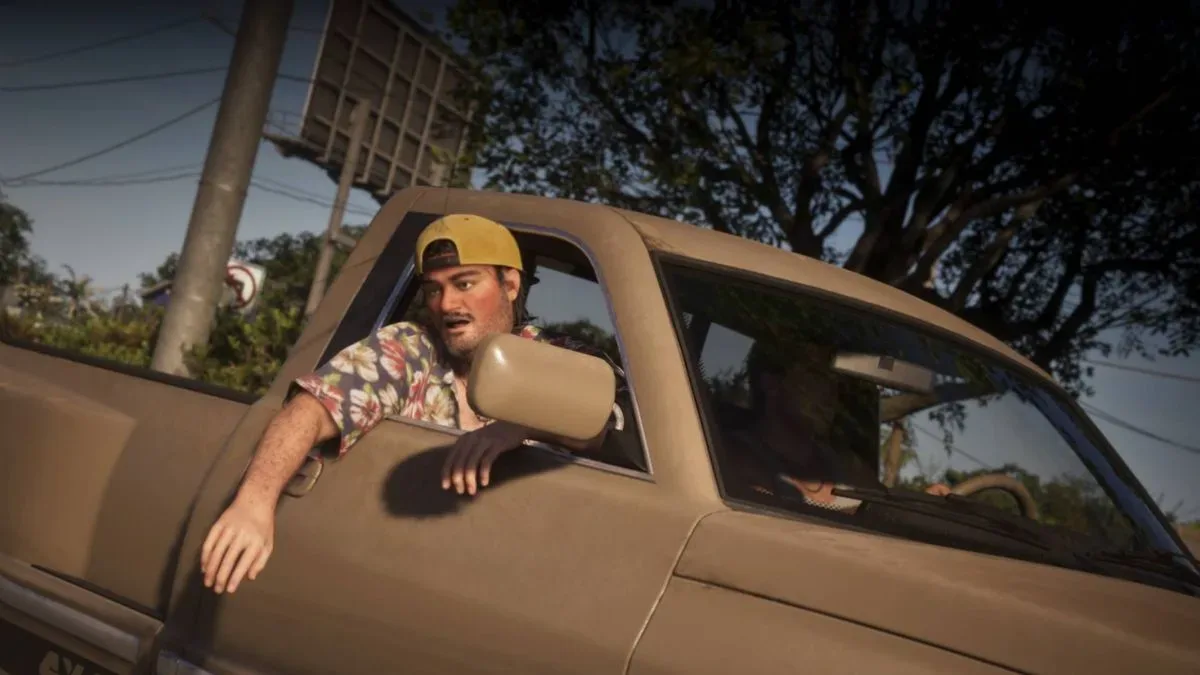
GTA 6 seeks a more nuanced effect. If pedestrians and other characters seem more aware, vulnerable, and individually present, then the player's actions naturally take on a different tone. Violence can still be funny, chaotic, or useful in a given situation, but it may no longer feel as interchangeable as it did in older entries. An encounter can become a choice with context rather than just another opportunity to press an attack button.
That context may be particularly important during spontaneous crimes. Nelson gave the example of trying to steal a motorcycle from someone who responds by pulling a gun. In that moment, the player is not simply initiating a canned action in a vacuum. The attempted theft can develop into a confrontation, and the player may decide that lethal force is necessary after provoking the conflict. That sequence gives the situation a cause-and-effect quality which can make the outcome feel more pointed, and potentially more darkly amusing.
It is a subtle but important distinction. A game can offer violence as a universal solution, or it can make violence one option among several while giving it a recognizable social cost. GTA 6 appears to be trying to maintain the former freedom without losing the latter texture.
Rampages remain possible, but they define the player
For players concerned that a morality mechanic could tame Grand Theft Auto too much, Rockstar's position is straightforward: rampages are still available. The franchise's anarchic side has not been erased. A player can intentionally push the Criminal Profile to its limit and reject the system's expectations altogether.
However, GTA 6 frames that decision as an identity rather than a temporary detour. Once a player reaches the irreversible profile state, NPC interactions and reactions can be permanently affected. That makes the most extreme conduct a commitment, not merely something to be wiped away by driving across town or waiting for a wanted level to cool down.
This may create an interesting divide in how people approach the game. Some will likely treat the permanent state as a challenge or a badge of honor, deliberately seeing what changes when Leonida regards them as irredeemable. Others may prefer to preserve a lower-profile criminal lifestyle: stealing cars, completing illegal jobs, and surviving dangerous missions while avoiding unnecessary collateral damage.
There is also room for players who shift between those impulses. The ability to make choices does not require a perfectly consistent role-played persona. A player may make mistakes, react badly under pressure, or choose violence during a tense escape, then spend the rest of the game trying to avoid crossing a final line. That possibility is arguably closer to the messy, improvisational appeal that has always defined Grand Theft Auto than a simple good-versus-evil meter would be.
Jason and Lucia give the system more emotional stakes
The Criminal Profile system may also resonate differently because GTA 6 centers on Jason and Lucia. Their relationship gives players two protagonists whose future and shared story can feel worth protecting. Even players who enjoy petty theft, dangerous driving, and occasional shootouts may draw a line before behavior that makes either character seem beyond redemption.
That is where the system's role-playing value becomes more apparent. Rather than only tracking abstract points, it can support the version of Jason and Lucia a player imagines. They might be desperate criminals trying to get ahead, opportunists who avoid hurting bystanders, or figures willing to leave destruction behind wherever they go. The world's response can reinforce those interpretations.
Of course, Grand Theft Auto has always allowed a gap between narrative characterization and player behavior. A protagonist can deliver an emotional story scene immediately after the player has caused absurd havoc in free roam. GTA 6's new system will not eliminate that tension, nor should it necessarily try to. The series has long drawn energy from the clash between scripted drama and player-led comedy.
What Rockstar appears to be doing is giving that clash more consequences. Players can still create outrageous situations, but the game is better equipped to acknowledge what they have done and remember the direction they have chosen.
A broader vision of open-world freedom
At its best, this approach could expand the meaning of freedom in GTA 6 rather than narrow it. Freedom is not only the ability to cause chaos without limits. It can also be the ability to show restraint, respond to a situation without immediately escalating it, and build a distinct relationship with a world that recognizes those choices.
That does not mean every player will welcome the Criminal Profile. Some may feel that permanent consequences run against the carefree experimentation expected from a Grand Theft Auto sandbox. Others may be wary of a system that judges conduct in a game built around criminal protagonists. Those concerns are understandable, particularly for a series whose appeal has always included pushing against rules.
Yet Rockstar's stated reasoning suggests GTA 6 is not trying to lecture players. It is trying to make the city feel more alive and the player's place within it more specific. Leonida's residents are meant to be more than scenery for a destructive power fantasy, even if players remain free to treat them that way.
In the end, GTA 6's Criminal Profile system may be most successful if it gives every approach a clearer shape. Players can be cautious criminals, reckless antiheroes, or full-blown agents of mayhem. The difference is that Leonida may remember which one they chose to become.
Community
Discussion
Start the conversation.
No comments have been posted yet.