

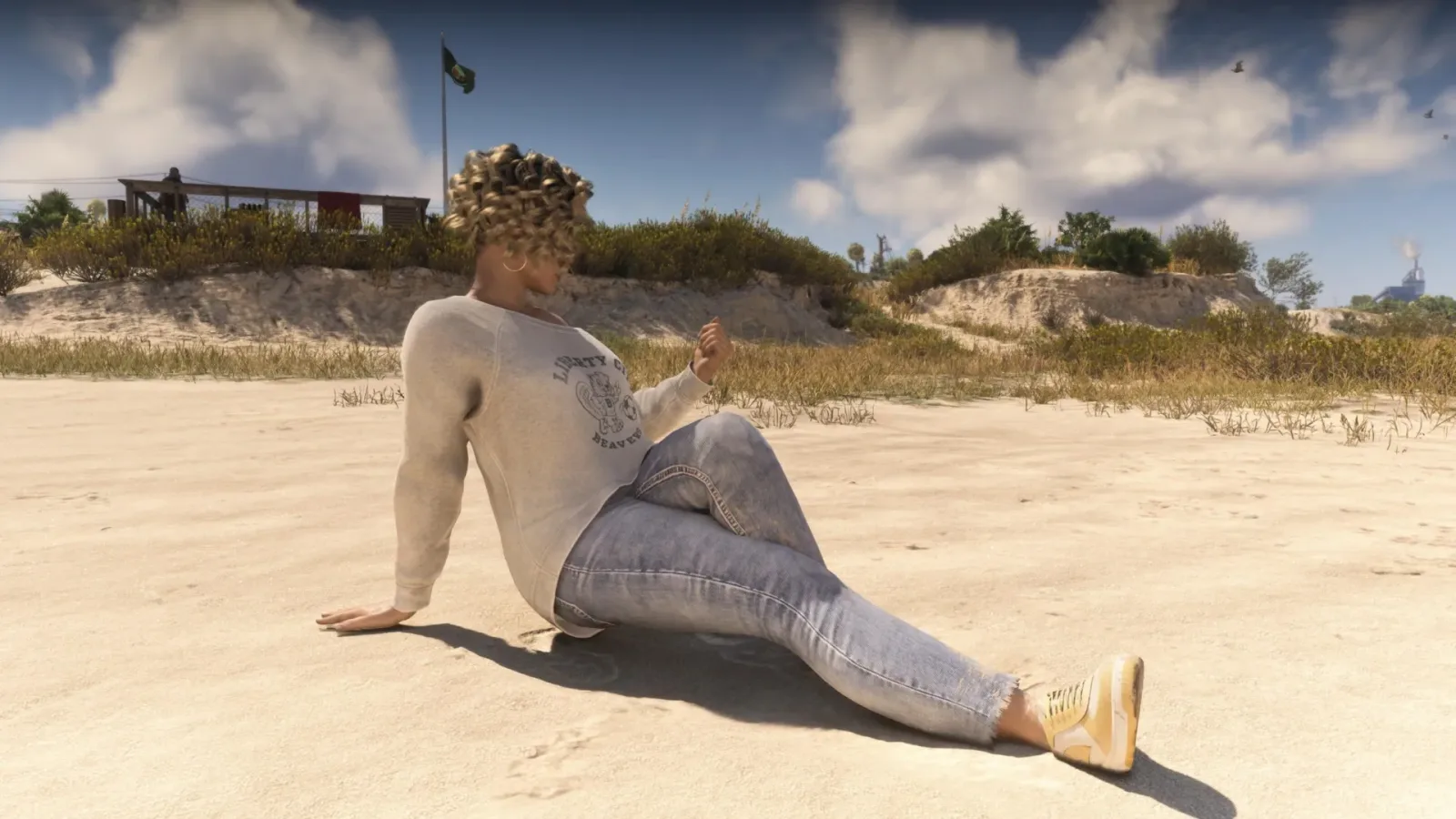
Grand Theft Auto 6 is built around high-speed escapes, robberies, pursuits, and the usual chaos expected from Rockstar's open-world crime series. Yet some of its most appealing additions are far quieter than a major mission set piece or a dramatic police chase. Players can physically push stranded vehicles, attempt to turn an overturned car back onto its wheels, shove a boat or jet ski from the sand into the water, and let protagonists Jason and Lucia sit down or lean against nearby scenery.
These actions are easy to overlook because they do not appear to be emphasized through the game's usual flow of missions and tutorials. In a world as dense as Vice City, where there are distractions in every direction, a small contextual prompt can be missed entirely. That makes these mechanics the kind of discoveries players may stumble across after dozens of hours, often in exactly the moment when they become unexpectedly useful.
Neither feature is likely to transform the central loop of stealing cars and outrunning law enforcement. But together, they add a sense of physicality and calm to a game that can otherwise move at a relentless pace. One is a practical recovery tool when a vehicle goes wrong. The other is an atmospheric option for stopping long enough to appreciate the world Rockstar has built.
How to push and flip vehicles in GTA 6
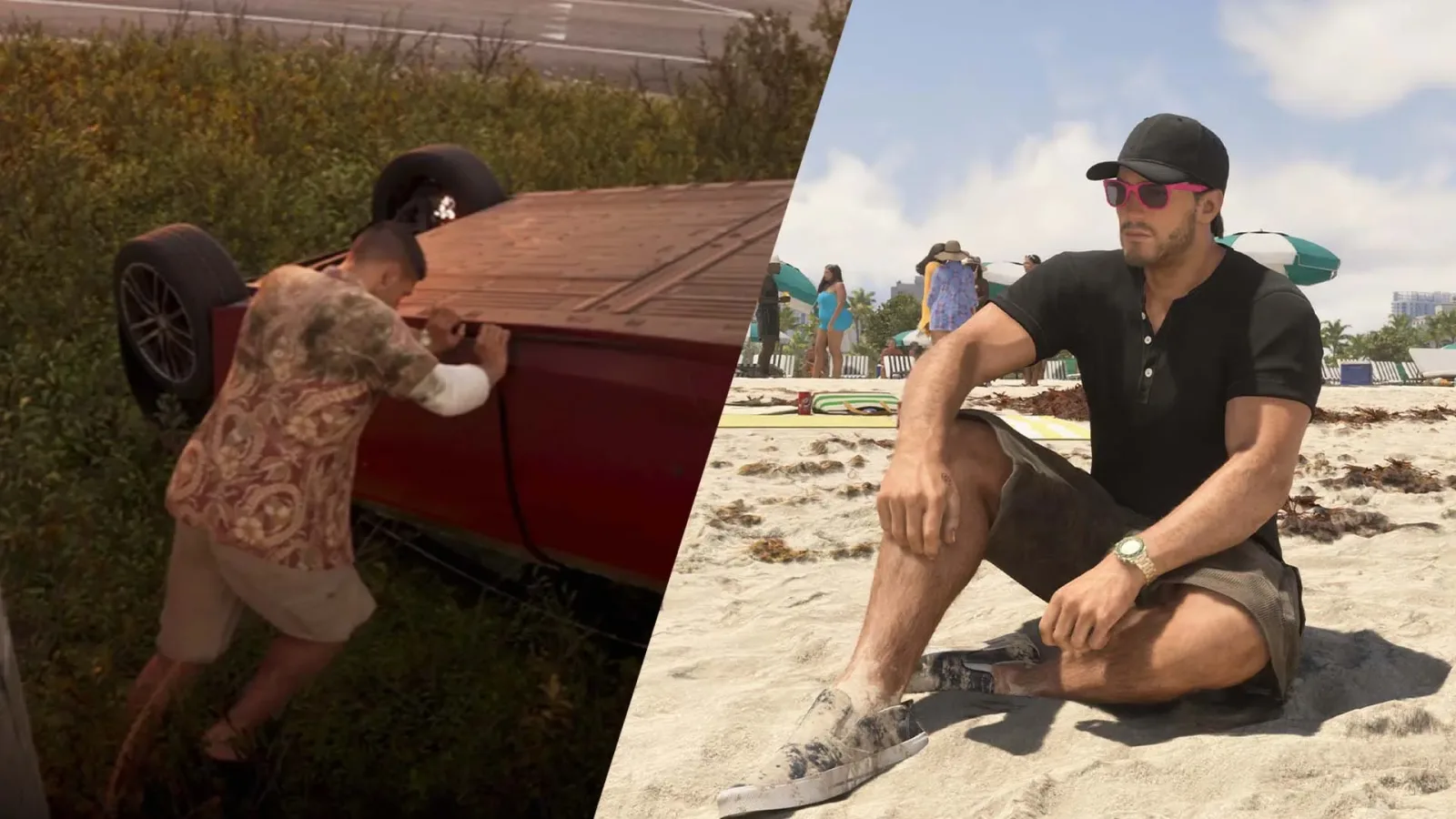
When Jason or Lucia approaches the side of a vehicle that has landed upside down, players can click the left stick to put the character into a pushing stance. From there, holding Square on PlayStation or X on Xbox begins an attempt to force the car back onto its wheels.
For useful background on this topic, read GTA 6 Builds Full Arcade-Style Games With Its Own Internal Development Team.
The important detail is that this is not the more abstract vehicle-recovery approach used in some earlier open-world games. The characters have to be positioned beside the vehicle and visibly brace themselves against it. The result depends on the circumstances rather than automatically fixing every accident. A car that is too heavy may not move, and the effort can fail if the character runs out of stamina. Steep slopes can also make a successful flip difficult or impossible.
That limitation is what gives the mechanic some character. In Grand Theft Auto V, players could rock an overturned vehicle with stick inputs until it righted itself. It was convenient, but it could feel detached from the physical situation. GTA 6's push system asks players to get out, walk over, and personally try to solve the problem. A bad crash is no longer always an immediate end for the vehicle, but rescuing it is not guaranteed either.
In the right scenario, that could matter. An overturned stolen car is especially inconvenient during an escape, and police attention can prevent easy access to the Scooter Bros app. Since the app can repair or respawn a vehicle for a fee under normal circumstances, many players may never need to push a car manually. But a player stuck in a fast-moving pursuit, far from a convenient replacement, may find that a successful flip creates a valuable second chance.
For another perspective on this story, read GTA 6's Overlooked Car-Flipping and Rest Controls Can Save a Getaway--or Slow It Down.
The same interaction is not limited to upside-down cars. It can also be used to push a vehicle along the road after it has run out of gas. This will not be the quickest solution, and it is unlikely to be anyone's preferred way to travel across Vice City, but it reinforces the idea that vehicles are objects in the world rather than strictly disposable transport menus. If a car is only slightly out of place, Jason or Lucia can try to move it instead of immediately abandoning it.
Boats and jet skis can be pushed into the water
The pushing system also applies to smaller watercraft. A boat resting on a trailer, or a jet ski sitting on the sand, can be shoved toward the shoreline and into the water. It is a modest interaction, but one that makes coastal areas feel more tactile. Rather than requiring every usable boat to begin perfectly positioned offshore, GTA 6 can let players create their own launch moment.
For players who enjoy experimenting with the environment, this is likely to be one of those small systems that encourages further testing. If a boat looks as though it ought to be movable, there is now a reason to walk up to it and try. The action also fits the setting particularly well: beaches, marinas, trailers, and shallow shorelines are natural parts of Vice City's broader landscape. A game built around a coastal city benefits from allowing players to interact with watercraft before they are already floating.
Not every use of this feature needs to be strategic. Sometimes the reward is simply seeing the game acknowledge a common-sense action. A small boat on land is not merely background scenery if a player can put their shoulder into it and send it toward the waves. These kinds of details are often where a giant open world starts to feel less like a collection of mission spaces and more like a place with objects that obey understandable rules.
How to sit, relax, and lean on walls
The other lesser-explained control is much simpler: while on foot, hold Circle on PlayStation or B on Xbox to have Jason or Lucia rest. What that looks like changes based on the location. On grass, sand, and other suitable ground, a character may sit down and relax. In other spots, they may shift into a casual resting stance. Near a wall, the same input can lead to a lean against it.
There is no need for a special bench, a marked interaction point, or an elaborate animation prompt. The point is the flexibility. Players can sit on a beach and watch pedestrians pass by, pause beside a campfire in the woods, or lean on a wall in a busy part of the city. The action is a welcome contrast to the genre's usual assumption that a playable character must always be running, shooting, driving, or preparing to do one of those things.
It may also be discovered by accident. Players who expect a traditional crouch button to lead to a prone position can instead find Jason or Lucia taking a seat. That slight surprise speaks to why the feature has generated interest: it is both mundane and unusual for a game of this scale. Sitting does not unlock a reward or advance an objective, but it gives players control over their character's presence in the world.
A small feature with a big role in atmosphere
Open-world games often advertise their largest systems: map size, mission count, weapon selection, vehicle variety, or the number of activities available. GTA 6's push and rest controls are much smaller systems, yet they can leave a strong impression because they change how players relate to downtime. A beach becomes a place to stop rather than just a route to a mission marker. A wrecked car becomes a problem that might be solved through effort rather than a guaranteed explosion or instant reset.
That is especially notable for a series historically associated with escalation. Grand Theft Auto has always offered opportunities to wander and create unscripted moments, but its protagonists are often pushed forward by urgent criminal plots. Letting Jason and Lucia sit quietly does not change that identity. Instead, it creates breathing room between the shooting, driving, and robbing. A player can choose to observe Vice City instead of constantly consuming it at top speed.
The vehicle interaction follows the same philosophy from the opposite direction. It creates friction rather than pure convenience. Flipping a car requires positioning, stamina, and a vehicle light enough to move. It may fail on an incline. Those constraints mean players cannot treat the action as a magical undo button, but they can still try to salvage a bad situation when it makes sense.
Why players may miss these controls
Both actions appear to rely heavily on context. The car-pushing ability can reveal itself through a small prompt when a player stands close enough to an overturned vehicle. That is useful, but it is also easy to miss amid combat, traffic, police alerts, and the many other interface elements that can demand attention. The resting command may be even easier to overlook if players assume its button has only one familiar movement-related purpose.
For anyone exploring GTA 6 now, the takeaway is straightforward. When a vehicle is overturned, do not immediately assume it is lost: stand beside it, click the left stick, and hold Square or X to see whether Jason or Lucia can flip it. The same push action can help shift an empty car, boat, or jet ski. When the action slows down, hold Circle or B on foot and see how the surrounding terrain changes the resting animation.
These are not headline-grabbing superpowers, and that is exactly why they work. They are modest tools that reward curiosity, whether that curiosity leads to a successful getaway or a few quiet minutes sitting beside the water. In a vast and busy Vice City, that kind of player-driven pause can be as memorable as the next big score.
Community
Discussion
Start the conversation.
No comments have been posted yet.