

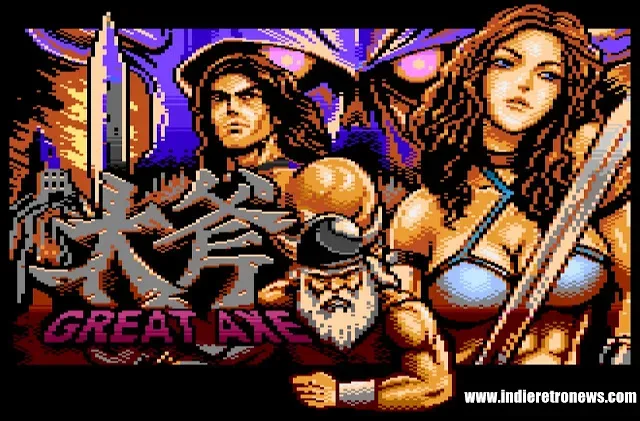
Great Axe, a new non-commercial conversion of Sega's 1989 arcade sword-and-sorcery hit Golden Axe, is now available for the Atari XL/XE family. Created by Vega and the A-8bit Redefined Team, the project is an unusually ambitious production for Atari's 8-bit hardware: it recreates the arcade game's five-stage journey, supports one or two players, and is designed to run across the full XL/XE range, including the XEGS.
The release is free and has been presented as a gift to the Atari community rather than a commercial product. More importantly for retro enthusiasts interested in how these projects are made, the team says Great Axe was built from the ground up. Its developers did not reuse code from versions on other systems, and the project was made without AI assistance. That makes it both a playable tribute to a celebrated arcade brawler and a technical showcase for what a carefully tailored Atari 8-bit engine can achieve.
A full five-stage quest on Atari 8-bit hardware
Golden Axe remains one of the defining fantasy action games of its era. Designed by Makoto Uchida, the original arcade release casts players as warriors seeking revenge in a world of monsters, magic, melee combat, and oversized enemies. Its appeal came from more than simply swinging a weapon: the game combined memorable fantasy imagery, cooperative play, rideable beasts, screen-clearing magic, and a pace that made each encounter feel theatrical.
Bringing that style of game to an Atari XL/XE is a significant proposition. The machines are beloved for their distinctive graphics and sound capabilities, but an arcade-style scrolling action game has to balance many demands at once. Large player characters and enemies need to remain readable, movement has to feel immediate, backgrounds must advance smoothly, and the screen still needs enough activity to preserve the feeling of the source game.
For useful background on this topic, read GTA 6 Builds Full Arcade-Style Games With Its Own Internal Development Team.
Great Axe aims to meet that challenge by allowing players to battle through all five of the original arcade stages, continuing through to the final demo sequence. That scope matters. Fan conversions can sometimes focus on a small opening section or a technical demonstration, but this release is intended as a complete journey through the core progression associated with the 1989 arcade game.
The title is not described as an official Sega release. Instead, it is a fan-made conversion and a non-commercial one. Its new name also establishes its own identity while making its inspiration immediately clear to anyone familiar with the classic fantasy beat 'em up.
A bespoke engine built around the Atari XL/XE
At the center of the project is a newly created custom engine. The A-8bit Redefined Team built it specifically to support the game's action on Atari hardware rather than adapting existing code from another platform. The engine can display up to five large software sprites at once while maintaining smooth fine scrolling, a combination that speaks directly to the demands of an arcade-like brawler.
For players, software sprite terminology may sound highly technical, but the outcome is easier to understand. Large characters are essential to the visual identity of a game in the Golden Axe mould. Heroes, hostile soldiers, creatures, and bosses need presence on screen. Fine scrolling is equally important because the adventure needs to travel through lengthy side-view environments without the motion becoming harsh or disjointed.
Those features also reveal why a from-scratch approach can be valuable. Rather than forcing another system's design into the Atari XL/XE's strengths and restrictions, a dedicated engine can make choices around memory, drawing, animation, input, and scrolling specifically for this hardware. Retro development often involves that kind of close negotiation with a machine. The result is not simply a smaller version of an arcade game; it is a version designed to make the intended platform work as effectively as possible.
The project's credits identify Vega as the main programmer. Graphics were created by Gaspar and Vega, while Miker handled music and sound effects. That division highlights the range of disciplines involved in a conversion like this. Code has to drive the game's action and technical systems, art must convey the original's bold fantasy atmosphere within the Atari's constraints, and audio needs to support every swing, impact, magical moment, and stage without overwhelming the experience.
PAL, NTSC, stock machines, and expanded setups
Compatibility is another notable part of the release. Great Axe supports both PAL and NTSC formats, allowing it to run on Atari XL/XE hardware across regions. It is intended for the complete Atari XL/XE line, from stock systems to upgraded configurations, and the Atari XEGS is included as well.
The base requirement is an Atari XL/XE or XEGS with 64 KB of memory. Players need one or two joysticks depending on whether they want solo or cooperative play, and the game supports Joy2B+. The release comes in ATARIMAX CAR cartridge-image format. For use on original hardware, it requires a compatible cartridge solution such as SUB-CART or AVG CART. For those who prefer a software setup, the Altirra emulator has been identified as working especially well.
That list is useful because the Atari 8-bit scene is home to many different ways of playing. Some fans use original computers with modern loading hardware, others maintain XEGS consoles, and many explore the library through emulation before moving to physical machines. Supporting standard 64 KB hardware means the project is not reserved solely for heavily modified enthusiast systems, while compatibility with upgraded setups offers flexibility for users with broader collections.
- Supported machines: Atari XL/XE computers and Atari XEGS
- Memory requirement: 64 KB
- Video formats: PAL and NTSC
- Players: One or two, with joysticks required
- Input support: Joy2B+
- Real-hardware loading: Compatible cartridge hardware such as SUB-CART or AVG CART is needed for the ATARIMAX CAR image
- Emulation: Altirra is confirmed to work well
Why projects like Great Axe matter
New releases for decades-old systems are often exciting simply because they exist. Great Axe goes a step further because it takes on a game that is closely associated with busy arcade visuals and kinetic co-op action. The conversion's stated feature set addresses the qualities people would expect from such a project: a complete stage run, substantial characters, scrolling environments, two-player potential, and compatibility that does not leave the ordinary 64 KB Atari behind.
It also demonstrates the continuing energy of the Atari 8-bit development community. The XL/XE line was originally released in an era when games were commonly designed around the exact behavior of a fixed hardware target. Modern homebrew teams still embrace that approach, but with decades of accumulated knowledge, new development tools, and an audience eager to see familiar ideas reinterpreted on unusual platforms.
There is a special appeal to conversions of arcade games in this space. Arcade originals were frequently adapted to home systems in the 1980s and 1990s, but each version had to make compromises based on memory, processor speed, graphics modes, sound, storage, and controller options. A contemporary team revisiting that process is not merely repeating history. It is revisiting an old technical challenge with a modern homebrew mindset, often seeking outcomes that were impractical, unavailable, or simply never attempted during the original commercial lifespan of the machine.
For Golden Axe fans, the attraction is obvious: another way to experience its famous barbarian-fantasy formula. For Atari owners, the more compelling point may be seeing a new action engine designed around their system and applied to an ambitious, recognizable game structure. The combination of large software sprites and fine scrolling suggests that the team has targeted exactly the kind of on-screen movement that can make an 8-bit action game feel alive.
A free fan production with a clear technical ambition
The release arrives with a straightforward message: this is a free, community-minded project that seeks to bring an arcade favorite's complete adventure to Atari XL/XE and XEGS hardware. It does so with original code, custom technology, credited artists and audio work, and support for both major video standards.
Players with suitable hardware can use the ATARIMAX CAR image through compatible cartridge devices, while emulator users can turn to Altirra. Either route provides a chance to explore an Atari 8-bit interpretation of a fantasy action landmark, one built around the limitations and possibilities of the platform rather than borrowed program code.
Great Axe is therefore more than a nostalgia novelty. It is a substantial homebrew exercise in conversion design: five stages of classic arcade-inspired combat, a dedicated technical foundation, and a production tailored for a machine that continues to receive new reasons to be switched on.
Community
Discussion
Start the conversation.
No comments have been posted yet.