

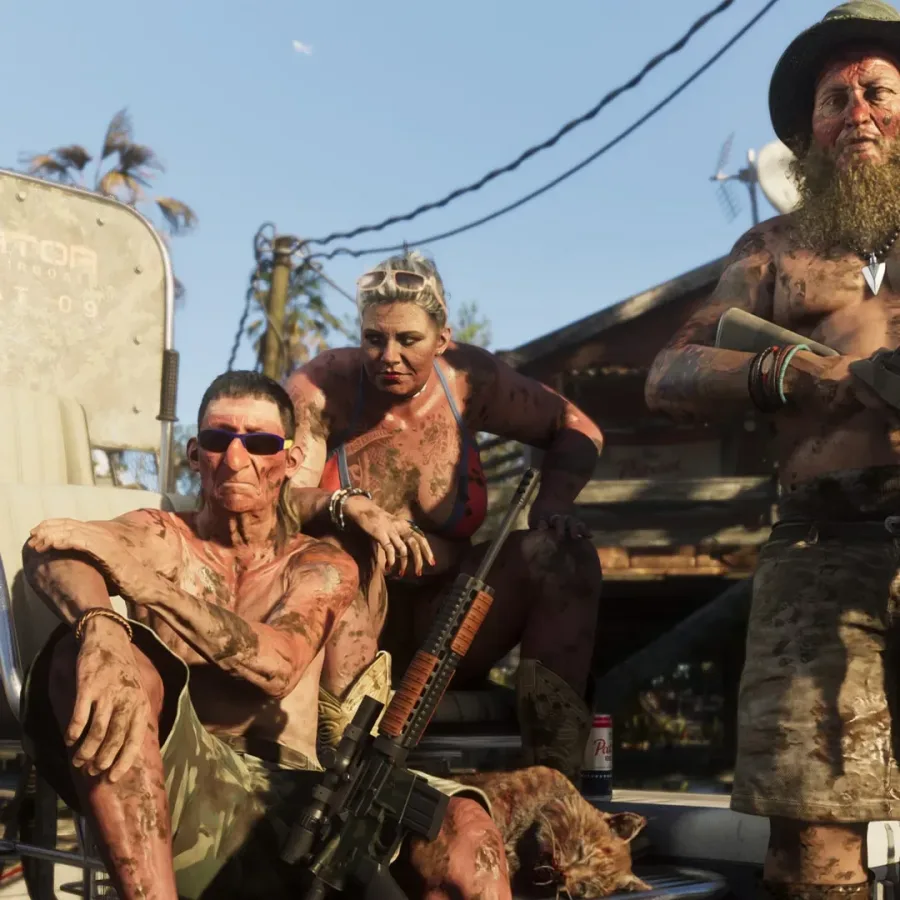
Grand Theft Auto 6 is aiming to make its fictional state of Leonida feel alive not simply through a large map, detailed landmarks, or busy roads, but through the people occupying every corner of it. Rockstar has described an approach where pedestrians, criminals, police officers, beachgoers, and incidental characters are treated as individuals with distinct looks, moods, behavior, and an implied history that exists whether players stop to notice it or speed past at full tilt.
That philosophy reaches well beyond the usual open-world promise of a crowded city. Leonida's NPCs are designed to react differently to confrontation, participate in unfolding events, and visually stand apart from one another. Behind those encounters is a considerable amount of planning, from detailed criminal supply chains to the technical work necessary for characters of dramatically different body types to interact naturally.
For a series long associated with satire, chaos, and elaborate city simulation, the focus is notable: Rockstar wants the residents of Leonida to feel like characters in their own right, rather than anonymous assets placed in the world to fill empty space.
Backstories create the foundation for a believable world
Steven Messinger, Rockstar's senior design director for the open world, said the team's process began with constructing extensive background detail for elements throughout the setting. Crucially, not all of that information is intended to be delivered directly to players. The value is in giving the developers a consistent logic to follow as they build locations, encounters, dialogue, and behavior.
For useful background on this topic, read GTA 6 safe codes: Every Fixed Combination and How to Find More.
"A big part of it was establishing deep backstories for almost everything, even if they were never meant to be fully explained to the player, and then really sticking to those backstories," Messinger said.
He pointed to gang compounds as an example. Rockstar mapped a complex drug network covering where narcotics originate, who transports them, how they are distributed between compounds, what happens at the various stops along the way, and how they eventually make their way to street-level customers.
Most players will not receive a complete explanation of that system. They may only overhear a conversation, witness a suspicious exchange, encounter one of the groups involved, or recognize a small environmental clue. But the underlying structure gives the game's disparate details a shared context. In Messinger's words, it helps Leonida suggest a larger machine that continues operating even when Jason and Lucia are elsewhere.
This is an important distinction for open-world design. A game can populate a street with activity without making that activity feel connected. By building histories and relationships behind the scenes, Rockstar is attempting to ensure that the visible moments in GTA 6 appear to be pieces of a functioning place rather than isolated animations triggered for the player's benefit.
Every pedestrian is meant to have a different response
The results are intended to be apparent in small-scale interactions. NPCs have varied anatomy, hairstyles, clothing, skin tones, and general styles, but the differences are not limited to visual customization. Their personalities and temperaments also affect how they handle trouble.
A hostile interaction may not play out the same way twice. One character might choose to fight back, while another flees. An NPC could begin a confrontation with a slap, flick a cigarette at the player, or dump a drink over them. Nearby people may run away, cheer the confrontation on, or decide to join it. Some opponents may quit after a single well-placed punch; others may persist until they are knocked unconscious.
That range matters because GTA's streets have historically been places where a player's impulsive actions can quickly escalate into spectacle. GTA 6 appears to be pushing that unpredictability further. Rather than relying on a single generic response for a type of pedestrian, the game's population is built to introduce different social reactions, making even minor disruptions feel less scripted.
John Macpherson, senior design director of world and population, said the team sought to capture Florida's intense and often chaotic energy through research trips and direct observation. The work included spending time in reference locations, speaking with locals, and gathering visual material and notes. Rockstar's research also involved activities such as helicopter trips across the Florida Keys and police ride-alongs.
"Everywhere you look, little stories constantly unfold," Macpherson said. "It could be as simple as what someone's wearing, how fit they are, how they walk and talk, who they're with, what tunes they're blasting as they cruise down the street."
Those observations inform the everyday texture of Leonida. On Vice Beach, players can encounter tourists sunbathing, locals playing volleyball, people walking pets, and couples whose appearance and behavior communicate a story before they ever speak. It is the kind of environmental characterization that encourages players to observe the world, not merely use it as a route between missions.
More than 100 interiors expand Leonida's storytelling
Rockstar's environmental storytelling extends indoors as well. GTA 6 features more than 100 explorable interiors, with individual homes intended to reveal something about the people who live in them. A room's possessions, layout, condition, and surrounding details can communicate personality, financial circumstances, relationships, or daily habits without requiring a lengthy cutscene.
Street conversations serve a similar purpose. They give players glimpses into the thoughts and problems of people around them while preserving the exaggerated humor and volatility that fit the series' identity. The goal is authenticity without stripping away the larger-than-life tone expected from Grand Theft Auto.
There is even a mission around the middle portion of the story in which protagonists Jason and Lucia sit by a hotel pool and invent backstories for nearby guests. It is a fitting expression of the design goal: Leonida's residents are varied enough to invite speculation. Players may find themselves doing the same thing while walking through a neighborhood or waiting at a beachside venue, reading a character's life through posture, clothing, companions, and conversation.
New character technology supports the visual ambition
Making a population this varied believable requires more than writing and world design. Valmor Garcia, senior technical art director on GTA 6, said Rockstar moved beyond the more uniform NPC model standards seen in Grand Theft Auto 5 and Red Dead Redemption 2.
"We evolved from monolithic NPCs built to visual standards that were lower than the main cast in GTA 5 and Red Dead Redemption 2, to fully fleshed-out characters with singular awareness and visual identities," Garcia said.
According to Garcia, NPCs are driven by dynamic moods, personality traits, unique anatomy, facial features, and dialogue while maintaining a visual quality comparable to Jason and Lucia. Rockstar created technology to simulate hair, clothing, and muscles moving beneath skin, then applied that work across the character population rather than reserving it exclusively for the protagonists and key story figures.
The practical effect is meant to avoid the familiar open-world disconnect in which a highly detailed hero meets a pedestrian who looks flat, stiff, or visually unfinished at close range. If every person can be approached, challenged, observed, or pulled into an event, visual consistency becomes a core part of preserving immersion.
Body diversity made animation considerably harder
The decision to use broad variation in character height, weight, and body shape also created major animation challenges. Combat and vehicle interactions are easier to construct when most models occupy a similar physical range. GTA 6 does not have that convenience, and its protagonists can themselves change size through diet and exercise.
Vice president of animation Mark Tennant said the team needed a durable method for sharing animations between characters while still resolving physical contact points. That applies to activities including entering or exiting vehicles and grappling during hand-to-hand fights.
The solution required animators to adopt techniques beyond a conventional workflow, while a dedicated implementation group worked closely with art and rigging teams. It was, Tennant said, a broad team effort. The technical investment reflects how GTA 6's NPC design is not a cosmetic layer. The body variation affects the fundamentals of how the game must animate physical interactions.
Reactive events must account for player interference
Leonida is also packed with scripted encounters that can happen around the player. Some resemble the unusual side activities associated with previous Rockstar games, while others allow players to watch conflicts between NPCs with competing goals. The complication is that GTA 6 cannot assume the player will remain an observer.
Stephen Donkin, vice president of design, described the questions the team has to consider when the center of action shifts away from the player. If an officer is conducting a stop-and-search on a criminal and the player commits a crime nearby, for instance, should the police redirect their attention? Should they judge the severity of the new offense? If they pursue the player, does the detained suspect flee, and what happens if the player then follows that person?
Every new mechanic adds another possible input to these scenarios. That creates a huge web of conditions, but it is essential to the sense that Leonida is responsive rather than staged. One reported example has police abandon a stop-and-search after the player takes out an in-game phone to record them. Another small interaction sees Jason comment while Lucia is eating food during an affectionate moment. These are minor details individually, but together they suggest a world designed to acknowledge behavior that games often ignore.
GTA 6's most ambitious feature may therefore be difficult to summarize in a single trailer moment or technical buzzword. It is the accumulation of thousands of tiny decisions: a passerby's temperament, a house's implied history, an officer's shifting priorities, a gang's hidden supply line, or a physical interaction that works across radically different character builds.
Leonida is not just being built as a place for Jason and Lucia to cause mayhem. Rockstar's stated aim is to make it feel like a place where life was already happening before they arrived--and will continue after they leave.
Community
Discussion
Start the conversation.
No comments have been posted yet.