

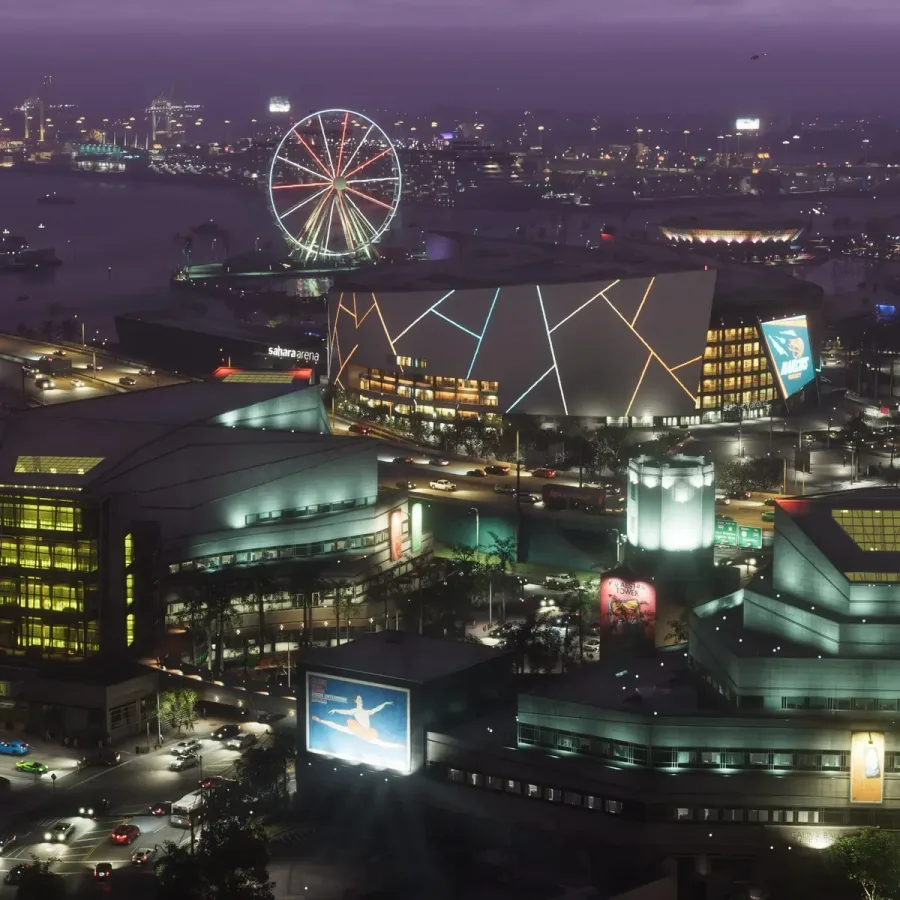
Grand Theft Auto 6 has brought its fictional take on Florida a little closer to reality with a striking promotional installation at Miami's Kaseya Center. The lighting display atop the arena now carries the message "Welcome to Vice City" alongside the Roman numerals VI, turning one of the city's most recognizable waterfront buildings into a giant piece of GTA 6 marketing.
The campaign is especially fitting because the Kaseya Center has a clear counterpart inside Rockstar Games' upcoming open-world sequel. GTA 6 does not use the venue's real name, but recent screenshots show a comparable building called the Sahara Arena. Its placement closely mirrors the Miami location, including the nearby Ferris wheel and its position in the broader Biscayne Bay area.
That connection gives the installation more meaning than a conventional logo projection. It is designed to underline one of the central appeals of GTA 6: Rockstar's reimagined state of Leonida is fictional, but it is built from recognizable visual cues, architecture, neighborhoods, coastlines, and cultural touchstones associated with Florida. For Miami residents, the campaign creates a direct comparison between the real skyline and the exaggerated world players will explore in Vice City.
A Vice City landmark appears in Miami
The Kaseya Center is a multi-purpose arena on Biscayne Bay and the home venue of the NBA's Miami Heat. It is already a highly visible building along Miami's downtown waterfront, making it a natural centerpiece for a major entertainment campaign. With "Welcome to Vice City" displayed at its top, the location becomes a particularly effective bridge between the real city and Rockstar's fictionalized version.
For useful background on this topic, read LEGO Astro Bot Is Now Available Separately Through PlayStation Direct.
Fans had noticed work apparently being set up at the building in late September, ahead of the fully illuminated signage. Once active, the installation made the connection unmistakable: the message uses the name of GTA's famous fictional city, while the VI branding highlights the sixth numbered entry in the long-running series.
The Sahara Arena shown in GTA 6 imagery is not presented as a one-to-one recreation of the Kaseya Center. Rockstar's approach has traditionally involved blending real inspirations with altered names, layouts, and details. Still, the resemblance is clear enough that the real-world takeover works as a deliberate wink at the game's setting. The surrounding visual details, especially the waterfront positioning and Ferris wheel, help make the parallel easy to spot.
For a series known for transforming real American places into satirical playgrounds, that reversal is notable. Normally, players identify a familiar landmark after seeing it filtered through GTA's style. In this case, Miami's actual arena is being temporarily framed through the language of the game world.
A reported million-dollar marketing move
The arena display is reported to have cost Rockstar close to $1 million. That figure, if accurate, reflects the extraordinary scale expected from the promotional push surrounding GTA 6. The game is one of the most anticipated releases in modern entertainment, and a high-profile physical campaign in Miami gives Rockstar a location-specific way to build excitement that standard trailers and online advertising cannot replicate.
Negotiations over a wider Miami marketing takeover had reportedly been underway for months between Rockstar and Miami-Dade County officials. Early concepts considered several much larger possibilities, including a transformation of the airport, drone shows, and beach-focused promotional activity. The eventual Kaseya Center installation may be narrower than some of those initial ideas, but it still delivers a very public statement in a location inseparable from the cultural image of Miami.
The negotiations were not without opposition. Miami-Dade County commissioners voted 4-3 to approve the discussions, indicating that the potential campaign generated a closely divided response among local officials. Miami Beach Commissioner David Suarez was among those pushing back, showing footage from GTA 6's extended look and arguing that the game did not represent local values.
That criticism reflects a tension that has followed Grand Theft Auto throughout its history. The series is famous for satire, criminal stories, adult themes, and an intentionally heightened portrayal of American culture. Its fictional locations borrow heavily from real communities, but Rockstar's version of those places is built for parody and drama rather than civic representation. A real-world campaign in Miami naturally makes that relationship more visible.
Not every official viewed the prospect negatively. Commissioner Monica Matteo-Salinas strongly supported the effort, describing it as a positive moment for gamers and self-identified gaming enthusiasts. Her stance points to the other side of the debate: GTA 6 is not only a controversial entertainment product, but also a massive cultural and commercial event with a direct connection to the region that inspired its setting.
Why Miami is the ideal stage for GTA 6
Vice City has always been one of Grand Theft Auto's most memorable locations. The city first appeared in the original Grand Theft Auto and later became the focus of 2002's Grand Theft Auto: Vice City, a game remembered for its neon-soaked 1980s mood and Miami-inspired identity. GTA 6 returns to that world in a new era, expanding the concept into the wider state of Leonida.
The new game's setting is therefore more ambitious than a simple revisiting of an old map. GTA 6 uses Vice City as part of a larger fictional Florida, allowing Rockstar to draw on the area's beaches, urban density, highways, nightlife, tourism, wildlife, social-media culture, and distinctive contradictions. Marketing the game in Miami itself emphasizes how much the setting is expected to depend on that local inspiration.
The Kaseya Center stunt also demonstrates the appeal of landmark recognition in open-world games. Players often enjoy finding places that feel connected to their real-world counterparts, even when Rockstar has changed their names or reshaped their purpose. The Sahara Arena is likely to be one more location fans compare against Miami after GTA 6 launches, studying viewpoints, adjacent attractions, skyline features, and the changes made for gameplay.
That kind of comparison has become part of the experience around Rockstar's worlds. The studio's environments encourage exploration, and the attention given to GTA 6 screenshots has already shown how eager fans are to inspect minute details. A real building promoting its in-game analogue turns that fascination into an unusually literal piece of advertising.
A campaign built around scale and anticipation
Rockstar has kept GTA 6's marketing selective, which makes a physical display of this size stand out. Each official image, trailer, and new detail has received enormous scrutiny from fans, particularly as they search for signs of the game's world design, activities, characters, and technology. The Kaseya Center installation adds another layer to that campaign by giving people a shareable real-world spectacle rather than simply another digital asset.
It also places GTA 6 alongside the largest cross-media launches, where games are promoted through city takeovers, landmark activations, and public installations. Yet this example is more specific than a generic billboard because it uses a location with a direct in-game counterpart. The arena is not merely hosting an ad; it is helping sell the illusion that Vice City is hovering just beside Miami.
There is a practical dimension as well. Miami is a global destination with heavy tourism, busy waterfront areas, professional sports traffic, and a skyline that is instantly recognizable in photographs and videos. A message placed on a building such as the Kaseya Center can quickly reach people far beyond the immediate area, especially when fans circulate footage and images online.
For Rockstar, the timing makes the installation a high-visibility reminder that GTA 6 is moving toward release. The game is scheduled to arrive on November 19 for PlayStation 5 and Xbox Series consoles. No additional platform availability is established by this campaign, and the central focus remains firmly on the console launch.
The line between Leonida and Florida gets thinner
The Kaseya Center display does not mean Miami itself has become part of GTA 6, nor does it erase the divide between the actual city and Rockstar's satirical fiction. Instead, it makes that divide more playful. The message invites onlookers to imagine the familiar waterfront as the threshold to Vice City, while the Sahara Arena screenshots reveal how Rockstar has adapted the area for its own universe.
It is also an apt summary of GTA 6's broader promise. The game appears set to offer a highly detailed fictional state that feels grounded in recognizable places while remaining free to exaggerate, remix, and comment on them. Miami's real arena becoming a beacon for Vice City is a concise visual expression of that idea.
With the launch date approaching, fans will likely continue examining every real-life Florida reference that surfaces in official material. The Sahara Arena and Kaseya Center may be one of the clearest comparisons yet, but they are unlikely to be the last. For now, the glowing words over Biscayne Bay offer a rare moment when Rockstar's imagined city visibly spills into the landscape that helped inspire it.
Community
Discussion
Start the conversation.
No comments have been posted yet.