


Halo's future may now be in Activision's hands, but a newly revealed set of concept-art details offers a striking glimpse at the direction Halo Studios had once envisioned for Halo 7. The unrealized project would have returned players to Zeta Halo, expanding the ringworld conflict into a larger campaign involving snowfields, jungles, wetlands, ruins, Banished installations, Prometheans, the Flood, and a particularly ominous Forerunner prison.
The artwork and accompanying descriptions emerged in what is believed to be the final edition of Canon Fodder, the long-running Halo lore newsletter written by franchise writer Alex Wakeford. Rather than laying out a complete plot or confirming a playable build, the material presents fragments of an ambitious setting: named locations, potential combat spaces, narrative hooks, and visual moods that suggest how broad the battle for Zeta Halo could have become.
Its most intriguing thread is a place called the Containment Facility, an underground location tied to advanced Forerunner engineering and an imprisoned entity described only as an "ancient, terrible creature." It is the sort of unanswered mystery that Halo has long used effectively, mixing military science fiction with the unsettling implications of civilizations and conflicts too old for humanity to fully understand.
A Lost Direction for the Seventh Mainline Halo
Halo Studios had apparently been planning its version of a seventh mainline entry before responsibility for the next Halo game shifted to Activision. The studio is now positioned as a support team for existing releases, leaving these ideas as a look at a game that will not arrive in the form originally imagined.
For useful background on this topic, read Goalbound codes for October 2026: Active Spins, Coins, and Yen Rewards.
That makes the concept material especially interesting. It does not simply depict another stretch of familiar Halo terrain. It points to a campaign built around the contested surface and interior of Zeta Halo, with numerous forces operating across dramatically different environments. The ring had already served as the central setting for Halo Infinite, but the new descriptions imply a version of Zeta Halo with more distinct regions and deeper connections to its layered history.
The planned conflict was said to encompass much of the ring's surface. Among the teased environments are broad snow-and-ice fields, dense jungle areas, wetlands dominated by enormous trees containing embedded Banished metal, and sand-worn ruins associated with the Tudejsa. The variety matters because Halo ringworlds have always been more than simple landscapes; they are purpose-built weapons, archives, prisons, laboratories, and ecosystems shaped by forces with radically different goals.
In visual terms, the proposed locations seem to have aimed for a mixture of familiar Halo iconography and more unusual terrain. There are clear opportunities for the wide-open encounters that defined parts of Halo Infinite, but also for enclosed Forerunner spaces, vertical jungle combat, frozen bases, and ancient ruins buried under centuries of history. Such a range could have supported a campaign that felt more like a planetary war despite remaining on a single artificial ring.
The Containment Facility and Its Timelock
The strongest narrative hook in the revealed material is the Containment Facility. The location is overseen by the submonitor Adjutant Repose, who is forced to initiate a lockdown when Reclaimers arrive and the Flood begin to spread through the complex. Flood outbreaks are never casual problems in Halo fiction. Their arrival immediately raises the stakes, because the parasitic species represents an existential danger to every faction on the ring and beyond it.
Yet the Flood may not have been the facility's only threat. The prison reportedly uses timelock technology, a concept based on the Forerunners' understanding of advanced higher-dimensional engineering. The technology also draws on knowledge gained from study of an Ancestor-San'Shyuum alliance device called the "time bolt." In practical story terms, that suggests a containment system capable of doing more than locking a door or erecting an energy barrier. It may have manipulated time, dimensional boundaries, or both in order to hold its prisoner.
That prisoner is characterized as an ancient and terrible creature which once held dominion over the ring when Zeta Halo was designated Gyre 11. The description provides no name, species, motive, or visual design, and that uncertainty is what makes it compelling. Halo's lore contains a vast catalogue of ancient powers, but the wording leaves room for something outside the most obvious possibilities.
Was the creature a ruler of Gyre 11 before the Forerunners repurposed or reclaimed the installation? Was it confined because it posed a military threat, because it possessed knowledge that could not be released, or because its existence was linked to some older disaster? The concept material does not answer those questions. It does establish, however, that the game could have placed Master Chief and allied forces close to a danger important enough to require exotic Forerunner time-based imprisonment.
There is also a potentially chaotic structure to the premise. A lockdown triggered by the arrival of Reclaimers, combined with Flood activity and a prisoner secured by timelock technology, is the kind of layered emergency that can turn an exploratory mission into a fight for survival. It could have given Halo 7 a more focused horror-inflected chapter beneath the ring's surface before returning players to larger battlefield zones.
Fireteam Crimson, Prometheans, and a Wider War
Other fragments hint that the campaign would not have centered on a single discovery. Fireteam Crimson was apparently involved in events surrounding a slipcase artifact, which the team had to surrender after being redirected. The significance of that object remains unclear, but slipspace-related artifacts have consistently carried major narrative weight in Halo. Depending on its function, it may have connected the Zeta Halo conflict to travel, communication, ancient technology, or a threat extending beyond the installation.
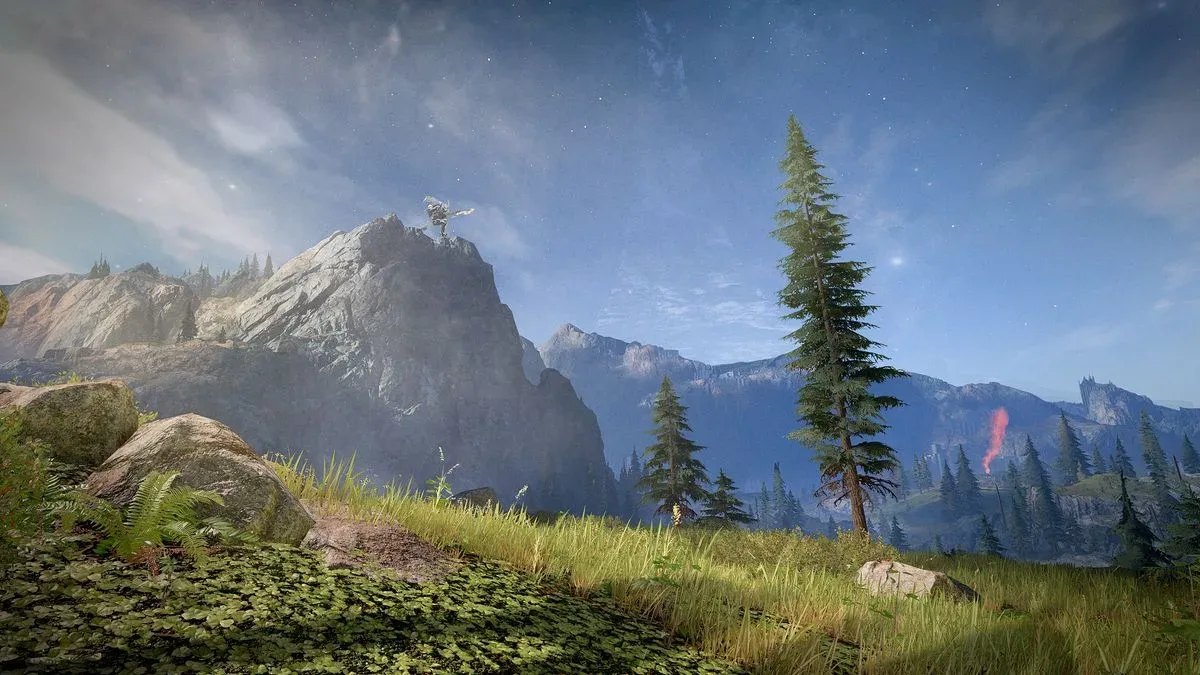
The concept images also feature a Promethean Knight standing above Zeta Halo's surface after escaping laboratories below ground. That image alone raises several possibilities. Prometheans have been closely associated with the Forerunner legacy and the Didact-era conflicts explored in prior games, so their presence could have deepened the sense that Zeta Halo was becoming a convergence point for old dangers rather than merely a Banished-held battlefield.
Visually, the scene appears to capture one of Halo's enduring strengths: a solitary armored combatant overlooking an immense alien landscape, with a likely firefight waiting beyond the horizon. Open ground, dramatic elevation, distant structures, and the promise of combat remain a powerful combination for the series. Even in a piece of unused production art, that identity is immediately recognizable.
The Banished would seemingly have remained a major force as well. Descriptions of their steel integrated into colossal jungle trees suggest more than temporary encampments. Their presence may have reshaped the ring's ecosystems and landmarks, turning natural terrain into a war zone marked by industrial occupation. That is a potent visual contrast: ancient living environments altered by the aggressive construction and scavenging associated with the Banished.
Why Zeta Halo Still Has So Much Potential
Zeta Halo is uniquely suited to this kind of story because it can support virtually every scale of Halo fiction. On one level, it is a place for infantry encounters, vehicle warfare, bases to assault, allies to rescue, and enemy patrols to intercept. On another, it is a Forerunner installation with a history stretching back through eras of galactic conflict. The ring can hide weapons, prisons, monitors, lost civilizations, and surviving echoes of catastrophes that predate modern humanity.
The unmade Halo 7 appears to have leaned into that flexibility. Snowy expanses, jungle wetlands, buried facilities, Tudejsa ruins, Banished infrastructure, Promethean survivors, and Flood-infested containment zones all sound as though they could have formed a campaign with sharply differentiated chapters. The key question would have been how those elements connected: whether they were separate fronts in a conventional war, pieces of a mystery around the creature in the timelock, or stages in a larger crisis involving the slipcase artifact.
There is no indication that Activision's next Halo project will adopt any of these specific concepts. The change in development leadership means the next game may pursue an entirely different setting, tone, cast focus, or gameplay structure. The newly revealed art should therefore be viewed as a record of an abandoned creative path rather than a roadmap for what comes next.
Still, it demonstrates that Halo Studios' planned continuation had big ideas. A Flood outbreak inside a time-bending prison, an unknown ruler of ancient Gyre 11, and a surface war spanning ice, jungle, ruins, and Banished installations could have created an expansive and distinctly Halo-like follow-up. For now, the ancient creature remains locked behind its conceptual timelock, another mystery from Zeta Halo that players may never get to confront.
Community
Discussion
Start the conversation.
No comments have been posted yet.