

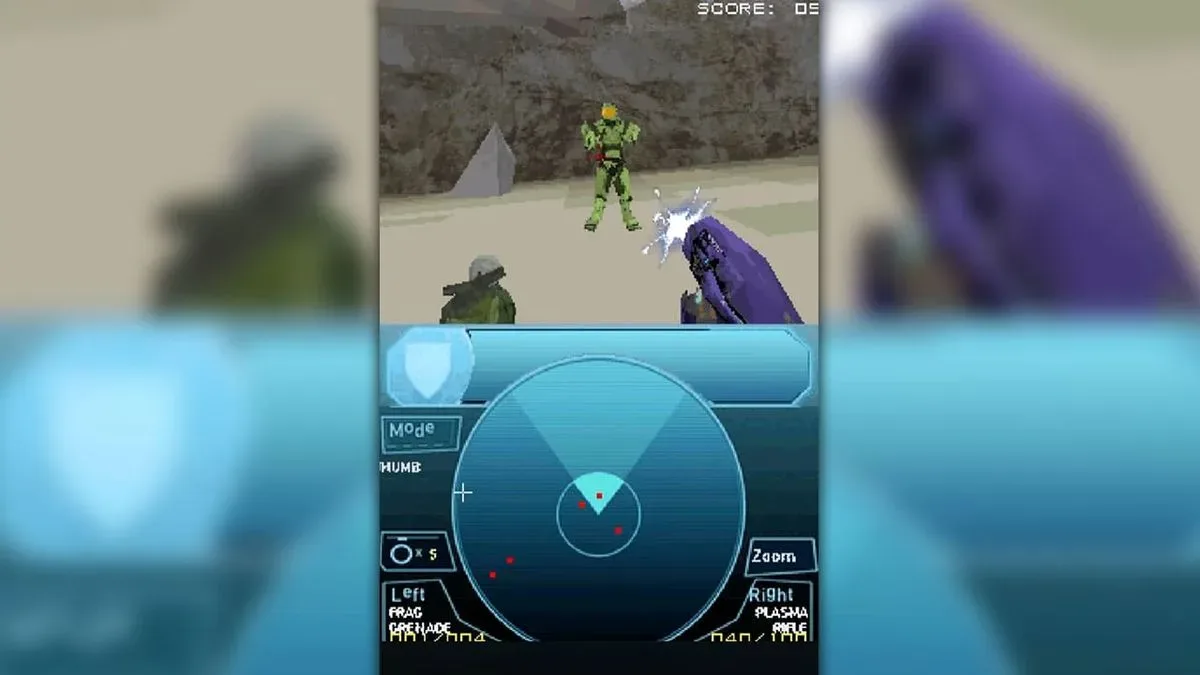
For years, the supposed Halo DS demo has occupied a peculiar place in video game history: not quite a released game, not quite a conventional cancellation, and never fully erased from public memory. Images and footage from the mid-2000s suggested that a version of Microsoft's flagship shooter had appeared on Nintendo's dual-screen handheld. It looked improbable, exciting, and a little surreal. Now, a fan-led project is attempting to turn that fragmentary history into something playable.
Halo modder Steve Roth is working on a recreation of the elusive Nintendo DS prototype, building a game around the information and visual evidence that remains. Early footage of the project has been shown by Nostalgic Aubrey, offering the clearest look yet at how this long-discussed handheld concept might have functioned if it had progressed beyond a short internal demonstration.
The recreation is not being presented as a recovered official build. Instead, it is an effort to reconstruct the apparent design, controls, visual style, and general feel of the old demo as closely as possible. That distinction matters, but it does not make the project any less fascinating. In some ways, the uncertainty surrounding Halo DS is exactly what gives this recreation its appeal: it is a chance to explore a gaming alternate history that players have debated for nearly two decades.
The Halo DS mystery has lasted since the 2000s
Talk of a Halo game on Nintendo DS has circulated for years, fueled by screenshots, video, developer comments, and recollections from people who encountered the project. n-Space had said that it worked on a demo for a couple of months. Matt Casamassina played the demo at the time. Bungie, meanwhile, indicated that it may have been an unofficial pitch effort by a development team rather than an officially commissioned Halo release.
For useful background on this topic, read No Man's Sky Forsaken update Brings Haunted Tech, Biological Horrors, and Star-to-Star Warping.
Those details leave room for important questions. Was it ever intended to become a full product? Did it have any formal support from Halo's rights holders? How far did the team get before the idea stopped moving forward? The available information has never offered a single neat answer. That ambiguity is why Halo DS has continued to be discussed alongside the many prototypes, pitches, and technical demos that briefly surface before disappearing into gaming folklore.
The screenshots were especially memorable because the concept itself was so unusual. The DS was home to ambitious first-person shooters, but it had major limitations compared with the original Xbox hardware that defined Halo. A faithful conversion of Halo or Halo 2 would have been a tremendous challenge. Yet the idea of carrying a version of Master Chief's world in a pocket, using the DS stylus and second screen for controls or information, was compelling enough to stick with fans.
It also arrived during an era when handheld adaptations often had to reinterpret their console counterparts rather than simply shrink them down. The best portable games found ways to work with their hardware instead of fighting against it. A Halo game designed around the DS's touchscreen, compact display, and reduced processing power would likely have been a different experience from the Xbox titles--but potentially a memorable one in its own right.
A reconstruction built from the clues that remain
Roth's project takes the surviving evidence seriously. The goal has been to match the apparent structure of the old demonstration rather than produce a modernized fan game that only borrows Halo imagery. That means retaining the distinctive use of the DS layout seen in earlier material, with gameplay on the top display and interface functions handled through the lower screen.
In the early footage, the bottom screen serves as a motion tracker, echoing a familiar part of Halo's interface while adapting it to the DS hardware. It is also used for weapon information, player statistics, and menu selections. This is a natural fit for Nintendo's handheld, and it helps explain why the rumored demo made such a lasting impression. The dual-screen setup did not merely place Halo on smaller hardware; it suggested a version of Halo shaped around a platform-specific control and information design.
The recreation has been made using the GoldenEye: Rogue Agent DS engine. That connection has long been part of the conversation around the original Halo DS material, as many observers felt the footage looked as if it could have been related to, modified from, or built with technology associated with that game. Roth's work leans into the practical reality of that foundation, using the engine as the basis for a playable interpretation of what people remember seeing.
AI has reportedly been used in a limited capacity to assist with the Rogue Agent recompiling process. Roth then brought Halo modding experience to the project, incorporating assets from Halo 2 and adapting them into the handheld-oriented build. The result is a project that sits between preservation, reverse engineering, modding, and design reconstruction. It cannot replace a lost original build, but it can provide a tangible interpretation of an idea that otherwise exists only through incomplete documentation.
Why the rough visuals are part of the appeal
No one should expect the original Xbox version of Halo on a Nintendo DS. The early recreation footage has the simplified geometry, compressed presentation, and limited visual detail one would associate with a first-person shooter on the system. But that is not a flaw in the project's premise. It is central to it.
The point is not to prove that the DS could have displayed Halo at Xbox quality. The point is to see the game through the technical lens that an actual mid-2000s handheld version would have required. The lower-resolution visuals, smaller environments, and reworked interface make the project feel closer to a period curiosity than a contemporary demake polished for modern hardware.
That authenticity can be more exciting than a smoother, more elaborate reinterpretation. Fans who remember the original images and video are likely to recognize the peculiar visual identity immediately: familiar Halo elements filtered through a very different engine and a very different machine. It creates the impression of encountering a game from an alternate release schedule, one where the DS received an unlikely Halo spin-off that somehow existed alongside the Xbox series.
There is also an archival value to recreations like this. Video game history is not made up only of finished games. Prototypes, cancelled projects, demos, pitch builds, and developer experiments all reveal what studios thought might be possible at a particular moment. When original software is unavailable, preservation-minded reconstructions can help players understand the concepts and constraints that surrounded it.
What remains unknown about the project
There is still no announced completion date for Roth's Halo DS recreation. It is also unclear how much content the finished project may include. The available material does not confirm how many maps might be recreated, whether the scope will extend beyond the currently demonstrated gameplay, or when players may be able to try it for themselves.
Those unanswered questions are significant because they define the difference between an impressive technical proof of concept and a broader fan-made release. Recreating one representative scenario could already be enough to preserve the spirit of the rumored demo. Expanding into multiple environments, weapon sets, or additional systems would make the project more substantial, but it would also require more reconstruction work and more assumptions about material that may no longer be documented.
For now, the footage is the key milestone. It demonstrates that the idea can function: Halo-like combat adapted to the DS layout, a motion tracker on the second screen, and a visual presentation grounded in the old prototype's apparent design. After so many years of speculation, simply seeing a playable form of the concept is notable.
A reminder that gaming history is full of unrealized possibilities
The Halo DS story resonates because it represents a broader kind of game-history mystery. Players often remember the projects that almost happened just as strongly as the ones that reached store shelves. A screenshot in a magazine, a trade-show demonstration, a developer anecdote, or a few seconds of leaked footage can become a permanent part of a community's memory.
In this case, the mystery is heightened by Halo's importance and by the unexpected platform involved. The series was closely associated with Xbox, while the Nintendo DS was building its own enormous audience through touch-focused software, stylus controls, and inventive portable games. A Halo title bridging those worlds would have been a genuine oddity, regardless of whether it ever advanced beyond demo status.
Roth's work does not settle every historical question surrounding the original. It cannot establish exactly what was planned, what was approved, or what an official finished Halo DS would have contained. What it can do is give the idea shape. By combining available evidence with careful modding work, the recreation offers a way to experience the possibility rather than merely discuss it.
Until more details emerge, the Halo DS recreation remains a project worth watching for fans of Halo, Nintendo DS curiosities, and game preservation alike. It is a reminder that even an unfinished experiment can have a long afterlife--and that, sometimes, dedicated fans can bring an old "what if?" close enough to reality for everyone else to finally see why it was so hard to forget.
Community
Discussion
Start the conversation.
No comments have been posted yet.