

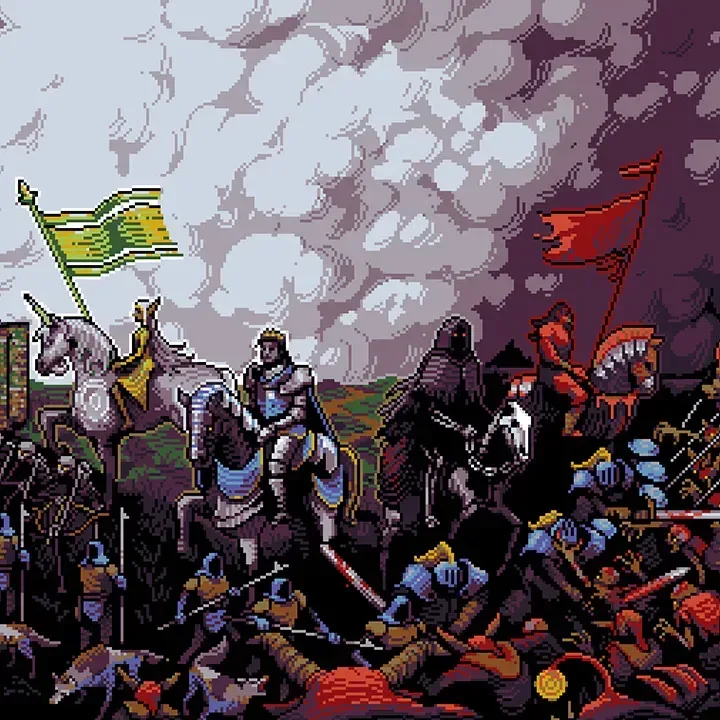
Heroes Never Die is a newly announced fantasy strategy game headed to PC in 2027. Developed by Ludogram, the project is built around an unusual but appealing pitch: blend the immense enemy swarms and escalating power curve of the survivor genre with the larger-scale decision-making of a fantasy tactics game.
The result is a game where surviving a sea of monsters is only part of the challenge. Players will choose a hero, construct and improve a town, collect resources, recruit units, and contend with rival heroes while their army evolves in real time. Ludogram is positioning Heroes Never Die as a game of repeated runs shaped by meaningful tactical calls rather than a simple exercise in wiping out as many enemies as possible.
There is not yet a precise launch date beyond 2027, nor have additional platforms been announced. PC is the only confirmed destination so far. Before release, Ludogram plans to hold a private playtest, with registration available for players interested in getting an early look at the game.
A survivor structure with bigger strategic stakes
Survivor-style games have become known for a straightforward, highly replayable loop. A character begins with limited offensive options, enemies arrive in ever-denser waves, and experience or resources feed a growing collection of upgrades. The action can look deceptively simple at first, but the best runs depend on finding combinations that turn an initially vulnerable character into a screen-clearing force.
For useful background on this topic, read PS5 hypervisor exploit Bounty Sparks Homebrew Clash Over AI, Linux, and GTA 6.
Heroes Never Die appears to use that escalating pressure as its foundation while expanding the player's responsibilities. Instead of focusing solely on an individual combatant's build, players will also be building an army and strengthening a settlement. That shift could make each decision carry consequences at multiple levels. An upgrade might improve a hero's immediate survival odds, reinforce a particular unit type, accelerate resource gathering, or prepare the town for later threats.
It is this combination that distinguishes the game's premise. The goal is not merely to survive a hostile battlefield for as long as possible. Players will have to consider what their armies need, how quickly their infrastructure should grow, and when it is worth taking fights against opponents instead of concentrating on monster hordes.
The approach evokes the broad fantasy campaign appeal associated with classic hero-and-army strategy games, but it does not sound like a conventional turn-based map conquest experience. Ludogram has emphasized tactical decisions and real-time army building, suggesting that the pace and immediacy of a horde survival game will remain central to the experience.
More than 20 heroes will lead the fight
A hero selection of more than 20 characters is planned for Heroes Never Die. Each hero will have their own skills, giving players a reason to experiment with different approaches across successive runs. That variety is particularly important in a game designed around repeat play, since distinct hero abilities can change what strategies are viable from the opening moments onward.
One hero may be naturally suited to direct damage and aggressive engagements, while another could potentially encourage a more defensive, resource-focused, or army-oriented style. Specific characters and their powers have not been detailed yet, so those possibilities remain speculative. Still, the promise of individual skill sets indicates that heroes are intended to be more than cosmetic commanders.
Hero choice will also matter because monsters are not the only danger. Players will face rival heroes as well. This introduces a competitive layer that could force a reassessment of an otherwise successful run. A powerful build for clearing hordes may not necessarily be ideal against an opposing commander and their forces. Likewise, a town expansion plan that pays off over time could be threatened if a rival arrives before the player is ready.
The inclusion of rival heroes gives Heroes Never Die a potentially stronger sense of a living fantasy conflict than games that only ask players to endure anonymous waves. The battlefield may be crowded with creatures, but there are also competing leaders pursuing their own objectives. How directly those encounters are structured has not been revealed, yet their presence should make positioning, army composition, and timing more important.
Four factions and more than 60 units
Ludogram has confirmed four factions and over 60 units for the game. That is a substantial pool for a strategy title whose identity rests on adaptive runs, especially when combined with more than 20 heroes. Factions could establish broad strategic identities, while individual units provide the tools necessary to address specific battlefield problems.
At this stage, the developer has not named the factions or outlined their rosters. It is therefore too early to make firm claims about how they will differ. Even so, the number of factions and units suggests that assembling an army will involve more than simply accumulating the strongest available troops. Players may need to weigh unit roles, hero synergy, resource demands, and the threats appearing in a particular run.
Army building is one of the game's most intriguing elements because it promises to bridge the gap between an action-forward survival format and strategic command. In a traditional survivor game, the player's "army" is often expressed through automatically firing weapons, summoned allies, passive effects, and upgrades. Heroes Never Die looks set to make that idea more literal by putting a fantasy force under the banner of a chosen hero.
The town system is likely to be a key part of that loop. Players will gather resources from the world and from combat, then use them to upgrade their settlement. A stronger town could logically mean greater access to forces or more powerful strategic options, although the precise building and progression mechanics have not been announced. What is clear is that growth between battles--or amid the chaos of battle--is intended to be a core concern rather than background flavor.
Designed so no two runs play out the same way
Ludogram says that no two runs will be alike. Procedural variation is a familiar promise in survivor and roguelite games, but Heroes Never Die has several systems that could support it: hero selection, skills, four factions, a roster of more than 60 units, resource acquisition, town upgrades, monster encounters, and clashes with rival heroes.
That does not necessarily mean every element will be randomly generated. It does mean the developer is aiming for a flexible structure where players need to react to circumstances rather than follow one fixed solution. The most satisfying version of this concept would let a player recognize an opportunity in the middle of a run and pivot their plans accordingly--perhaps adapting their forces to a difficult enemy, leaning into an especially useful hero skill, or deciding that an early confrontation with a rival is worth the risk.
Replayability will depend on how these layers interact. A long list of units alone does not guarantee varied strategy if every run rewards the same dominant combination. But if town development, hero abilities, faction choices, and battlefield pressure consistently pull players toward different priorities, Heroes Never Die could offer the kind of run-to-run stories that make the genre so compelling.
It will also be interesting to see how the game handles failure and progression. The announcement describes individual runs, but does not explain whether there will be permanent unlocks, meta-progression, or campaign-wide advancement. Those details can radically shape the rhythm of a survivor-inspired game, particularly one that includes a large roster of heroes and units. For now, Ludogram is keeping its focus on the central fantasy: lead a hero, grow an army, develop a town, and push back against enormous threats.
A project developed in secret for years
Creative director Edouard Gaudel said the team had been working on Heroes Never Die quietly for a couple of years before the announcement. Gaudel also highlighted the developer's excitement at seeing players fight monster hordes, grow their armies, and encounter the game's heroes for the first time.
"We're delighted to finally announce Heroes Never Die, a project we've been working on in the shadows for a couple of years," Gaudel said. "We cannot wait to see our first players fighting hordes of monsters, and evolving their armies while meeting our heroes. Don't forget to join our upcoming Playtest!"
That upcoming private playtest should provide the first practical sense of how confidently the game merges its different genres. It is one thing to promise tactical choices amid constantly escalating battles; it is another to make those choices readable, responsive, and rewarding while hundreds of enemies are demanding attention. Early player feedback may be especially valuable for balancing the relationship between a hero's personal power and the army's importance.
For players interested in following development, Heroes Never Die can be wishlisted on Steam, and sign-ups are open for the private playtest. With its 2027 PC release window, there is still time for Ludogram to reveal much more about its factions, heroes, combat systems, town management, and the shape of its rival encounters.
For now, Heroes Never Die stands out as a promising attempt to push survivor-style design in a more strategic direction. Its appeal will rest on whether it can make horde survival and high-level planning feel like parts of the same battle rather than separate ideas competing for attention. If the blend works, the game could give fantasy strategy fans a fresh way to experience the thrill of building an unstoppable force while the monsters keep coming.
Community
Discussion
Start the conversation.
No comments have been posted yet.