

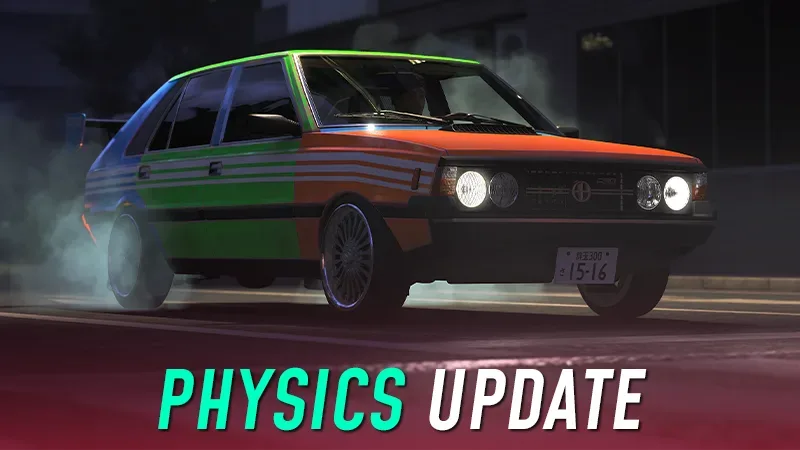
JDM: Japanese Drift Master has received a substantial new update across its available platforms, with the development team focusing on the parts of a driving game that players feel most immediately: suspension movement, steering response, grip recovery, and the small tuning choices that shape how a car behaves at the limit.
The patch revisits several areas at once. It adjusts suspension behavior over uneven roads, improves how forces are conveyed through the wheels during skids, and refines reactions to modest steering inputs, with particular attention paid to cars carrying more of their weight toward the rear. It also brings tire pressure adjustment back to the Car Tuning Workshop, while a separate collection of fixes addresses multiplayer interface problems and defects affecting several vehicle models.
For a game built around controlled slides rather than simply reaching the finish line, those mechanical changes could be among the most meaningful improvements in the update. Drifting is especially sensitive to transitions: the instant a car moves from grip into a slide, the point where a driver countersteers, and the moment when traction returns. Even a relatively subtle revision to damping, rebound, or steering feedback can change whether a vehicle feels predictable when the road surface becomes rough or when a driver needs to make a quick correction mid-corner.
Suspension and handling receive the headline changes
The new build enhances suspension response and rebound speeds when vehicles are traveling over inconsistent surfaces. That should matter on bumpy roads where a car's wheels need to maintain contact while the body continues moving and shifting weight. In drifting, a loss of contact or an overly delayed suspension response can make a car react in a way that feels disconnected from the driver's steering and throttle inputs.
For useful background on this topic, read Pocketpair Publishing Lead Calls Combolands a 2026 Indie Standout.
The update also improves force translation through the wheels during skids. The intent is to correct steering reaction timing and make grip recovery behave more consistently. That wording points to a key part of the driving experience: when a car is sliding sideways, drivers need to understand how quickly the front wheels will bite after countersteering and how the chassis will respond as the rear tires regain traction. Better communication between the simulated tire forces and steering behavior can make it easier to catch a slide without making every recovery feel automatic.
Minor steering adjustments have also been revisited. Rather than treating every input as a broad attempt to redirect the vehicle, the revised behavior is designed to improve how cars respond to the smaller corrections drivers make while holding an angle. Rear-heavy cars are singled out as an area of focus. These vehicles can be particularly lively during deceleration, lift-off transitions, and fast direction changes, so a more natural response to light steering inputs could help them feel less abrupt without stripping away their character.
None of these changes are framed as a complete redesign of the game's driving model. Instead, they represent a targeted pass on the systems that influence confidence behind the wheel. Players who spend time tuning their setup, linking corners on mountain roads, or competing against others online will likely be most interested in how the changes affect consistency from one run to the next.
For another perspective on this story, read JDM Update Refines Drift Physics and Restores Tire Pressure Tuning.
Tire pressure controls return to the workshop
Alongside the physics work, tire pressure tuning has been restored in the Car Tuning Workshop. Its return gives players another way to tailor the balance of a car instead of relying solely on broader setup changes.
Tire pressure is a familiar adjustment in motorsport and driving simulations because it can affect the way a tire responds under load. In practical gameplay terms, players often use it as part of a wider setup process, experimenting with how readily a car breaks traction, how stable it feels once sideways, and how it behaves as it returns to grip. The exact result will depend on each vehicle and the updated handling model, but bringing the option back restores a layer of player agency for drivers who want something more personal than a default configuration.
The timing is notable given the patch's wider focus on suspension and wheel behavior. Setup options are most useful when players can perceive their effects clearly, and the refinement of skid forces, rebound, and steering corrections may make tire-pressure experimentation more valuable for dedicated drivers. It also gives players a reason to revisit builds that may have felt slightly off before the update.
Multiplayer fixes clean up races and menus
The update includes several corrections for multiplayer, covering both the information shown during a race and the menus used around it. One issue could cause track completion percentages to jump unpredictably between numerical values and a completed state. Accurate progress tracking is important in a competitive race, particularly when players are trying to judge positions, chase rivals, or determine whether someone has crossed a key checkpoint.
The post-race summary screen has also been adjusted to display longer nicknames properly. Names exceeding 10 characters had been affected by a display issue, which could make it harder to identify competitors once an event concluded.
Other fixes address the flow of an active session. Players should now receive the missing pop-up warning when trying to leave a race that is still in progress. Post-race voting screens, meanwhile, have been corrected so they no longer appear while competitors are still racing. Together, these changes should reduce moments where the interface interrupts or misrepresents the actual state of an event.
Gamepad navigation in event-creation menus has also been repaired. That is a less glamorous correction than suspension physics, but it is vital for players using controllers, particularly on PlayStation. Creating an event should be straightforward regardless of the input device, and menu friction can be especially frustrating in a multiplayer game where players want to set rules and get on track quickly.
Specific vehicle problems addressed
A series of car and asset repairs rounds out the patch. The Nissan 180SX Type R had a career-screen issue in which changed vehicle statistics were not updating correctly. The Nissan Z33's headlights were inverted and have now been corrected.
The Ironvale Hauler F84 receives a collision fix for its front end, resolving an issue that could allow it to clip through objects. Collision problems can be particularly disruptive in a driving game because they undermine the reliability of a course and can create unpredictable consequences in races or free driving.
Visual completeness has also been improved for several vehicles. The FSO Polonez was missing its seats, while the Akina Phantom and Roebuck Jetstream had problems with body-kit positioning and the placement of the right-side mirror. These changes may not transform lap times or drift scores, but detailed vehicle presentation is a major part of the appeal for an automotive game centered on Japanese car culture and customization.
- Nissan 180SX Type R: career-screen vehicle stats now update correctly after changes.
- Nissan Z33: inverted headlights have been fixed.
- Ironvale Hauler F84: front collision behavior has been corrected to prevent clipping through objects.
- FSO Polonez: missing seats have been restored.
- Akina Phantom and Roebuck Jetstream: body-kit and right-mirror placement issues have been repaired.
Discounts are currently available on PC and PlayStation
To coincide with the update, JDM: Japanese Drift Master is available at a limited-time discount across the listed storefronts. Steam players can find the game at 60% off, while the PlayStation Store discount is 50% off. No end date for either offer was specified, so interested players will need to check the relevant platform storefront for the current status of the promotion.
For newcomers, the patch arrives at a useful point: it combines quality-of-life repairs with revisions to the core driving experience rather than offering only cosmetic additions. For returning players, it presents an opportunity to retest favored cars, adjust tire pressure settings, and see how established setups perform under the revised suspension and skid behavior.
Liveries are next as the team looks beyond this year's roadmap
The development team says it is now finishing work on the long-awaited liveries system following the arrival of multiplayer on consoles. With multiplayer and liveries described as the two largest roadmap features planned for the year, the studio is positioning the current update as part of a broader effort to build out both driving competition and car personalization.
Additional content is also in development, though no details have been announced. The team has stressed that JDM remains a passion project and acknowledged the limits of competing with the cadence and scale of major AAA releases. Its message is not one of promising an endless stream of features on blockbuster timelines, but of continuing to improve the game with the resources available.
"We're working as fast as we can," the team said, while emphasizing its commitment to keep evolving JDM.
That approach is reflected in this patch. It does not rely on a single flashy addition; instead, it works through the fundamentals that determine whether drifting feels satisfying, whether tuning has meaningful depth, and whether online races operate without distracting interface errors. With liveries still ahead and unannounced material in the works, JDM: Japanese Drift Master's latest update gives its driving foundation a careful polish while setting up the next phase of its roadmap.
Community
Discussion
Start the conversation.
No comments have been posted yet.