
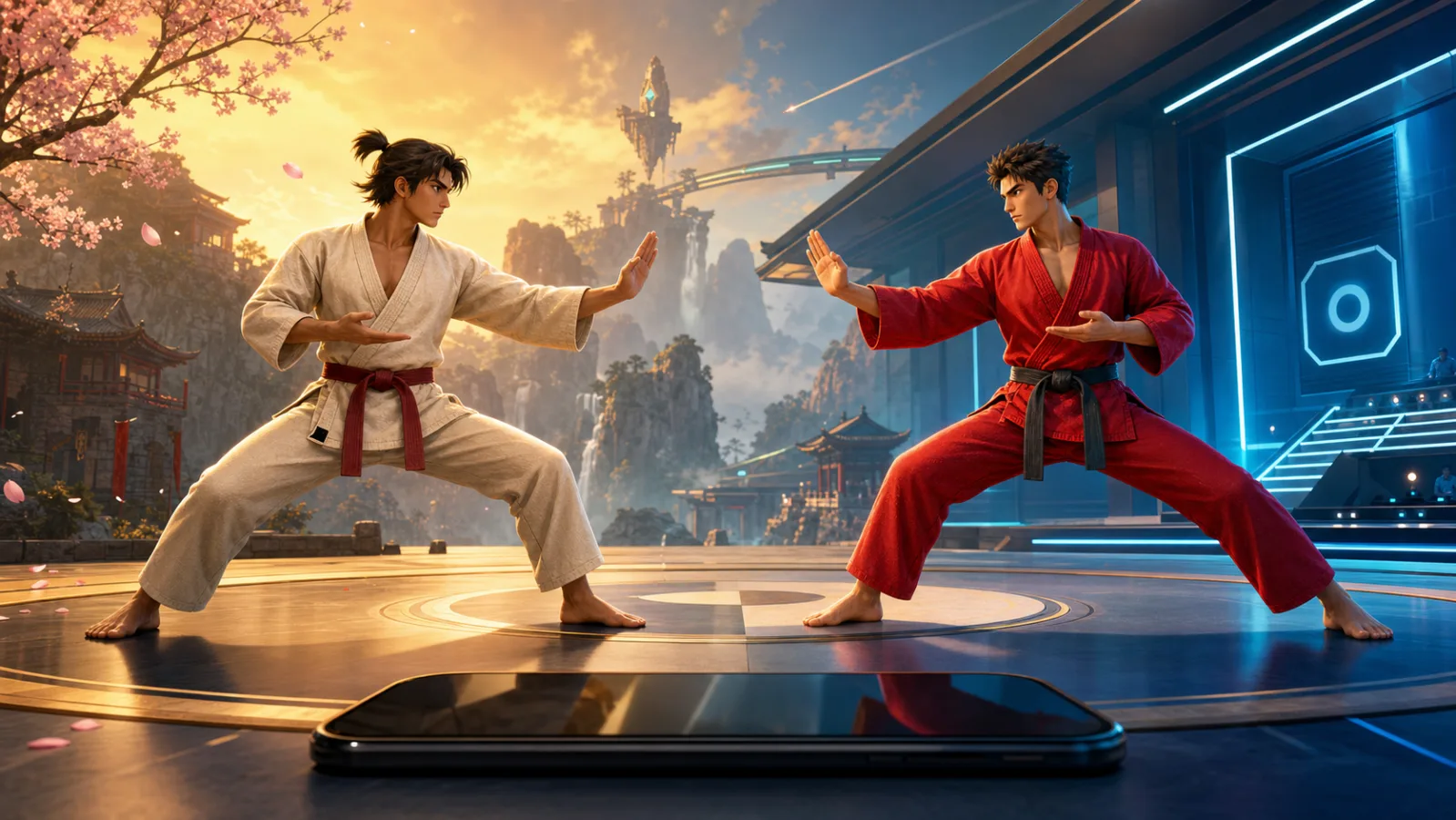
Karateka and Karate Champ share an obvious surface connection: both are classic games built around karate combat, both arrived in the early 1980s, and both ask players to win through careful attacks rather than overwhelming firepower. Yet they represent two very different ideas of what a martial-arts game can be. Karateka is a linear rescue adventure with a cinematic premise, escalating opponents, and a final confrontation inside an enemy fortress. Karate Champ is a direct competitive fighting game, structured around one-on-one matches and an unusually physical control concept.
That difference matters more than the similar names. Choosing between these games is not simply a matter of picking the one with karate in the title. It is a question of what kind of session you want: a solitary journey with a clear destination, or a rules-driven duel where every successful strike and defensive read carries weight. For players browsing older games on mobile-compatible or retro-friendly platforms, understanding that divide is the fastest way to find the better fit.
Karateka is the better choice for someone who wants a compact action story and a sense of forward movement. Karate Champ is the stronger match for players who want to study a competitive system, face another person, or repeatedly test their reactions against a computer opponent. Both have historical appeal, but their design priorities could hardly be more distinct.
The core difference: journey versus duel
Karateka follows a returning martial artist after his village has been destroyed and Princess Mariko, his bride-to-be, has been taken by the warlord Akuma. Armed only with karate, the hero fights through increasingly powerful warriors on the way to Akuma's mountain fortress. The ultimate goal is a hand-to-hand confrontation with Akuma himself.
This framing gives Karateka a clear dramatic line. The player is advancing into hostile territory, overcoming a succession of guards, and moving toward a specific rescue. Even without a large cast of characters or a sprawling world, the game has the momentum of an action adventure. Each victory is not merely a point on a scoreboard; it is progress toward the fortress and the final fight. That makes Karateka particularly approachable for players who value an ending, a premise, and a satisfying sense of completion.
Karate Champ takes a more concentrated approach. Its central appeal is the karate match itself. Players face a computer-controlled rival in single-player play or challenge another player in multiplayer. The objective is to land successful attacks while avoiding the opponent's strikes. Its contest structure puts the entire focus on spacing, execution, reading an opponent, and choosing the right move at the right moment.
There is no rescue mission to carry Karate Champ between bouts. The narrative is the contest: two fighters testing technique under a shared set of rules. This is a major advantage if you enjoy games that become more interesting as you better understand their mechanics. It can be less appealing if you need exploration, changing locations, or story context to remain invested.
Gameplay comparison: action progression against martial-arts precision
Karateka makes each fight part of an obstacle course
Karateka belongs to the fighting and beat 'em up tradition, with elements of hack-and-slash action also associated with its genre listings. The important practical point is that combat is embedded in an advancing journey. You are not selecting isolated matches from a menu-like structure. You are working through Akuma's defenses, confronting stronger opponents, and pushing toward the fortress.
That progression naturally creates tension. A player who has made meaningful progress has a reason to care about the next encounter. Because the game's story is so direct, it also communicates its stakes efficiently: get through the warriors, reach the captured princess, defeat Akuma. This makes it well suited to players who want a classic game with a defined dramatic arc rather than an endlessly repeated competitive loop.
Its combat premise is also admirably clean. The hero has karate, and the opposition is built around increasingly powerful warriors. The focus stays on hand-to-hand confrontation. There is no need to manage a complicated roster, build a character, or learn an elaborate inventory. Karateka's appeal is in the pressure of making a lone martial artist's skill carry an entire rescue mission.
Karate Champ turns control knowledge into strategy
Karate Champ is a fighter and sports-oriented arcade game built around individual bouts. Its standout feature is the control scheme. Rather than treating punches and kicks as simple single-button commands, the game uses two joysticks to represent different limb movements: the left joystick controls the upper body and the right controls the lower body. Together, these inputs can create kicks, punches, blocks, and other maneuvers.
That concept makes Karate Champ feel fundamentally different from a typical action game. The player is not just pressing an attack command and watching a move happen. They are coordinating upper- and lower-body choices to produce a response. In theory and in practice, this creates a more deliberate relationship between input and technique. The result is a game where execution is part of the contest, not merely a gateway to it.
The design especially rewards players who enjoy learning a compact but demanding ruleset. A newcomer can understand the basic goal immediately: hit the opponent and avoid being hit. The deeper challenge is turning the two-part control language into reliable offense and defense. That gives Karate Champ a strong practice appeal. As familiarity grows, what first feels unusual can become the foundation for more confident play.
For a head-to-head session, that focus is invaluable. Two people can sit down with the same simple objective but discover that timing, anticipation, and move selection make the matchup richer than it initially appears. Karate Champ is therefore the clearer winner for competitive local play in spirit, while Karateka is the clearer winner for a solo adventure mindset.
Controls and platform fit
Platform fit is an essential part of this comparison because these games come from an era of very different control expectations. Karateka appeared across a wide collection of systems, including Apple II, Atari systems, Commodore systems, DOS, Family Computer, MSX, PC-9800 Series, Amstrad CPC, Sinclair ZX Spectrum, Atari ST/STE, Android, and iOS. Karate Champ is associated with Apple II, arcade, Commodore C64/128/MAX, Family Computer Disk System, Nintendo Entertainment System, Nintendo Famicom Disk System, iOS, and Final Burn Alpha Neo.
For players interested in mobile-oriented versions, both games have iOS listed among their platforms, while Karateka also has Android listed. That alone does not make either game identical on a touchscreen. Their original design ideas point to different strengths and potential compromises.
Karateka's straightforward forward-moving action and single-character rescue structure make it conceptually easy to approach in a portable setting. Its main attraction is a self-contained run through a hostile environment, making it a natural option when you want to focus on one goal and steadily work toward an endpoint. The game's old-school challenge may still demand patience, but the overall mission is immediately legible.
Karate Champ requires more consideration because its identity is tied tightly to the two-joystick control scheme. A version played with traditional physical controls most directly reflects the original idea of independently directing upper- and lower-body movement. On a touch device, players should be prepared for the fact that a control scheme designed around coordinated directional inputs may ask for more adjustment than a simple button-based game. That does not diminish the game's design; it simply means the best fit depends heavily on whether you enjoy tactile control experimentation.
For retro hardware enthusiasts, both games offer meaningful pathways. Karateka's broad historical platform list makes it a particularly wide-ranging retro title, connected to home computers and several console families. Karate Champ has especially strong appeal to players who love the arcade-to-home experience and classic Nintendo formats. The choice here is less about which title is more "retro" and more about which kind of retro experience you seek: a cinematic computer-and-console action journey, or an arcade-style competitive challenge.
Longevity: replaying a rescue or mastering a match
Neither Karateka nor Karate Champ needs a huge modern-style content checklist to offer lasting value. Their longevity comes from mastery, but the shape of that mastery differs.
Karateka is replayable because a fixed journey can still be difficult to conquer cleanly. The escalating opposition and final objective give each new attempt a natural purpose. Returning players can work on reaching farther, handling stronger warriors more effectively, and making the route to Akuma feel more controlled. The rescue premise provides a finish line that makes repeat attempts feel like renewed missions rather than disconnected rounds.
This makes Karateka's longevity personal. It is about the player versus the path. You are revisiting a challenge designed around atmosphere, escalation, and survival through a sequence of confrontations. Players who enjoy repeatedly improving against a campaign-like structure will get the most from it.
Karate Champ's longevity is more social and systemic. A computer opponent provides a single-player test, but multiplayer is where its design has its clearest opportunity to keep changing. Another player brings unpredictability. A friend may favor a particular attack, respond defensively, or adapt after losing a round. Since the game emphasizes attacks, avoidance, blocks, and coordinated control inputs, each opponent can make the same basic arena feel different.
It is also well suited to short repeat sessions. You do not need to commit to a journey through a fortress to have a meaningful Karate Champ session. A handful of matches can be enough to test an idea, settle a score, or gradually improve your command of its moves. That makes it the more flexible choice for competitive play, especially when two players are available.
Which game is better for different players?
Choose Karateka if you want a solo action story
Karateka is for players who want their martial-arts action to have a destination. Its destroyed village, kidnapped princess, mountain fortress, and final battle with Akuma create a complete action-movie framework. If you like the idea of a lone hero fighting through an enemy force with no weapon but karate, it delivers a focused version of that fantasy.
It is also the stronger recommendation for someone who prefers progress through a world over repeated competitive matches. The action is not abstracted into a series of unrelated duels. Every warrior stands between the protagonist and the rescue. Players looking for a vintage game that feels like an urgent mission should begin here.
Choose Karate Champ if you want a pure fighting contest
Karate Champ is for players who find the most satisfaction in a close, readable duel. Its single-player and multiplayer options support two distinct moods: practice against the computer or direct competition with another person. The game's two-joystick concept gives it a special appeal for anyone interested in unusual fighting-game control design.
Pick Karate Champ if you enjoy examining how controls translate into moves, making deliberate decisions under pressure, and seeing whether your timing beats another player's timing. It is not trying to send you through a fortress or carry you with a plot. It wants the fight itself to be enough, and for the right player that focus is exactly the point.
Choose based on session length and mood
- For a focused solo mission: Karateka.
- For a competitive two-player challenge: Karate Champ.
- For a clear rescue premise and escalating foes: Karateka.
- For control experimentation and technical duels: Karate Champ.
- For a mobile-compatible game with Android and iOS listed: Karateka.
- For an iOS-listed classic with arcade and NES-family heritage: Karate Champ.
- For replaying a route toward a final boss: Karateka.
- For repeat matches that can change with each opponent: Karate Champ.
The verdict
Karateka and Karate Champ are not substitutes in the narrow sense. They are complementary examples of early martial-arts game design. Karateka uses karate combat to support a tense rescue adventure, carrying players from a ruined village toward Akuma's fortress and the fate of Princess Mariko. Karate Champ strips the premise down to the essence of competitive combat, asking players to control upper and lower body movement with precision and outthink an opponent.
If you can play only one, choose Karateka when you want story momentum, solitary action, and a defined beginning-to-end challenge. Choose Karate Champ when you want multiplayer potential, a more concentrated fighting format, and the distinctive challenge of its two-joystick-inspired control philosophy.
The best reason to try both is that each reveals a different strength of classic game design. One proves that a small amount of narrative can make a sequence of fights feel like a memorable journey. The other proves that a simple competitive setup can gain remarkable depth when the controls demand thought and coordination. Whether you are approaching them through a mobile-compatible version or through retro platforms, the deciding factor is simple: do you want to save a princess by fighting forward, or do you want to step onto the mat and prove that your technique is better?
Community
Discussion
Start the conversation.
No comments have been posted yet.