

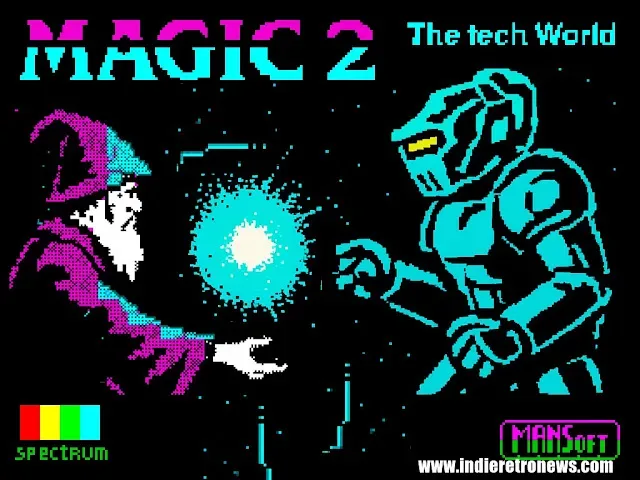
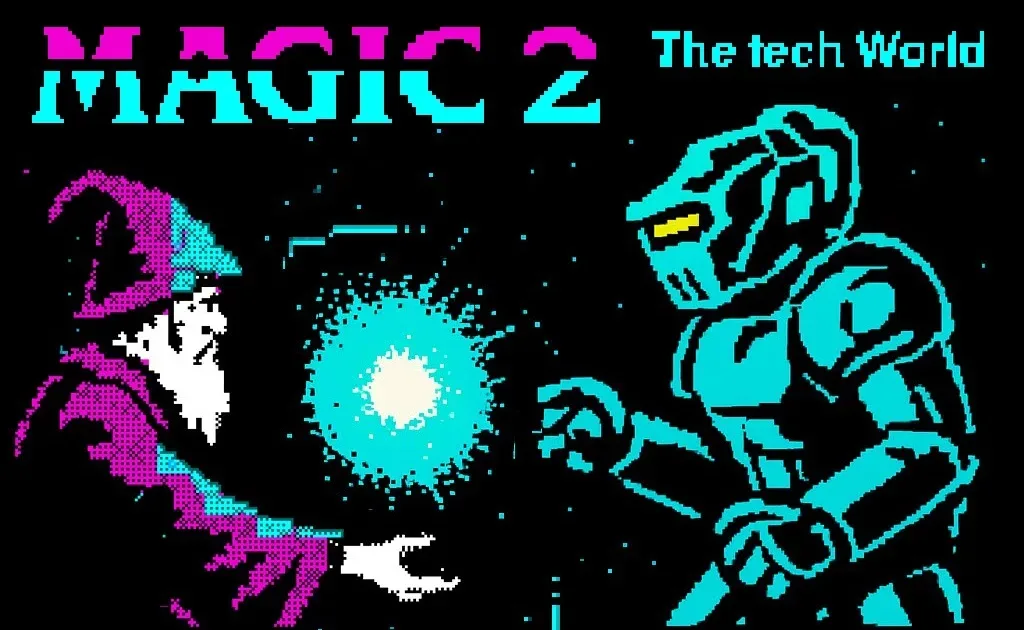
MAGIC 2: The Tech World is a new platformer in development for the ZX Spectrum 48K, with Mansoft returning to the misadventures of the accident-prone wizard Mordebruk. The game pairs a traditional run-and-jump structure with a distinctly unusual setting: rather than another fantasy kingdom, Mordebruk has been thrown into a technologically advanced temporal dimension filled with futuristic hazards, strange anomalies, and the pieces he needs to build a route home.
The premise begins with another magical disaster. Mordebruk attempts a spell, the spell goes wrong, and the wizard is left stranded far from familiar surroundings. This time, however, his predicament is not simply a matter of escaping a dungeon or surviving an enchanted wilderness. He has landed in a high-tech world where the usual rules and tools of his magic are no longer enough to guarantee safety.
For Spectrum players, the project is notable both as a new game for the 48K machine and as a platformer designed around demanding navigation and resource management. The task is not only to guide a character through dangerous rooms. Players will need to explore carefully, collect useful power-ups, and decide when using Mordebruk's defensive magic is worth the cost to his survival.
A wizard out of his element
Mordebruk's latest problem begins when a spell malfunctions and deposits him in an unfamiliar temporal realm. The dimension is described as bizarre and technologically sophisticated, creating a contrast between its magical protagonist and the electronic-looking setting that surrounds him. The central goal is clear: assemble the hardware needed to reconstruct a portal device and use it to return home.
For useful background on this topic, read Valve Says Steam Deck 2 Plans Still Depend on the Right Conditions.
Four specific components are required for that effort: a monitor, a gear, an energy collector, and a software cassette tape. The selection reinforces the game's fusion of old-school fantasy and retro technology. Mordebruk may be a wizard, but his escape depends on locating parts that sound more at home in a workshop or computer room than inside a spellbook.
This structure gives the adventure a practical scavenger-hunt objective. Each component represents a necessary step toward the portal, so progress will involve pushing deeper into the game's hazardous layout rather than merely reaching a single exit. The journey is framed as an attempt to undo one more of Mordebruk's own magical mistakes, putting the character's survival and eventual return at the center of the game.
The setup also continues the character's reputation for finding trouble. Mordebruk is described as having landed in serious danger once again, and the question facing players is whether he can survive a second major magical blunder. That light comic angle sits alongside what is presented as a very challenging platforming experience.
For another perspective on this story, read MAGIC 2: The Tech World Sends Mordebruk Into a ZX Spectrum 48K Techno-Temporal Trap.
Platforming with a survival cost
MAGIC 2: The Tech World does not treat Mordebruk's spells as unlimited solutions. Defensive magic draws from two vital pools: his magic reserves and his life energy. Every defensive spell therefore comes with a cost, making its use a decision instead of a reflex. Casting at the wrong time, or relying on magic too often, could leave the wizard in a weaker state when later hazards demand quick reactions.
That mechanic suggests that reaching the next area is only part of the challenge. A player must also consider the condition in which Mordebruk arrives there. Holding onto energy may be valuable in a dangerous stretch, while spending it to deal with an immediate threat could be the difference between surviving the current obstacle and running short later. The game's hazards are intended to test reflexes, but the spell system adds a layer of planning to that action.
Exploration provides the answer to this pressure. Power-ups are hidden through the game's layout and can replenish both the magic and life-related meters. Finding them is therefore more important than simply chasing a high score or optional bonus. These pickups can restore resources that make defensive casting viable, and they reward players who investigate the levels instead of rushing through every screen.
The resulting loop is straightforward but potentially tense: explore dangerous areas, avoid or confront hazards, look for restorative power-ups, preserve enough of Mordebruk's strength, and keep searching for the four portal components. On ZX Spectrum hardware, where precise movement and compact level design have long been central to platform games, that combination could make every route choice matter.
A new release for the ZX Spectrum 48K scene
The game is being developed specifically for the ZX Spectrum 48K, placing it among the continuing wave of new software created for classic home computers. The Spectrum remains a distinctive target for modern developers, with its recognizable visual identity, tightly constrained memory environment, and a community that continues to support new physical and digital retro projects.
MAGIC 2: The Tech World's choice of platform is particularly fitting for its premise. The game's technology-themed dimension, including the software cassette tape required for the portal, speaks directly to the era associated with cassette-loaded Spectrum games. Rather than treating the machine's age as a limitation to be hidden, the concept leans into the vocabulary of vintage computing while placing it inside a fantasy-platforming story.
Its title also signals a continuation rather than a completely unrelated one-off adventure. Mordebruk's mention as a wizard who has once again caused his own crisis makes the game a second outing for the character, although the immediate story is easy to understand on its own: he is trapped, he lacks his standard scroll spells, and he needs to recover the components that will take him out of the dimension.
No broader platform list, launch timing, or pricing information has been detailed here. What is established is that the project is a ZX Spectrum 48K game from Mansoft, built around difficult platforming, collectible restorative items, and a resource system in which magical defense is tied directly to the protagonist's wellbeing.
Technology, hazards, and careful exploration
The technological world surrounding Mordebruk is more than a visual backdrop for the premise. It defines the kind of escape he must engineer. A portal cannot be restored through a single powerful incantation; it requires separate pieces of equipment, including a monitor and a cassette tape. That makes the mission feel like a hybrid of magical rescue and mechanical repair.
Meanwhile, the futuristic anomalies and dangerous environmental threats ensure the wizard cannot simply wander freely in search of those items. The game is presented as a challenge for players' reflexes, so navigating its environments will demand care. With magic and life energy linked, mistakes may have consequences beyond losing immediate momentum. A defensive response that saves Mordebruk from one danger may reduce his ability to deal with another.
Power-ups offer a reason to take risks and examine the game's layout. Hidden replenishments can improve a difficult situation, but reaching them may itself require navigating hazards. This creates a familiar platform-game trade-off: the safest visible route is not always the route that best prepares the player for what lies ahead. In MAGIC 2, that choice is amplified because supplies affect both the wizard's magical capability and his vitality.
The unusual collision of themes should help the game stand apart within retro platforming. Mordebruk remains an old-fashioned wizard, but the challenge before him involves technological artifacts and a temporal realm rather than castles, dragons, or standard fantasy scenery. The contrast opens the door for a playful interpretation of the Spectrum era's computer culture without abandoning the direct, screen-by-screen urgency expected from a demanding platformer.
Mordebruk's route back home
At its heart, MAGIC 2: The Tech World is about extracting Mordebruk from a predicament of his own making. His failed spell has taken away the comfort of his usual scroll-based magic and placed him in a hostile world where every useful action needs to be weighed against a finite reserve of strength. The four portal parts provide a tangible path forward, while the dangers between them create the game's moment-to-moment test.
Players who enjoy new productions for classic machines will find a familiar foundation in its platforming focus, with an added emphasis on collecting resources and managing defensive abilities. The goal is not merely to survive a sequence of jumps and traps, but to arrive at the final portal-building objective with enough resources and persistence to finish the job.
Whether Mordebruk can escape the technological temporal dimension remains the adventure's central question. For now, Mansoft's ZX Spectrum 48K project promises a compact retro challenge where an unlucky wizard, a collection of strange computer-like components, and a hazardous maze of futuristic obstacles all converge in one very inconvenient magical accident.
Community
Discussion
Start the conversation.
No comments have been posted yet.