

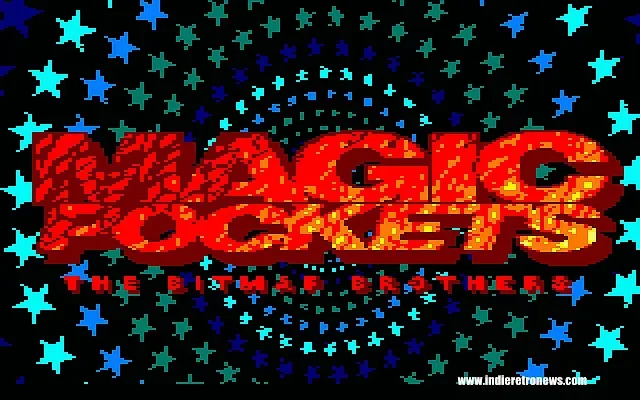
Magic Pockets, the colorful 1991 platformer created by The Bitmap Brothers and originally published by Renegade, is receiving a new conversion for the Amstrad CPC 6128. The project comes from Lake Software and is intended to bring the full arcade-style journey of Bitmap Kid to standard, unmodified CPC hardware.
The conversion is an ambitious fit for a machine with very different strengths and limitations from the Amiga systems most closely associated with the original. Lake Software's stated goal is not simply to recreate the name or a handful of familiar stages, but to capture the structure and momentum of the game: four themed worlds, 30 levels, distinctive weapon behavior, animated presentation, and the quick platforming flow that defined the 1991 release.
There is also a clear technical angle to the project. The CPC version is being built around hardware scrolling and double-buffering, two elements intended to keep movement smooth while action remains responsive. It is a notable objective for a conversion of a game remembered for busy screens, imaginative environments, and a character whose unusual equipment is central to both its humor and gameplay.
Bitmap Kid's missing toys return
Magic Pockets stars Bitmap Kid, whose seemingly bottomless trousers are at the heart of the game's offbeat premise. After his toys are lost, the hero must venture across a series of fantastical locations to get them back. The route takes players through The Cave, The Jungle, The Lake, and The Mountain, with each world offering its own visual identity and hazards.
For useful background on this topic, read Puzzle Bobble AGA Brings Taito's Arcade Bubble Classic to Amiga 1200.
The planned CPC 6128 conversion covers those four regions across 30 levels. That scope matters because Magic Pockets is not built around one repeating backdrop or a simple progression of interchangeable obstacle courses. Its worlds are designed to feel separate, and the changing themes support the game's evolving arsenal. A faithful conversion needs to preserve that variety while maintaining readable platforms and enemies on an 8-bit home computer.
At its most direct, the game is a platformer about moving quickly, timing jumps, avoiding danger, and pushing onward through stages. Yet its personality comes from the unusual actions available to the player. Bitmap Kid does not rely on a single conventional projectile from beginning to end. Instead, the weapons change with the world, helping each area establish its own rhythm and flavor.
World-specific weapons are part of the appeal
Lake Software's version aims to retain the original game's distinctive world-based attacks. Players can expect weapons including whirlwinds, rolling balls, ice cubes, and snowballs. These are more than cosmetic swaps for the same shot: their presence is part of why Magic Pockets remains memorable among early-1990s platform games.
The varied ammunition reinforces the surreal tone of the adventure while also giving the levels a stronger sense of place. A player heading from the cave environments into the jungle, lake, and mountain settings is not merely seeing a palette change. The tools being used against threats change alongside the scenery, creating a more playful take on progression than a standard run-and-jump game might offer.
That design is especially well suited to a retro conversion, because it gives the release recognizable moments to preserve. Fans are likely to look for the journey's four-world structure, Bitmap Kid's peculiar trousers, and the characteristic projectiles as much as they will compare individual screen layouts. Lake Software is therefore taking on both the technical challenge of fast action and the equally important task of retaining the game's unusual identity.
Built for a standard CPC 6128
The Amstrad CPC 6128 is the specific target for the conversion, and Lake Software hopes it will run smoothly on normal, unmodified hardware. For retro players, that is an important detail. Projects made for classic systems can sometimes depend on expanded memory, accelerators, modern storage devices, or other additions that were not part of the typical original experience. This release is instead designed with the base machine in mind.
To support fluid gameplay, the conversion uses a combination of hardware scrolling and double-buffering. Hardware scrolling can reduce the workload involved in shifting a game view across the screen, while double-buffering helps present animation in a more stable way by preparing a new frame before it is displayed. In practical terms, the approach is intended to preserve a fast, reactive feel during platforming rather than settling for a heavily simplified interpretation.
It is an appropriately demanding choice for Magic Pockets. The original is remembered for motion, colorful animation, and a lively, often chaotic energy. Bringing that sensation to the CPC requires careful compromises, but the project's technical plans suggest an effort to make those compromises in ways that protect the pace of the game.
As with any conversion still being assessed in motion, the ultimate result will depend on how these techniques hold up throughout the full game, including during the busiest sequences. Still, the focus on smooth scrolling and responsiveness indicates that Lake Software understands what needs to survive the transition for Magic Pockets to feel like Magic Pockets rather than simply resemble it.
Intro animation and AY chip audio are planned
The presentation is not limited to the playable stages. Amstrad CPC owners are set to receive the original animated introduction sequence and title music as part of the package. Including these elements gives the conversion a stronger sense of completeness, particularly for a game whose style was a major part of its original appeal.
Audio is being handled natively through the CPC's AY sound chip. The planned sound package includes crisp effects and jingles in addition to the title track. The AY chip has a distinctive voice familiar to long-time Amstrad, Spectrum, and MSX enthusiasts, and using it directly is fitting for a production focused on authentic CPC 6128 operation rather than modernized audio playback.
For a platformer, short sound cues carry more weight than they sometimes receive in technical summaries. Jump sounds, impacts, pickups, weapon effects, stage jingles, and transitions all contribute to feedback and momentum. The combination of an animated opening, title music, and dedicated in-game sounds should help the conversion feel like a full commercial-era production rather than a stripped-back demonstration of what the machine can do.
A custom loader tackles the disk space challenge
Fitting a large multi-world platformer onto CPC disk media presents another challenge beyond graphics, movement, and sound. Lake Software is using a custom disk loader to make the release viable, with 210 KB of data packed onto each side of the disk across 42 tracks.
That figure illustrates the level of care required when adapting a larger game to period storage constraints. Every component competes for space: level data, artwork, animation, music, sound effects, loading routines, and the code itself. A custom loading solution can be as essential to the final result as a clever scrolling routine, particularly when the aim is to include a full 30-level adventure rather than a reduced selection of screens.
The loader is therefore not just a behind-the-scenes technical footnote. It is part of the conversion's attempt to balance scope against the practical limits of the CPC 6128 format. Retro software development frequently requires this kind of whole-project engineering, where disk layout and memory management directly shape what players ultimately see and hear.
AI assistance is disclosed
Lake Software has disclosed that the Magic Pockets conversion is AI-assisted, specifically in relation to code and sounds. That disclosure is useful context for following the project and evaluating the workflow behind it. The game remains a conversion being assembled for original Amstrad hardware, with the finished program needing to meet the very real constraints of the CPC 6128 regardless of the tools used during development.
AI-assisted development has become an increasingly visible topic across games of all sizes, from modern studio productions to homebrew releases for vintage machines. In this case, the disclosed use covers code and audio work, while the project's stated goals remain concrete and testable: smooth play on unmodified hardware, four worlds, 30 levels, original-style presentation, AY-driven sound, and disk loading designed around the available capacity.
Magic Pockets has always had a personality that stands apart from more straightforward platform games of its era. Its bizarre premise, themed weapons, and richly varied environments made it a memorable part of The Bitmap Brothers catalogue. If Lake Software can deliver on its intended feature set, the Amstrad CPC 6128 edition could offer a substantial new way to experience Bitmap Kid's toy-recovery adventure on one of the most enduring 8-bit home computer platforms.
Community
Discussion
Start the conversation.
No comments have been posted yet.