

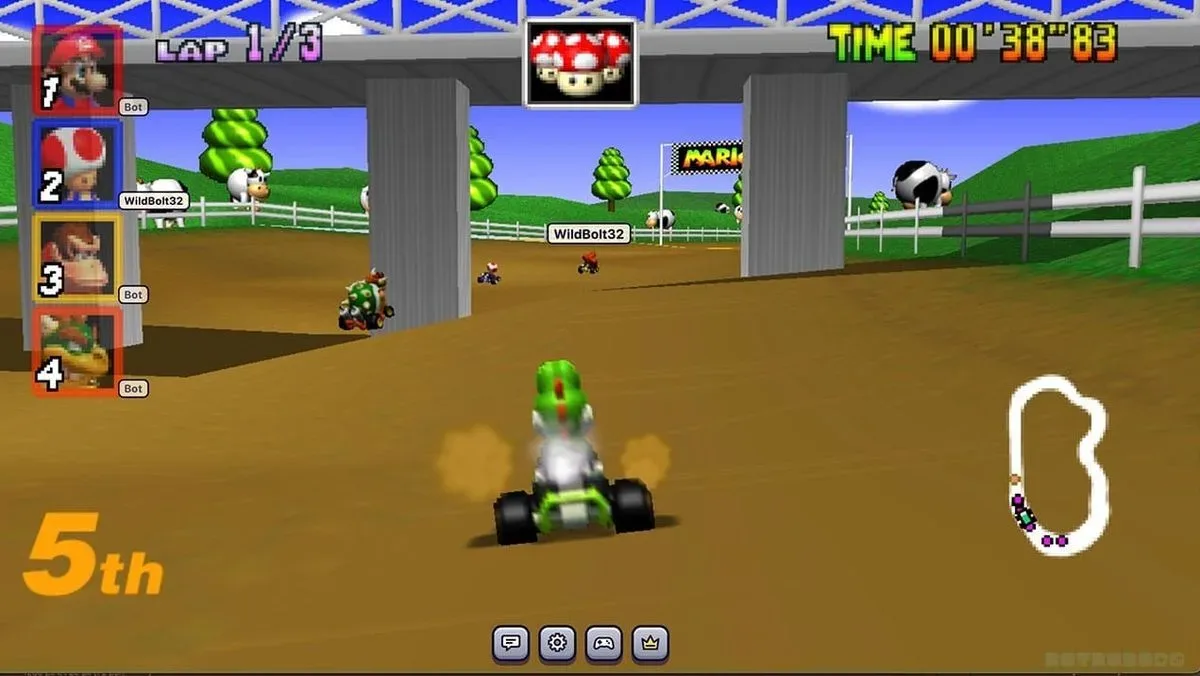
Mario Kart 64 can now be played through a web browser in a version that includes real-time online multiplayer and private rooms. The project, credited to Oliver Sauter, makes Nintendo 64-era kart racing immediately accessible without a conventional download, installation process, or account sign-up. Players can choose a racer and track, set a display name, and enter quick races that rotate regularly, while private options offer a way to race with selected friends.
For a game so closely associated with local multiplayer on Nintendo's 1996 console, the appeal is easy to understand. Mario Kart 64 was built around gathering in front of one television, dividing the screen among up to four competitors, and accepting the inevitable chaos of shells, banana peels, and last-second position changes. A browser implementation with online play shifts that familiar experience toward the modern convenience of opening a page and joining a race from virtually anywhere.
The browser version is said to use SpaghettiKart, libultraship, and WebAssembly technology. In practical terms, WebAssembly enables demanding software to run within compatible web browsers at speeds and with capabilities beyond what many players may associate with older browser games. Rather than treating Mario Kart 64 as a simple streaming video or a lightweight imitation, the project aims to provide a playable version directly in the browser environment.
Online races begin quickly, with bots filling the grid
One of the project's most notable features is its approach to matchmaking. New races begin every 30 seconds, allowing players to enter a relatively fast-moving rotation rather than waiting through a lengthy lobby process. Competitors can race against other people in real time, and when the available player count does not fill out a race, computer-controlled drivers are used to complete the field.
For useful background on this topic, read Secret of Goku ROM hack Recasts Secret of Mana With Dragon Ball Z's Hero.
That detail matters for a browser-based multiplayer project. A game that depends entirely on a large simultaneous audience can become difficult to enjoy at quieter times. Including bots means a player can still get onto the track even if the room contains only a small number of human racers. Mixed races featuring both online players and AI opponents are supported, preserving the sense of a fuller Mario Kart event without demanding that every slot be occupied by another person.
Private rooms are available as well. Public rotating races are useful for spontaneous sessions, but private spaces give groups a more controlled way to play together. Friends can arrange races without relying on the public queue, potentially making the port particularly appealing for remote game nights or quick breaks where everyone wants to revisit a classic course together.
Keyboard controls keep the desktop setup simple
On desktop and laptop browsers, the control scheme is intentionally uncomplicated. The arrow keys handle steering, while the X and Z keys cover the key racing and item actions. That means players can get moving without the extra step of configuring a controller before their first race.
The reduced setup is a major part of the project's appeal. Classic games are frequently revisited through emulation or fan-made ports, but those routes can involve locating compatible software, choosing input settings, managing files, or troubleshooting performance. Here, the stated goal is immediate access: open the browser page, choose the desired options, and race.
Players are able to select their character, pick a track, and change their name before joining in. If no character is chosen, the game assigns one automatically. There are also options connected to camera use, adding another layer of personalization for participants who want it. The experience is designed around getting players into races rapidly while still retaining a few of the choices expected from an online multiplayer game.
Touch controls bring the experience to iPhone
The browser port is not limited to a traditional computer setup. It has also been tested on iPhone, where it presents a touch-friendly control layout. On-screen inputs include a virtual joystick and four buttons corresponding to drifting, acceleration, braking, and item use.
Mobile support is an especially interesting fit for Mario Kart 64. The original game's tracks are generally short, its races are easy to understand at a glance, and its action is immediately recognizable even to players who have not touched the Nintendo 64 version in years. Those qualities make it well suited to brief mobile sessions, whether someone is playing a single public race or meeting friends in a private room.
Of course, playing a fast kart racer through touchscreen controls will not be the preferred setup for every player. Precision steering, drifting, and item timing can feel very different when virtual buttons replace a physical controller. Still, simply having the option to launch the game on a phone without an app installation makes this project stand out. Users can also save the page to a phone's home screen as a shortcut, making later access feel closer to opening a dedicated game.
A new way to revisit a defining Nintendo 64 multiplayer game
Mario Kart 64 remains one of the most recognizable multiplayer games of its generation. Its roster, battle-tested item system, and memorable circuits helped establish the series as a long-running social staple. Courses such as Rainbow Road, Toad's Turnpike, Yoshi Valley, and Royal Raceway still inspire discussion among fans, whether they are debating shortcuts, favorite music, or the tracks most likely to cause an argument among friends.
What makes the browser project notable is not merely that an old game can run on newer hardware. Retro titles have been playable through various methods for years. The more unusual element is the combination of browser access, quick online matchmaking, private rooms, desktop keyboard inputs, and a mobile touch interface. It takes a game historically tied to a particular piece of hardware and places it in a form designed around convenience and connectivity.
That does not erase the charm of the original local setup. Four-player split-screen on Nintendo 64 hardware has a distinct atmosphere that online play cannot fully duplicate: people shouting across a couch, seeing one another's screens, and reacting instantly when a blue shell changes the result. But online browser play solves a different problem. It makes it easier for players separated by distance to share the same game with very little preparation.
Web technology continues to expand retro possibilities
Projects built around WebAssembly have increasingly demonstrated that browsers can be more than a place for simple puzzle games and lightweight distractions. Modern browsers can support substantial interactive applications, and retro software is a natural area for experimentation. Older games often have design strengths that remain appealing today, while their comparatively modest technical demands can make them suitable candidates for web-based projects.
For players, the benefit is straightforward: fewer barriers between curiosity and play. Someone who suddenly wants to revisit Mario Kart 64 does not necessarily need to unpack an old console, connect it to a display, locate controllers, or prepare a separate application. They can instead use a compatible browser and head directly into a race.
That convenience also gives the game an audience beyond dedicated retro enthusiasts. A longtime fan might share a private room with friends who never owned a Nintendo 64. Another player may join a public race simply to see why the game remains such a frequent point of nostalgia. The short matchmaking cycle and automatic bot support help accommodate both kinds of visitors.
What players should keep in mind
As with any browser-based multiplayer experience, performance can vary based on device, browser, connection quality, and the number of people in a session. Desktop keyboard controls and mobile touch inputs provide distinct ways to play, so comfort and responsiveness may differ between setups. Players looking for the closest possible feel to the original Nintendo 64 controller may prefer to experiment on a computer first, while those prioritizing portability may find the iPhone interface more convenient.
It is also worth remembering that this is a fan-driven technical project rather than a newly announced official Nintendo release. Its standout features are the accessibility of its browser format and the addition of online functionality, not a replacement for the original retail game or Nintendo's own modern Mario Kart offerings.
Even so, the project is a compelling example of how a celebrated retro game can be experienced in a new context. Mario Kart 64's core formula still works: select a character, learn the turns, use items at the right moment, and hope the race does not change completely before the finish line. Now that routine can begin from a browser tab, with public competitors, friends in private rooms, and bots ready to fill any empty places on the starting grid.
Community
Discussion
Start the conversation.
No comments have been posted yet.