

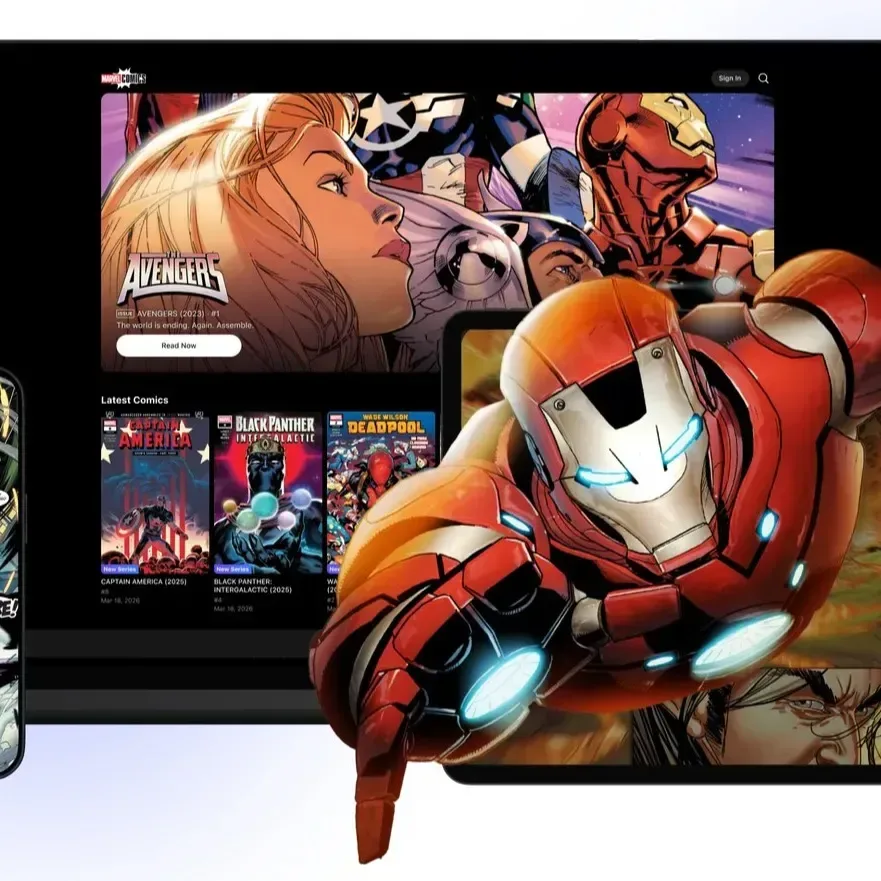
Marvel's long-running digital-comics subscription experience is entering a major transition, but an early hands-on look at the replacement suggests the practical differences may be more limited than the branding change implies. The new Marvel Comics app, powered by Webtoon, is set to launch on November 16 with more than 35,000 digital comics. It will replace the Marvel Unlimited app, which is scheduled to sunset on December 7, 2026.
For readers who have built reading histories, saved titles, and favorite event checklists within Marvel Unlimited over many years, that is a substantial change. Marvel Unlimited has existed since 2007, making it a familiar destination for readers catching up on decades of Marvel stories and the company's Star Wars comics catalog. The incoming app retains that broad-library proposition at both of its subscription tiers, but its clearest immediate benefit is a shorter delay before newer issues become available.
Under the new structure, the more expensive Ultimate tier will add new issues 30 days after print publication. That is a notable improvement over Marvel Unlimited's existing 90-day wait. For readers trying to avoid falling far behind on current runs without purchasing every single release individually, the reduced delay could be the strongest reason to embrace the new service.
Beyond that release-window change, however, the early version of the application appears more like a modernization of the established Marvel Unlimited formula than a dramatically different way to read comics.
For useful background on this topic, read Kanto Tactics Brings Grid-Based Pokémon Battles to the Browser.
A new shell for a familiar comics library
Webtoon's stated design goal for the Marvel Comics app is straightforward: make the service quicker and easier to use. That objective makes sense for a platform whose interface has long shown its age. Marvel Unlimited remains useful because of its enormous archive and strong organization around events and series, but its presentation has not always felt as contemporary or polished as the content it carries.
The new app's navigation does look more modern in an early convention-floor demonstration at New York Comic Con. Menus and browsing screens have been refreshed, and the overall visual structure is cleaner than the older application. Yet the most important part of that mission--speed--was not immediately obvious during the hands-on time.
There are important caveats to any short demo conducted at a busy convention. Devices at a booth, temporary configurations, and inconsistent venue Wi-Fi can all affect loading behavior. Still, the new app did not appear noticeably faster than Marvel Unlimited in that setting. That leaves an understandable question: if the core experience is so similar, why was a separate replacement app necessary instead of a substantial update to the existing one?
That question is particularly relevant because a service migration asks more of users than a redesigned interface. Readers will have to move to a new application, even though their collection access and much of the underlying reading experience are intended to continue. The Marvel Comics app will allow users to bring over their library and reading progress, which is essential for anyone in the middle of a long run or a massive crossover chronology. But even a supported migration can create friction for subscribers who are comfortable with the app they already use.
The issue page is one of the more useful changes
The most compelling element seen in the early build comes before a comic is opened. Rather than sending the reader directly into pages, the Marvel Comics app presents an overview screen for the selected issue. That page includes information about the comic and makes it possible to scroll through other issues in the same series along the top of the screen.
For ongoing comics, this can make navigating a run feel less like bouncing between disconnected search results and more like browsing a shelf. It is a small quality-of-life improvement, but comic readers often need exactly this kind of context. A single issue can be part of a monthly title, a crossover, a relaunch, a legacy-numbered sequence, or several of those things at once. Clearer movement between adjacent issues can help reduce that confusion.
The overview page also surfaces every reading guide that includes the chosen issue. This is significant because reading guides remain among the most valuable tools in a subscription library of this scale. Marvel stories are packed with events that spread across many series, companion issues that sit outside a main title, and older arcs that can take hundreds of comics to complete if read in strict publication order.
Many readers do not want to tackle every issue from every related series. A well-built guide can instead point them toward an efficient route through the essential chapters of an event or storyline. Marvel Unlimited's guides have been a major strength, and the early look indicates that functionality is carrying forward into the Webtoon-powered app.
There was not enough time in the hands-on session to verify whether every existing guide has made the transition intact. That detail matters. The value of a reading-guide system is not just the presence of a category labeled "guides," but the completeness, accuracy, and editorial maintenance of its entries. With a catalog encompassing Marvel and Star Wars material across many eras, preserving the depth of the old system will be at least as important as giving it a new interface.
Reading options remain largely unchanged
Once an issue is open, the actual digital-comics reader will be familiar to Marvel Unlimited subscribers. Users can read a full page at a time or switch to a panel-by-panel mode. The latter can be especially helpful on smaller screens, where dialogue and detailed artwork may be difficult to appreciate at standard page size.
The app also supports a useful option that zooms back out to the complete page when it is time to advance. That preserves the benefit of guided panel reading while still allowing readers to take in the intended composition of the page. Comic-book art is designed around panel placement, page turns, visual reveals, and the relationship between images; seeing the complete page remains an important part of the medium even for readers who prefer a guided approach for dialogue.
These are good reading features, but they are not new ones. Marvel Unlimited already offered the same core choices, and its setup was not especially difficult to use. That underlines the broader impression of the transition: the new Marvel Comics app may be more visually current, but it does not yet appear to introduce a revolutionary reader or a radically expanded set of tools at launch.
Promised additions need a timetable
Webtoon has outlined a broader roadmap that could eventually give the Marvel Comics app a more distinct identity. Planned additions include Disney and Pixar comics, easier creation of custom lists, and multiple profiles for households. The profile feature is particularly practical for families, as it could let parents separate their own reading progress from a child's selections and potentially make shared-device use much less cumbersome.
Custom lists could also be meaningful for dedicated readers. Fans frequently build personal queues around creators, character histories, alternate universes, major events, or specific eras such as the Claremont X-Men years or modern Star Wars publishing. Better list tools could turn the app into a more flexible personal library rather than simply a place to search, save, and resume individual comics.
Disney and Pixar material would broaden the service beyond its current Marvel and Star Wars foundation. But these roadmap items have not been given release dates. Until they arrive, they should be treated as future ambitions rather than launch-day reasons to migrate.
That distinction is important as Marvel Unlimited approaches its December 7, 2026 shutdown. A new interface, quicker access for Ultimate subscribers, and a promised transfer of libraries and progress give the Marvel Comics app a functional starting point. Yet several of the most potentially transformative improvements are still undefined in timing, and the main act of reading a comic looks very close to what existing subscribers already know.
What the transition means for readers
The new app's success will likely depend on execution after launch. If the migration process is smooth, reading guides are preserved, performance improves outside a convention environment, and the roadmap lands promptly, the service could become a more capable and more welcoming home for Marvel's enormous back catalog. The 30-day print-to-digital window at the Ultimate tier is already a concrete upgrade for subscribers who value current comics.
At the same time, the move carries risk. Some longtime Marvel Unlimited users may be reluctant to install a replacement when the old app already met their primary needs. Others may be wary until they can confirm that their progress, saved material, and preferred guides made the trip successfully. A service with a nearly two-decade history has accumulated habits as well as subscribers.
Marvel Comics, powered by Webtoon, launches November 16 with its library of more than 35,000 digital comics. It has a clear opportunity to make a vast archive easier to navigate and easier for households to share. For now, though, its most tangible launch advantage is speedier access to new issues for Ultimate-tier members, while many of its more ambitious changes remain things readers will have to wait to see.
Community
Discussion
Start the conversation.
No comments have been posted yet.