

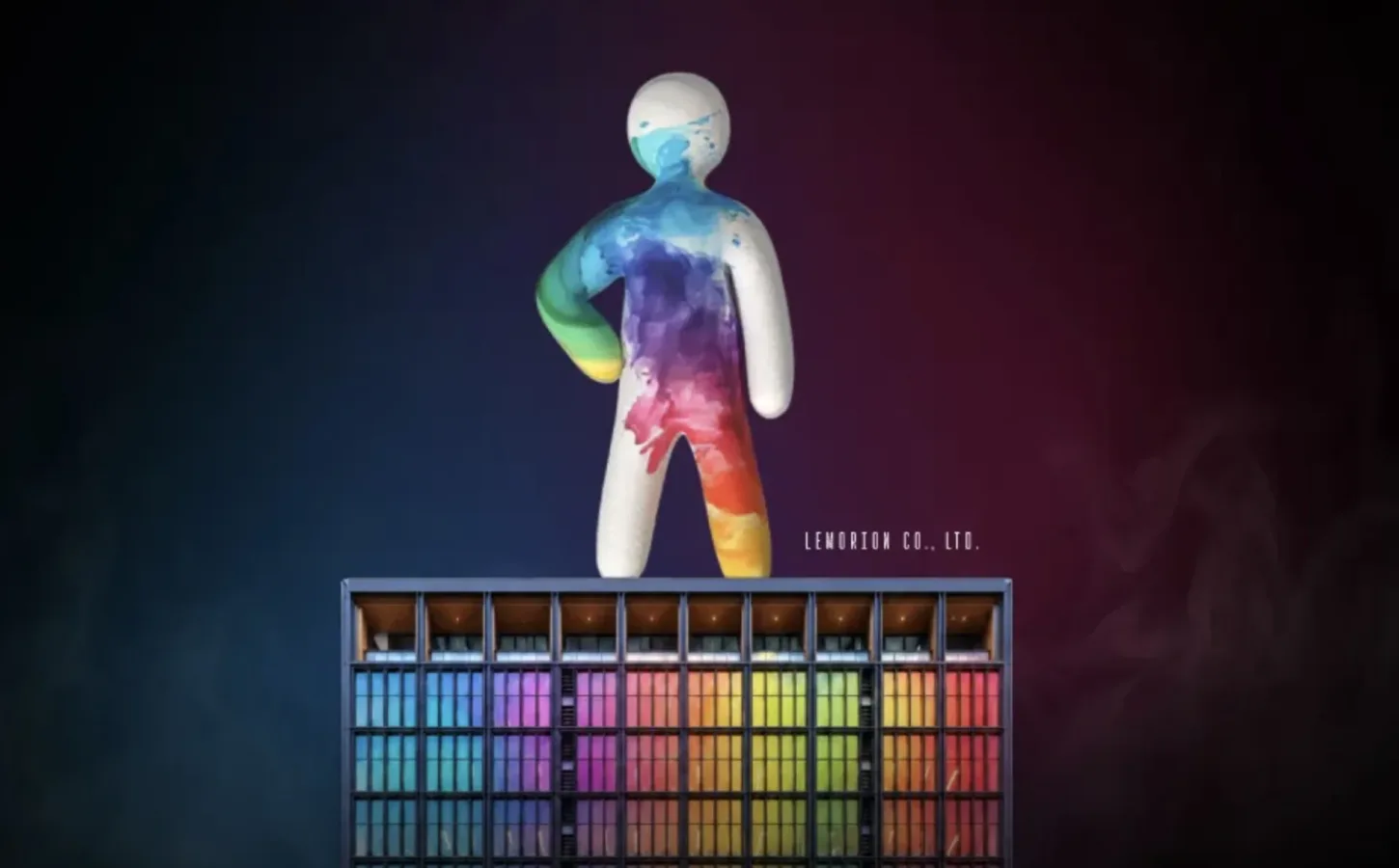
Meccha Chameleon, the Japanese indie game that surged across streaming communities earlier this summer, is taking its signature camouflage challenge out of the screen and into a public venue. A free event based on the game is planned for September 23 at the One Fukuoka Building in Fukuoka, Japan, inviting visitors to paint a small human figure and conceal it within a specially prepared real-world space.
The activity will use the building's sixth-floor Sky Lobby, adapting the game's core loop into a communal hide-and-seek experience. Rather than controlling an avatar through a digital environment, participants will create their own figure, color it to blend with the surrounding area, and place it somewhere that challenges other attendees to spot it.
It is a straightforward premise, but that simplicity is central to why Meccha Chameleon has connected so strongly with players. The game turns a basic character model into a blank canvas, asking players to study textures, colors, shapes, shadows, and visual clutter before covering themselves in a custom paint job. A well-hidden figure may be sitting in plain sight, yet remain difficult to identify until an opponent notices one small detail that does not belong.
Embedded X/Twitter post
That visual trickery has made the game especially well suited to streams and short clips. Viewers can join the search, debate where a disguised player might be hiding, and enjoy the eventual reveal when an apparently ordinary part of the environment turns out to be another contestant. Its emphasis on custom maps has also helped maintain variety, allowing different settings and hiding possibilities beyond a fixed selection of stages.
For useful background on this topic, read 1666: Amsterdam Turns Witchcraft and Possession Into a Dense Stealth Sandbox.
From digital camouflage to a physical challenge
The Fukuoka event builds on an idea that has already emerged around the game's community: recreating its little character figures and placing them in real places. In the game, environmental awareness and creative painting are the skills that matter. In person, those same instincts become a more tactile activity, with attendees considering how an object can disappear against a wall, display, prop, or themed backdrop.
That does not mean the event is simply a literal copy of the game. Digital play gives competitors immediate freedom to move, alter their character, and search sprawling virtual scenes. A physical activity has different constraints, but it also offers something the game cannot fully reproduce: people making art side by side, comparing their camouflage techniques, and searching an environment together.
The Sky Lobby setup is intended to provide the setting for both halves of the experience. Participants will first personalize their figures, then test whether their choices are convincing enough to escape the attention of other visitors. The strongest designs will likely depend on more than selecting the right color. Breaking up an outline, matching repeated patterns, and understanding where people naturally look could all make the difference between a clever hiding place and an immediately obvious one.
That kind of accessibility is an important fit for Meccha Chameleon. While the game can reward sharp observation and elaborate map knowledge, its basic idea is easy to understand almost instantly: paint yourself, hide, and try not to be found. The event similarly turns that concept into something that can be enjoyed without prior experience, controllers, or familiarity with the game's online community.
A family-oriented event with themed spaces
The planned activity is being positioned with younger visitors in mind. Elementary-school-age participants and younger children are encouraged to take part alongside a parent, while adults will also be able to participate on their own. The parent-child approach should make the event feel less like a competitive specialist gathering and more like a shared creative outing, where families can paint, hide, search, and discuss their choices together.
There is also a collaboration with Round1, the arcade chain, to provide themed stages. Those spaces should give the event more variety than a single general-purpose hiding area. Different backdrops can radically change how players approach camouflage: a bright arcade-style location may favor bold patterns and busy details, while a cleaner or more uniform section could demand subtler matching and carefully chosen placement.
The themed areas also mirror one of the game's enduring strengths. Meccha Chameleon thrives on the difference between environments. A strategy that works against a colorful sign, a shelf full of objects, or a heavily decorated wall might fail completely in a sparse space. By giving visitors multiple types of stages to work with, the event can turn that learning process into an approachable real-world experiment.
Organization is being handled in partnership with Bloomin' Kids, a group focused on making art activities enjoyable, inventive, and collaborative for children. That partnership helps explain why the event's format puts creation at the center rather than treating the figures purely as game pieces. Every hidden character begins as an art project, and the act of making one is part of the attraction even before anyone starts looking for it.
The September 23 gathering will ask visitors to turn observation, painting, and placement into one shared camouflage game.
A major success gives the concept room to grow
Meccha Chameleon's move into an in-person event follows an extraordinarily rapid rise. The game reportedly exceeded 20 million units sold during its first two months, an enormous result for an indie release and a clear sign that its easy-to-read premise reached far beyond a small niche. Its low price point, streamer visibility, and seemingly endless supply of player-created scenarios all contributed to the sense that there was always another clever hiding clip to watch.
Viral games often face a difficult question once their initial surge slows: how can the attention surrounding a simple, memorable concept become something lasting? For Meccha Chameleon, a physical event is a natural answer. The central mechanic does not rely on complicated lore or a particular competitive ruleset. It is built on a familiar childhood instinct--hiding something and daring somebody else to find it--enhanced by a creative coat of paint.
That makes the Fukuoka event more than a conventional promotional appearance. It is an attempt to show that the game's appeal can function outside of a digital interface. Participants do not need to be expert players to understand why a camouflage challenge is fun, and fans who already know the game can see its visual jokes and search mechanics translated into physical space.
There are practical benefits to that translation as well. In a game, a player may move through a map alone or compete with people online. At a public event, the searching becomes visible and social. Someone can point out a suspicious texture, laugh at a nearly invisible figure, or admire the work that went into a particularly effective disguise. The challenge becomes part puzzle, part craft activity, and part spectator experience.
Could Meccha Chameleon travel beyond Fukuoka?
No additional locations have been announced, so the September 23 event at One Fukuoka Building remains the only confirmed gathering. Still, the concept appears flexible enough to work in other venues if the first outing proves successful. Shopping spaces, arcades, museums, hobby events, and family-focused festivals could each offer distinctive environments for a version of the activity, especially when paired with themed backdrops.
Any expansion would depend on how the Fukuoka event is received and on the logistics of creating safe, manageable places for attendees to paint and hide their figures. But Meccha Chameleon's strong sales and broad online visibility give the experiment a substantial audience to draw from. The format also has an advantage over many game tie-ins: it is immediately recognizable even to people who have never played.
For now, the focus is on the sixth-floor Sky Lobby in Fukuoka. On September 23, attendees will have the chance to test a deceptively difficult question that has powered Meccha Chameleon's popularity from the beginning: if a small human figure is painted carefully enough, can it vanish in front of everyone's eyes?
Community
Discussion
Start the conversation.
No comments have been posted yet.