

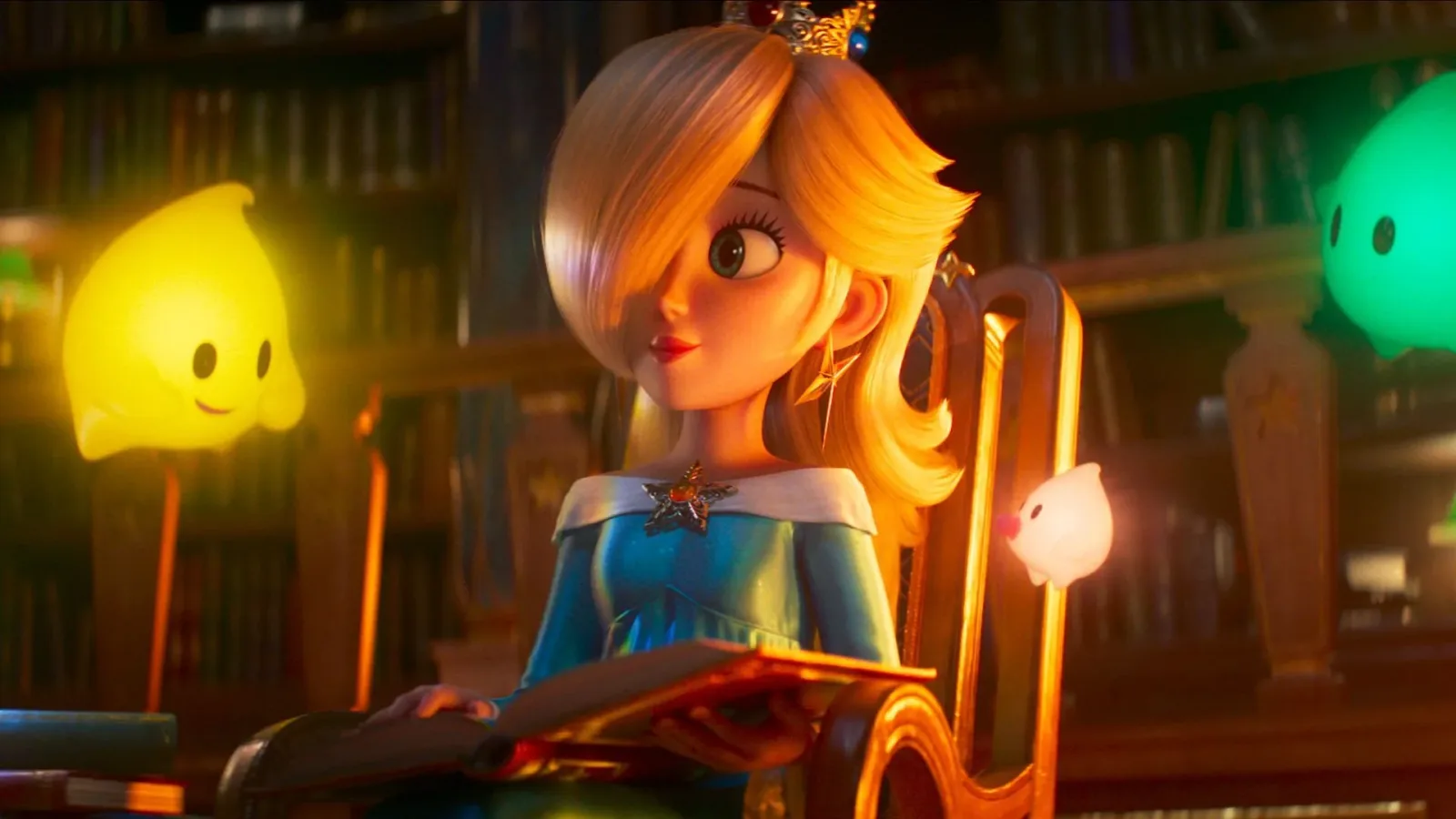
Mercedes Rose, the actor who first brought Rosalina to life in Nintendo's Super Mario Galaxy games, has shared a candid reaction to Brie Larson's portrayal of the character in The Super Mario Galaxy Movie. Rose praised Larson's work, but also joined the growing conversation around how the film uses one of the Mushroom Kingdom's most mysterious and emotionally significant figures.
Posting on X, Rose wrote that Larson was "a great Rosalina," while adding that the character should have received considerably more time on screen. She also made no secret of her personal feelings about the recasting, writing that she wished the part had been hers.
"Brie was a great Rosalina although I think we can all agree she needed much more screen time. And I DO wish it was ME! :)"
Embedded X/Twitter post
The response is notable because Rose's history with Rosalina goes back to the character's debut. She voiced the cosmic guardian between 2007 and 2010, beginning with the original Super Mario Galaxy. For many players, that performance helped establish Rosalina as a distinct presence in the wider Mario cast: calm, maternal, melancholy, and noticeably different from the fast-paced energy usually associated with the series.
For useful background on this topic, read Midnight Black PS5 Digital Edition Announced for Japan Alongside GTA 6 Launch.
Rose's remarks are not framed as criticism of Larson herself. Instead, they highlight two separate issues that have become central to discussion of the movie: whether Rosalina is given enough room within its story, and how fans respond when recognizable game characters receive new voices in major animated adaptations.
A major character with limited room to shine
Rosalina occupies an unusual position in Mario lore. Unlike Mario, Luigi, Peach, Bowser, or Donkey Kong, she is not simply another recurring resident of the Mushroom Kingdom. Her connection to the Comet Observatory, the Lumas, and the larger universe gives her a mythic quality. The games also linked her to one of the series' more reflective stories through the tale book found in Super Mario Galaxy.
That background made her inclusion in The Super Mario Galaxy Movie particularly important. The film revolves around Rosalina, yet a prominent criticism has been that she does not receive as much actual screen presence as the premise appears to promise. Rose's comment directly addresses that disconnect: a character can be crucial to the narrative without receiving enough scenes to develop her personality, relationships, and stakes.
The issue was echoed in a three-star assessment of the film, which described the sequel as more energetic and imaginative than its predecessor but argued that its ambitious approach loses momentum because of an underdeveloped story and an unusual handling of Larson's Rosalina. That reaction reflects a broader split in the reception. Viewers have responded much more warmly than many critics, even as questions have persisted about the way the movie structures its biggest character moments.
For Rosalina in particular, screen time matters. The character's appeal has never depended solely on visual recognition or a single memorable line. She works because of atmosphere, restraint, and the sense that she has lived through experiences far beyond those of most Mario characters. A movie that positions her near the center of its plot has a lot to gain from letting that quiet, otherworldly side breathe.
Brie Larson's take and the recasting conversation
Larson's casting gave the role a high-profile voice, continuing the approach established by the Mario animated films, which have built their ensembles around well-known screen actors. That strategy can introduce the characters to audiences who may not know the games, while also generating a very different kind of attention from longtime Nintendo fans.
It also inevitably raises questions about legacy performers. Voice acting in games can create a powerful association between a character and a performer, even if that performer worked on only a portion of the character's history. Rose's time as Rosalina covered the character's foundational years, so her wish to return is easy to understand.
Her post is especially measured in that context. Rose did not dismiss Larson's performance or suggest that the film's version of Rosalina failed because it used another actor. She complimented Larson first, then expressed her own understandable disappointment. Both reactions can coexist: audiences can appreciate a new interpretation while still feeling attached to the voice that introduced them to the character.
That tension is common whenever games become films. Adaptations have to make choices based on story structure, celebrity casting, vocal direction, and the needs of a new medium. At the same time, game performers often helped define the characters long before an adaptation reached cinemas. For fans, recognizing that history is part of recognizing what made a character worth adapting in the first place.
The Rosalina and Peach reveal changes the movie's priorities
One of the film's biggest story choices is its revelation that Rosalina and Princess Peach are sisters. It is a significant departure from the usual presentation of the characters in Mario games, where their relationship has not been defined this way.
The twist gives the movie a direct emotional bridge between Peach and Rosalina, potentially making Rosalina's cosmic storyline more immediately personal for the main cast. It also gives the filmmakers a way to tie the universe-spanning ideas of Super Mario Galaxy to an intimate family connection.
However, a reveal of that size also creates a demand for follow-through. If the relationship is meant to reshape how audiences see Peach and Rosalina, the film needs enough scenes to explore what it means for both of them. That is another reason the complaints about Rosalina's limited screen time stand out. The character is not only tied to the film's galactic stakes; she is also central to a new piece of family history that could have lasting implications for this version of the Mario universe.
Future installments, if they continue building on the reveal, have a clear opportunity to deepen it. Rosalina could move beyond being a key to the plot or a source of lore and become a more active participant in Peach's world. Likewise, Peach could gain a richer connection to the wider cosmos than she has traditionally had in game stories.
Critics and audiences diverge, but the box office is clear
The Super Mario Galaxy Movie has experienced a substantial gap between critical and audience responses. It holds a 42% critics score on Rotten Tomatoes, while its audience score is 87%. Those figures do not settle the question of the film's quality, but they do show how differently its energy, references, and storytelling choices have landed with different groups.
Critics have been more likely to focus on the movie's crowded plotting and the handling of its character material, including Rosalina. Audiences, meanwhile, appear to have found much to enjoy in its colorful spectacle, momentum, and expansion of Nintendo's animated world. The franchise's appeal across generations gives it an enormous advantage: children can enjoy the action and familiar characters, while longtime players can look for callbacks to decades of games.
Commercially, there is little ambiguity. Despite the mixed reviews, the movie has grossed more than $1 billion worldwide. That result makes it a major success and demonstrates that the appetite for Mario on the big screen remains exceptionally strong.
Its performance also reinforces the value of collaboration between Nintendo and Illumination. Illumination CEO Chris Meledandri has said that the key was bringing Shigeru Miyamoto and Nintendo's team into the center of the creative process. He characterized the arrangement as a new way of working for Illumination, which had previously made its films internally.
That partnership is visible in the sheer density of Mario material being adapted, from recognizable locations and power-ups to deeper cuts from the games' history. Yet commercial success does not end the conversation about character treatment. If anything, it makes those discussions more relevant, because the series now has a larger platform and more room to revisit characters who may not have received enough attention the first time around.
Why Rose's response resonates
Mercedes Rose's brief message has resonated because it captures the complicated but human side of franchise adaptation. She expressed support for Larson, advocated for Rosalina as a character, and acknowledged that she would have loved to reprise a role connected to an important part of her career.
For Nintendo fans, it is also a reminder that Rosalina's journey started long before the movie. Her game debut made her a standout because she introduced a different emotional register to Mario's usually buoyant adventures. Any screen adaptation of that character faces the challenge of preserving that identity while still fitting within a broad, fast-moving family film.
The Super Mario Galaxy Movie has unquestionably found a massive audience, but its treatment of Rosalina remains one of its most debated choices. Rose's comments put that debate into especially clear terms: Brie Larson's performance can be appreciated, while audiences can still want more Rosalina--and while the actor who originated the role can understandably wish she had been invited back for the trip among the stars.
Community
Discussion
Start the conversation.
No comments have been posted yet.