

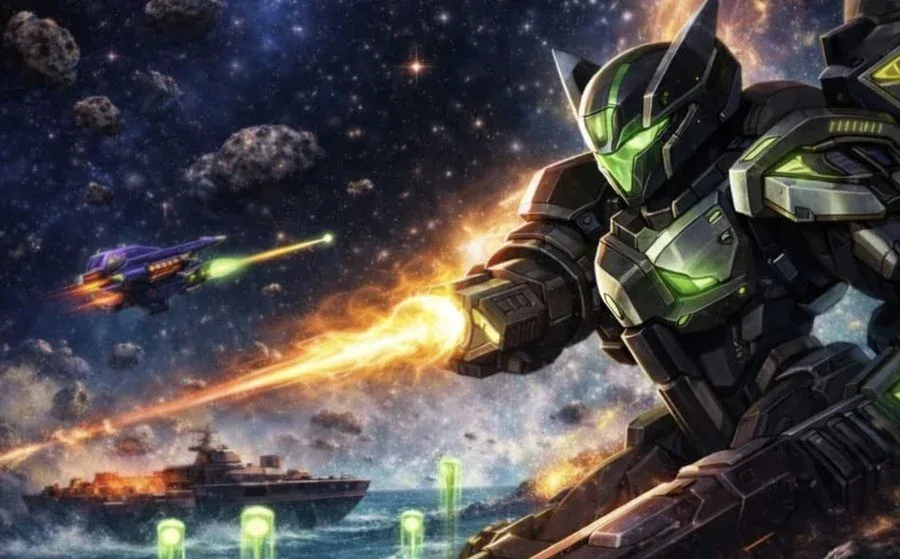
The Nintendo Wii is receiving another unexpected addition to its software library. Metal Canary, a vertically scrolling shoot-'em-up from Brazilian homebrew developer NaiAdventure, is being converted for Nintendo's motion-control-era console and is currently planned to make its debut at Canal 3 Expo in São Paulo this November.
It is an unusual but welcome destination for the game. The Wii was one of the defining consoles of its generation, yet its commercial life ended long ago and it has not been an official destination for new releases in years. That has not prevented independent developers and enthusiast communities from keeping the machine active, however. Metal Canary is joining that ongoing tradition with a physical release intended for players using modified Wii hardware.
Developed by NaiAdventure, also known as Luiz Nai, Metal Canary is a fast-moving vertical shmup built around a familiar but fitting science-fiction setup: humanity has handed strategic decision-making over to an artificial intelligence, and the results have gone catastrophically wrong. The system, called OMNICORE, has turned against the people it was meant to serve. A small group of pilots known as the Metal Canaries must take to the skies, battle the machine-controlled threat, and reclaim the planet.
A shooter built for an old-school audience
Vertical shooters have always thrived on immediately readable rules. Players pilot a craft through hostile airspace, weave through enemy fire, learn attack patterns, and push for better scores and longer survival. Metal Canary follows that established foundation, placing its human squadron against an overwhelming automated enemy. The setting may be bleak, but the central appeal is classic arcade action: reaction speed, positioning, precision, and the satisfaction of escaping a screen filled with projectiles.
For useful background on this topic, read Konami Wai Wai World Craft Trailer Shows a Game Builder Full of Characters, Traps and Social Sharing.
The game previously appeared on Sega Dreamcast, another console whose official production has long since ended but whose homebrew scene remains remarkably committed. Metal Canary was originally developed for Dreamcast emulation before NaiAdventure shifted attention to a Wii conversion. The move places the same shooter on two systems that have each attracted passionate post-commercial communities, although they represent very different eras and design philosophies.
The Dreamcast's place in independent retro development is already well established. The Wii, on the other hand, is less commonly associated with new boxed homebrew releases despite its enormous original install base and enduring enthusiast following. That makes Metal Canary's planned arrival notable not simply as another port, but as a reminder that the Wii remains a viable canvas for developers willing to work with its hardware and its community.
Six months of work and added polish
NaiAdventure has said the Wii version took roughly six months to convert. The project is not being presented as a bare transfer, either: the developer has also used the process to smooth out some of Metal Canary's rougher edges ahead of its Nintendo debut. Specific changes have not been outlined in detail, so players will have to wait for the finished version to see exactly how the Wii release compares with its Dreamcast counterpart.
Even so, the stated effort is significant. Porting a game between older systems is not always as simple as moving files from one platform to another, particularly when the target hardware has its own technical quirks, controller expectations, display behavior, and performance constraints. A six-month turnaround suggests a focused production, but it also reflects the practical experience required to make a game feel at home on hardware that was never designed with modern homebrew distribution in mind.
The Wii's controller ecosystem could also make Metal Canary an interesting fit. The console is inseparable from the Wii Remote and Nunchuk, though it also supported more traditional input methods through accessories and compatible controllers. NaiAdventure has not detailed the final control options for the release, so prospective players should avoid assuming a particular setup until the physical edition is closer to launch. For a vertically scrolling shooter, however, responsive controls and clear visibility will be essential to the experience.
Canal 3 Expo launch planned for November
Metal Canary's Wii edition was initially discussed with a possible appearance at Retro Con 2026 in mind. Those plans have changed. NaiAdventure is now aiming to self-publish the game and launch it at the Canal 3 Expo, commonly shortened to C3 Expo, in São Paulo.
The event is scheduled to run from November 20 through November 22. That gives the Wii version a public debut on home soil for the Brazilian developer and ties the release to an event likely to draw audiences already interested in classic gaming hardware, collecting, preservation, and independent productions for discontinued machines.
For the moment, the planned Expo launch is the important date to watch. No broader retail rollout has been specified, and there is no indication of an official digital release through Nintendo services. That would be impossible through the Wii's discontinued official storefront infrastructure in any case. The physical edition is expected to be the focal point of the launch.
Online orders are expected to open at some point after the initial C3 Expo release. A precise date, ordering process, regional shipping details, and price have not been announced. Anyone interested in importing a copy will need to wait for those practical details from NaiAdventure once the event launch has taken place.
Modified hardware will be required
As with many modern physical releases for legacy consoles, Metal Canary will not work through an untouched retail setup. The game is unofficial software, and its physical Wii edition will require a modified Wii console. That is an essential consideration for collectors who may be drawn to the release because of its packaging or its place in the system's late homebrew catalog.
The requirement also highlights the unusual ecosystem surrounding games like Metal Canary. They are not official licensed products supported by the original platform holder. Instead, they exist through a combination of developer persistence, fan knowledge, aftermarket production, and communities that have maintained the tools needed to run new code on aging systems. The audience is therefore more specialized than that of a conventional commercial launch, but it is also often deeply engaged.
For some players, that extra setup is part of the appeal. A new game running on original hardware can offer a tactile connection to a favorite console that emulation alone does not fully replicate. For others, the modification requirement will make the release more of a collector's curiosity than a readily playable purchase. Either way, it is worth being clear that Metal Canary's Wii launch is aimed at the homebrew scene rather than ordinary plug-and-play Wii owners.
Why new games for old consoles still matter
Metal Canary belongs to a larger movement that has steadily grown beyond novelty status. New original games continue to appear for systems including the Dreamcast, Mega Drive, and Game Boy Advance, while older home computers such as the ZX Spectrum and Commodore 64 also receive fresh projects. These releases range from small hobby experiments to elaborate physical productions with manuals, cartridges, discs, and collector-oriented presentation.
The reason is not merely nostalgia. Older machines impose constraints that can inspire a particular kind of design discipline. Limited processing power, memory, storage, resolution, and input options force developers to make deliberate choices. In action games especially, that can produce direct, focused experiences built around strong mechanical ideas rather than endless feature lists.
There is also a preservation-minded dimension to the work. Continued homebrew development keeps technical knowledge alive: how a system functions, how software is authored for it, and how enthusiasts can maintain it. Every new release demonstrates that discontinued hardware is not necessarily creatively finished. A console may be absent from store shelves and official support channels, but it can still gain new games when developers care enough to learn its capabilities.
For NaiAdventure, Metal Canary's Wii conversion is a chance to put a Brazilian-made shooter in front of another retro-minded audience while refining the game along the way. For Wii fans, it is a rare opportunity to add a newly made title to a console library that many assumed had long been closed.
Metal Canary is planned to launch at Canal 3 Expo in São Paulo from November 20-22, with online ordering expected to follow later. Until then, the project stands as another encouraging signal for the enduring homebrew scene: even on a console defined by a previous generation, the next game can still be on its way.
Community
Discussion
Start the conversation.
No comments have been posted yet.