

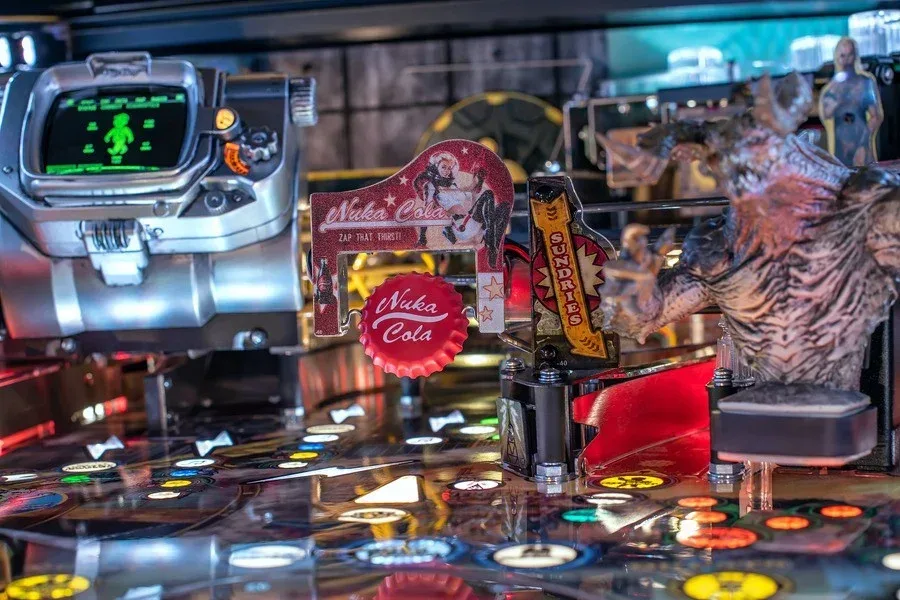
Stern Pinball is heading into the wasteland with a new Fallout pinball machine line inspired by the television adaptation of Bethesda's long-running post-apocalyptic game universe. The newly revealed tables turn the irradiated ruins of Los Angeles into a physical pinball adventure, with players taking on the roles of major characters from the series while battling mutants, visiting recognizable locations and collecting Nuka-Cola caps.
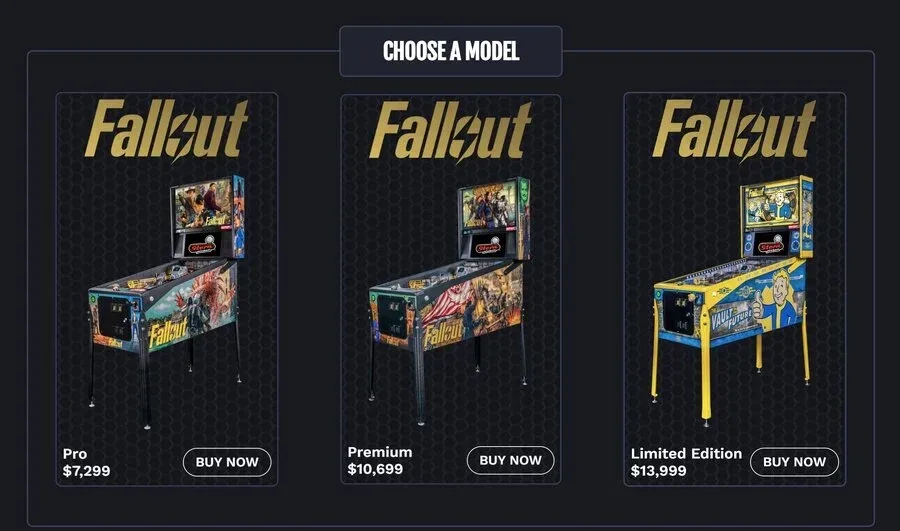
The machines arrive in three editions, beginning with the Pro model at $7,299. A more elaborate Premium version is priced at $10,699, while the Limited Edition reaches $13,999. Pre-orders are live through Stern Pinball.
It is an expensive way to venture into the wasteland, even by the standards of modern licensed pinball. But Stern's Fallout table is clearly designed as a large-scale collector piece rather than a simple conversion of the franchise into cabinet art and callouts. Its playfield incorporates several show-specific set pieces, a central miniature area representing a Vault interior, and an in-game-style Pip-Boy display intended to communicate scores and active modes.
A journey through post-apocalyptic Los Angeles
The table draws directly from the Fallout television series' version of Los Angeles. Players can traverse its devastated setting as Lucy MacLean, played in the series by Ella Purnell; Brotherhood of Steel squire Maximus, portrayed by Aaron Moten; and Cooper Howard, the gunslinging ghoul played by Walton Goggins.
For useful background on this topic, read Metal Canary Brings Its Bullet-Hell Mission to Nintendo Wii This November.
That character selection gives the machine a structure that reflects the show's intersecting perspectives. Lucy's Vault upbringing, Maximus's place within the Brotherhood of Steel, and Cooper's long history in the ruined world represent very different routes through Fallout's setting. A pinball machine cannot reproduce an open-world role-playing game or a serialized TV drama in full, of course, but the use of multiple playable characters suggests Stern is looking to capture the variety of the show rather than focus solely on one protagonist.
Players will encounter major landmarks associated with the series' Los Angeles setting as they progress. The game also uses Nuka-Cola caps as a collectible resource for trading, bringing one of Fallout's most recognizable pieces of world-building into the scoring and progression loop. On the hostile side of the board, the wasteland's threats include ghouls, radscorpions and the iconic Deathclaw.
Those creatures are natural candidates for pinball objectives: they are immediately legible to Fallout fans, visually distinct, and fit the escalating danger that a table needs as a game builds toward bigger multiball moments and mode completions. The Deathclaw in particular has long been one of the franchise's most memorable monsters, making it a fitting centerpiece for a licensed pinball experience built around danger, chaos and survival.
Vault 33, the Fat Man and a Pip-Boy on the playfield
Stern's announced playfield features lean heavily into Fallout imagery. One of the table's major mechanisms is a rolling Vault 33 ball lock, referencing the Vault that serves as Lucy's home at the beginning of the television series. Ball locks are a staple of contemporary pinball design because they can build anticipation before multiball, and locating one around Vault 33 gives the mechanic a clear thematic role.
The machine also includes a recreated Fat Man launcher. The Fat Man is one of Fallout's most unmistakable weapons, and its use as a launcher is a particularly direct translation of the series' exaggerated retro-futurist arsenal into a physical tabletop feature. Like the rest of the table, it appears intended to make the player feel as if they are interacting with recognizable Fallout hardware rather than merely shooting ramps decorated with franchise artwork.
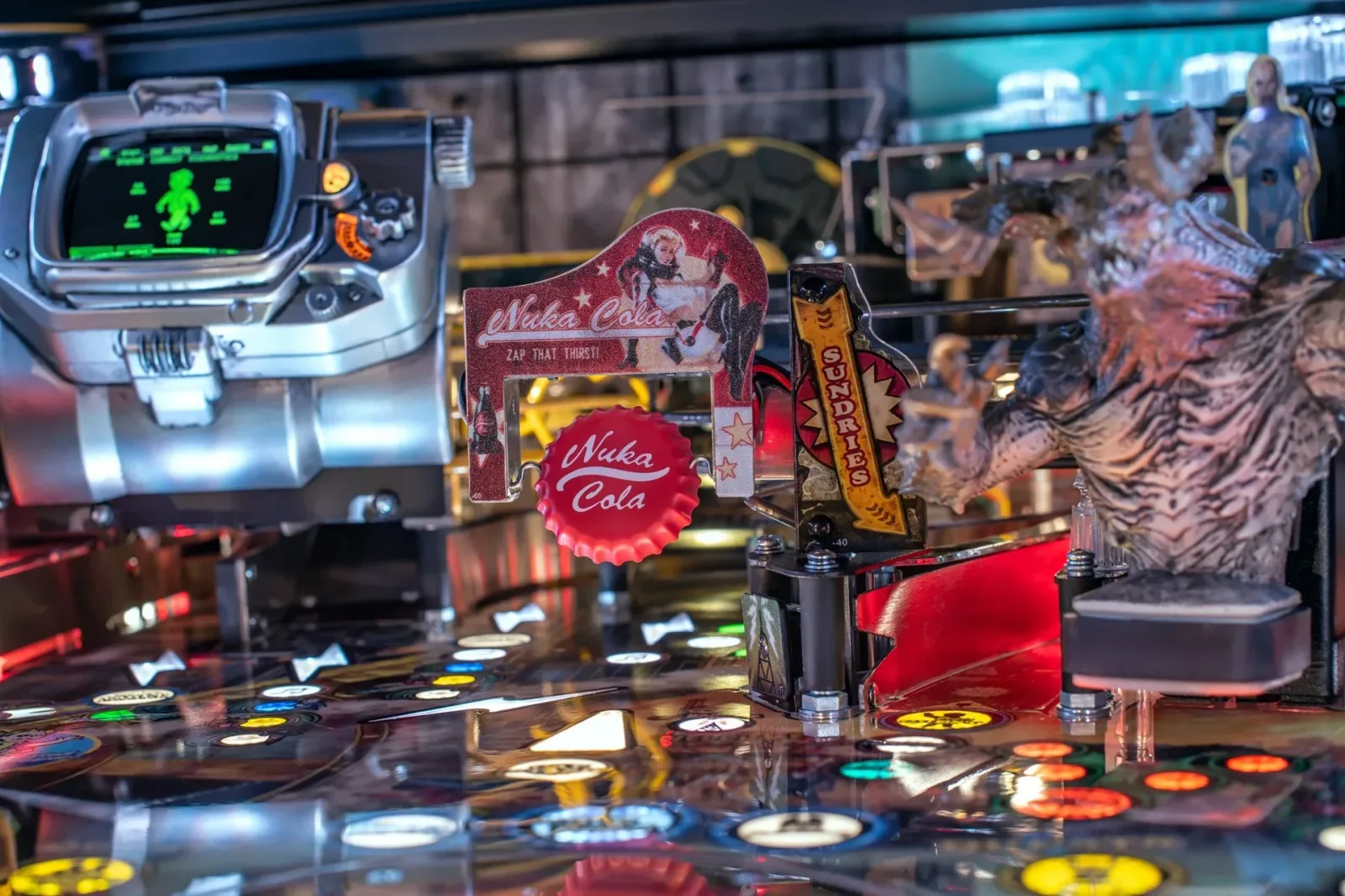
Perhaps the most notable visual component is the Pip-Boy 3000 mkV, which has its own pseudo-LED screen. The display is used for scoring information and mode details. In a video game, the Pip-Boy is a menu, map, inventory device and a defining part of the player's interface with the world. On a pinball machine, it cannot serve all of those functions, but placing it on the cabinet as a score and mode display is a smart thematic match for the device's established purpose.
Another distinctive element is the mini-playfield located in the center of the machine. It represents the interior of a Vault, adding a smaller contained environment within the broader wasteland layout. This physical contrast mirrors a central Fallout idea: safety and order inside a Vault set against chaos, ruin and uncertainty outside its doors.
The overall visual approach is deliberately dense. Fallout has always mixed battered Americana, atomic-age optimism, military imagery, corporate iconography and mutated wasteland horror. That leaves a lot of material for a pinball playfield, and Stern's design appears to embrace that busy, maximalist identity rather than strip it down into a minimal layout. For collectors who want a machine that immediately announces its license from across a room, that abundance may be part of the appeal.
Music inspired by the game series
Although this release is based on the TV adaptation, the audio presentation is also meant to connect with the wider video game legacy. Stern says the table has a soundtrack inspired by the original Fallout game series. That is an important bridge between the show's newer audience and players who know the world primarily through the RPGs.
Fallout's musical identity has always been central to its atmosphere, combining old-fashioned popular music with the tension of a shattered future. A pinball soundtrack has to work differently from a game soundtrack, since it must react quickly to shots, modes, jackpots and multiballs. Still, inspiration from the games should help make the machine feel tied to Fallout as a whole, not only to a single screen adaptation.
The choice also reflects why Fallout is such a natural license for pinball. Its fictional universe is full of tactile objects, loud machinery, exaggerated weapons, mascot characters, monster encounters and vintage visual language. Pinball itself carries some of that same old-school mechanical energy. A physical table cannot replicate wandering the wasteland for dozens of hours, but it can deliver the franchise's sense of colorful, dangerous disorder in short, repeatable bursts.
Three editions, three very different price points
The Fallout Pro is the entry point in the range at $7,299. Its cabinet uses artwork depicting the Battle of Griffith Observatory. The Pro model is described as having a more restrained cabinet presentation than the higher-end versions, but it still carries the core table theme and major Fallout features.
At $10,699, the Premium edition adds a more stylized art treatment and powder-coated framing. Its artwork depicts the Brotherhood of Steel's Deathclaw conflict on the streets of New Vegas. The juxtaposition is notable: while the TV show's story centers on Los Angeles, the broader Fallout universe has many locations and factions with powerful visual associations for longtime fans. The Brotherhood of Steel and the Deathclaw are among the franchise's most enduring symbols, making them an unsurprising focus for the Premium cabinet.
The highest-priced option is the Fallout Limited Edition, which costs $13,999. This version uses the familiar blue-and-yellow Vault-Tec-inspired color scheme and centers its artwork on Pip-Boy, Fallout's smiling mascot figure. It is the most overtly collector-focused model of the three and is aimed at buyers looking for a cabinet with an especially recognizable Fallout identity.
- Pro: $7,299, with Battle of Griffith Observatory cabinet artwork.
- Premium: $10,699, with stylized art, powder-coated framing and Brotherhood of Steel/Deathclaw imagery set in New Vegas.
- Limited Edition: $13,999, with blue-and-yellow styling and Pip-Boy-focused artwork.
A premium collector machine for Fallout fans
The Fallout line underscores both the appeal and the reality of current premium pinball. These are not casual impulse purchases. Even the least expensive model sits well above the cost of most game consoles, handhelds and home entertainment hardware, while the Limited Edition is firmly in luxury-collector territory. For prospective owners, space, maintenance and local service support are likely to matter almost as much as the license itself.
Yet Fallout is a property with the visual vocabulary to justify a complex physical adaptation. Vault 33, the Pip-Boy, Nuka-Cola caps, the Brotherhood of Steel, ghouls and Deathclaws are all instantly recognizable elements that can translate into toys, modes, ramps, ball locks and display animations. The new tables also arrive at a time when the TV series has expanded the audience for the franchise beyond those who first encountered it through role-playing games.
For pinball collectors who have wanted a machine that combines Fallout's retro-futurist style with Stern's modern feature-heavy design, this is that proposition. The price will keep it out of reach for many fans, but the table's announced mechanics and layered show-and-game references indicate that Stern is aiming squarely at enthusiasts who want the wasteland permanently installed in their game room.
Community
Discussion
Start the conversation.
No comments have been posted yet.