

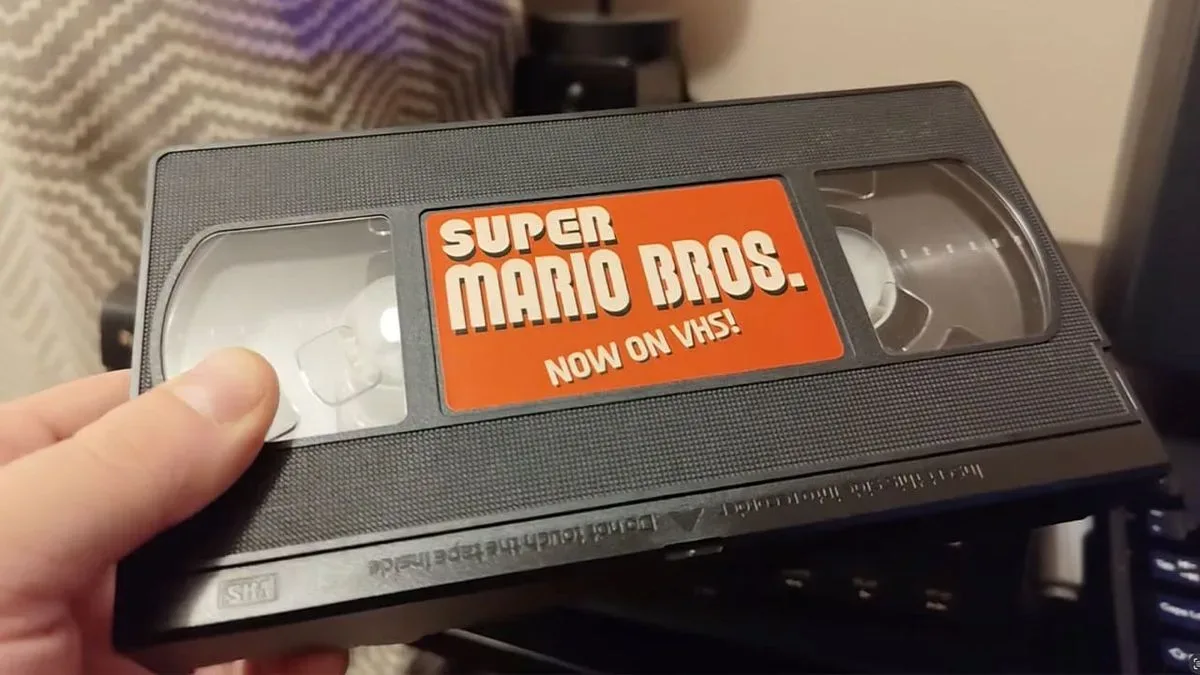
VHS tapes are usually remembered as the format of movie nights, worn-out family recordings, rental-store shelves, and the occasional need to rewind before returning something. They are not generally associated with responsive gameplay. A new hardware project from modder Throaty Mumbo, however, explores exactly what can happen when the visual language and limitations of VHS are combined with modern programmable hardware.
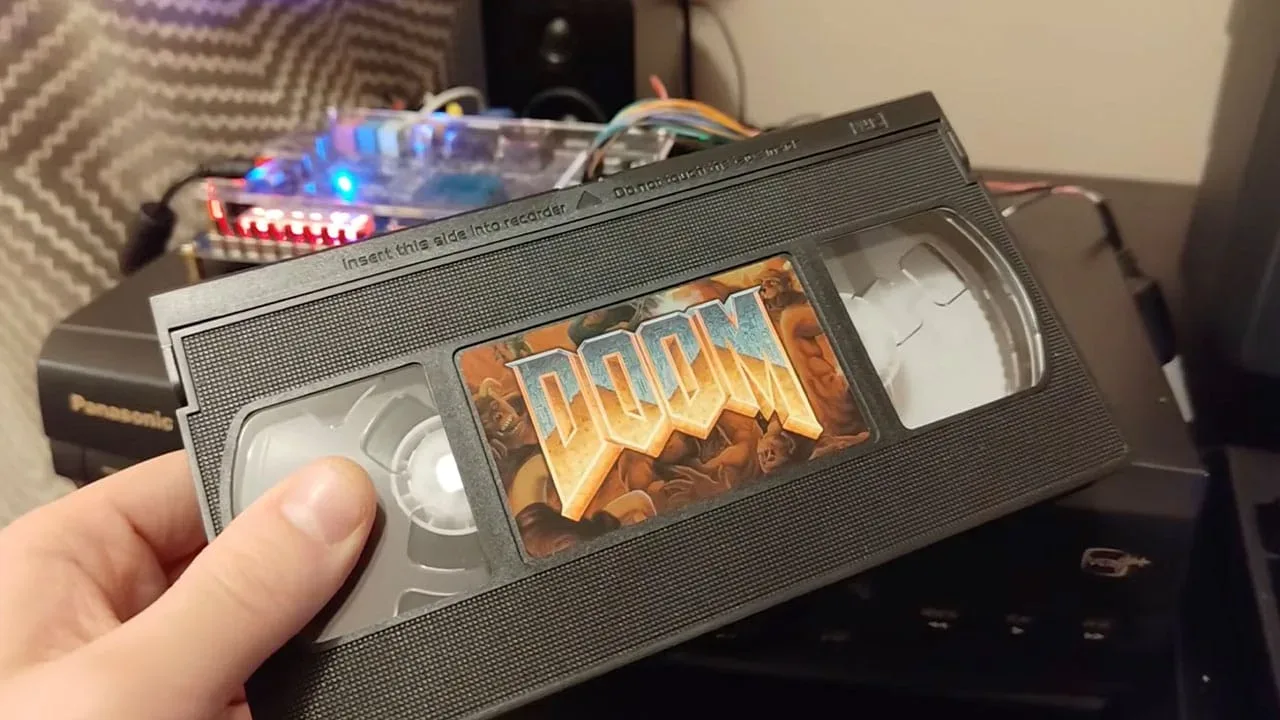
The result is an experimental VHS gaming system capable of presenting interactive demonstrations built around classic games. Rather than simply putting footage of a game onto a tape and pressing play, the setup uses an FPGA board and a microcontroller to create a playable experience in which recorded video and player input work together. Among the showcased concepts are versions inspired by Super Mario Bros. and DOOM, both given a distinctly analogue, tape-era twist.
It is a project that sits somewhere between retro preservation, hardware modding, and an alternate-history game-console prototype. It also serves as a reminder that VHS had a brief, strange relationship with video games long before disc-based interactive entertainment became commonplace.
VHS games were more than prerecorded quizzes
The idea of a VHS game may sound contradictory now. Video tape is a linear medium: it plays from one moment to the next in a fixed order, while games depend on instant reactions to player choices. Yet VHS-based games existed in the 1980s, particularly in forms that used prerecorded footage alongside external electronics, controllers, printed materials, or decision points.
For useful background on this topic, read Three New LEGO Batman Sets Bring Joker Art, Burton's Batmobile and Arkham Style to Shelves.
One early example was Parker Brothers' 1985 Clue Murder Mystery Game, known as Cluedo in the UK. The tape delivered scenes and clues, while players used the information to investigate the mystery. This was not gameplay in the same sense as an NES action game, but it was an attempt to make the home-video format participatory rather than purely passive.
More directly relevant to Throaty Mumbo's experiment is the Action Max, a VHS-based console released in 1987. The machine used videotapes as its visual medium and came with a light-sensing component positioned on the television, along with a light gun. In broad terms, it turned on-screen targets into a shooting-game interface, recalling the basic appeal of arcade light-gun games and Nintendo's Duck Hunt.
The limitations were obvious. A tape cannot generate a new scene in response to a player's every movement, so the video itself was fixed. But the system could still detect whether a target had been hit at a particular time, allowing for scores and a degree of interaction. It was an ingenious workaround for the technology of the era, even if it was fundamentally different from a console rendering its own game world in real time.
An FPGA approach to interactive tape-era design
After experimenting with the Action Max concept, Throaty Mumbo set out to build a more flexible version of a VHS game machine. The project uses a DE1-SoC FPGA board alongside an RP2350 microcontroller. FPGA, short for field-programmable gate array, hardware can be configured to carry out specialized digital tasks and is widely used in retro-computing, emulation, video processing, and custom electronics projects.
The important distinction is that this setup is not limited to simply replaying the exact same VHS experience every time. The hardware is designed to make player input matter. It can coordinate the prerecorded tape material with interactive game logic, effectively using the tape as one component in a larger system rather than treating it as the entire game.
That idea is the heart of the project. VHS supplies imagery, texture, and potentially preplanned sequences, while the FPGA and microcontroller handle the responsive behavior that a normal tape could never provide on its own. The result is not a conventional cartridge console hidden inside a VCR, nor is it merely a video recording with button prompts. It is a hybrid format built to investigate what a more advanced VHS-game ecosystem might have looked like.
For retro hardware fans, the appeal is not solely that familiar games appear through a fuzzy analogue presentation. It is the technical challenge of bridging two radically different forms of media: sequential magnetic tape and dynamic digital game systems.
Super Mario Bros. becomes a looping VHS showcase
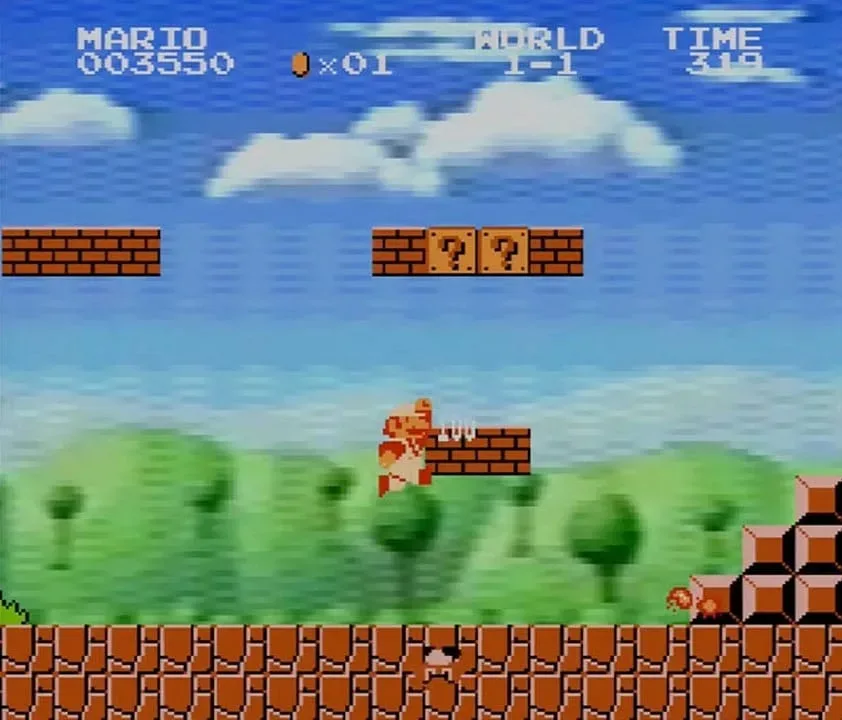
One of the demonstrations adapts the feel of Super Mario Bros. using a prerecorded looping background. The visual material supplies the scrolling or repeating scene, while the system layers interaction on top of it. This makes the demo easier to understand as a theoretical VHS game because it embraces the format's strengths rather than asking tape to behave exactly like a cartridge.
A VHS tape is well suited to delivering a prepared visual sequence. By organizing that sequence around a loop and using external hardware to interpret player actions, a designer can make the player feel involved without needing the tape itself to redraw the level. The approach echoes the design compromises that older full-motion-video games often made, but with a much older and more restrictive video format.
Of course, it is not a replacement for playing the original Super Mario Bros. on Nintendo hardware. The original's defining quality is precise real-time control over an active world, including movement, jumps, enemy behavior, and level progression. The VHS demonstration is compelling for the opposite reason: it asks how much of that sensation can be communicated through careful staging, synchronized electronics, and analogue video.
That makes it less a straightforward port and more a speculative design exercise. It is an example of how developers and hardware tinkerers might have tried to stretch the home-video format if they had more capable supporting electronics available during VHS's commercial peak.
DOOM uses quick-time interaction
The DOOM-inspired VHS demo takes a different route. Instead of attempting to recreate an uninterrupted first-person shooter running freely from player movement, it makes use of quick-time-event-style interactions. In the showcased footage, Throaty Mumbo uses an N64 controller to trigger actions during the sequence, including attacks.
This style of design is especially compatible with prerecorded video. The tape can provide a dramatic run through corridors, enemies, or attacks, while the external hardware watches for the correct input at the correct moment. Success or failure can then be recognized by the interactive system, even though the footage itself follows a prepared path.
There is a playful historical irony here. DOOM is often celebrated as one of the games that defined fluid, immediate PC action. Reimagining it through VHS transforms that freeform intensity into something closer to a reactive arcade challenge. The game's imagery remains recognizable, but the rules of engagement are dictated by the medium.
That shift is precisely what gives the demonstration its character. It is not trying to argue that VHS was secretly the best delivery system for first-person shooters. Instead, it shows that an imaginative designer can reinterpret a familiar game around the technological constraints of a format that was never built for it.
A study in signal, timing, and old technology
The project also highlights the often-overlooked technical side of analogue video. A VHS signal is not just a nostalgic blur or scanline effect; it carries information through timing, synchronization, and recorded signals that must be managed carefully. Working with that material while adding modern control logic requires an understanding of both old video technology and contemporary electronics.
That blend is part of what makes projects like this compelling. Retro modding is sometimes framed as a simple matter of attaching new parts to old devices, but the best experiments are usually more thoughtful. They involve understanding why original hardware worked the way it did, where its limits were, and how new components can interact with those constraints without erasing their identity.
Throaty Mumbo's VHS system does not present an off-the-shelf new platform or suggest that gamers will soon be buying commercial VHS editions of classic titles. It is a custom experiment and demonstration. But its value lies in the questions it raises: What kinds of games could have existed on VHS with different supporting technology? How can prerecorded footage become responsive? And how much interaction is needed before a video presentation begins to feel like a game?
Why this kind of retro experiment matters
Modern games are often discussed in terms of increasingly powerful graphics hardware, enormous storage capacities, and instantly updated online worlds. A VHS gaming project moves in the other direction. It deliberately works with a format defined by physical tape, image degradation, linear playback, and awkward limitations.
Those restrictions are not obstacles to be entirely removed; they become the creative prompt. The looping Super Mario Bros. presentation and the input-driven DOOM sequence are interesting because they respond to VHS on its own terms. They imagine a strange branch of gaming history where the living-room VCR became a more interactive device.
For anyone interested in unusual consoles, FPGA projects, obscure game formats, or the intersection of film and games, the experiment is an entertaining glimpse at what inventive hardware work can accomplish. It is also a useful reminder that even technology considered obsolete can still offer fresh design ideas when someone is willing to take it apart, understand its signals, and build something unexpected around it.
Community
Discussion
Start the conversation.
No comments have been posted yet.