


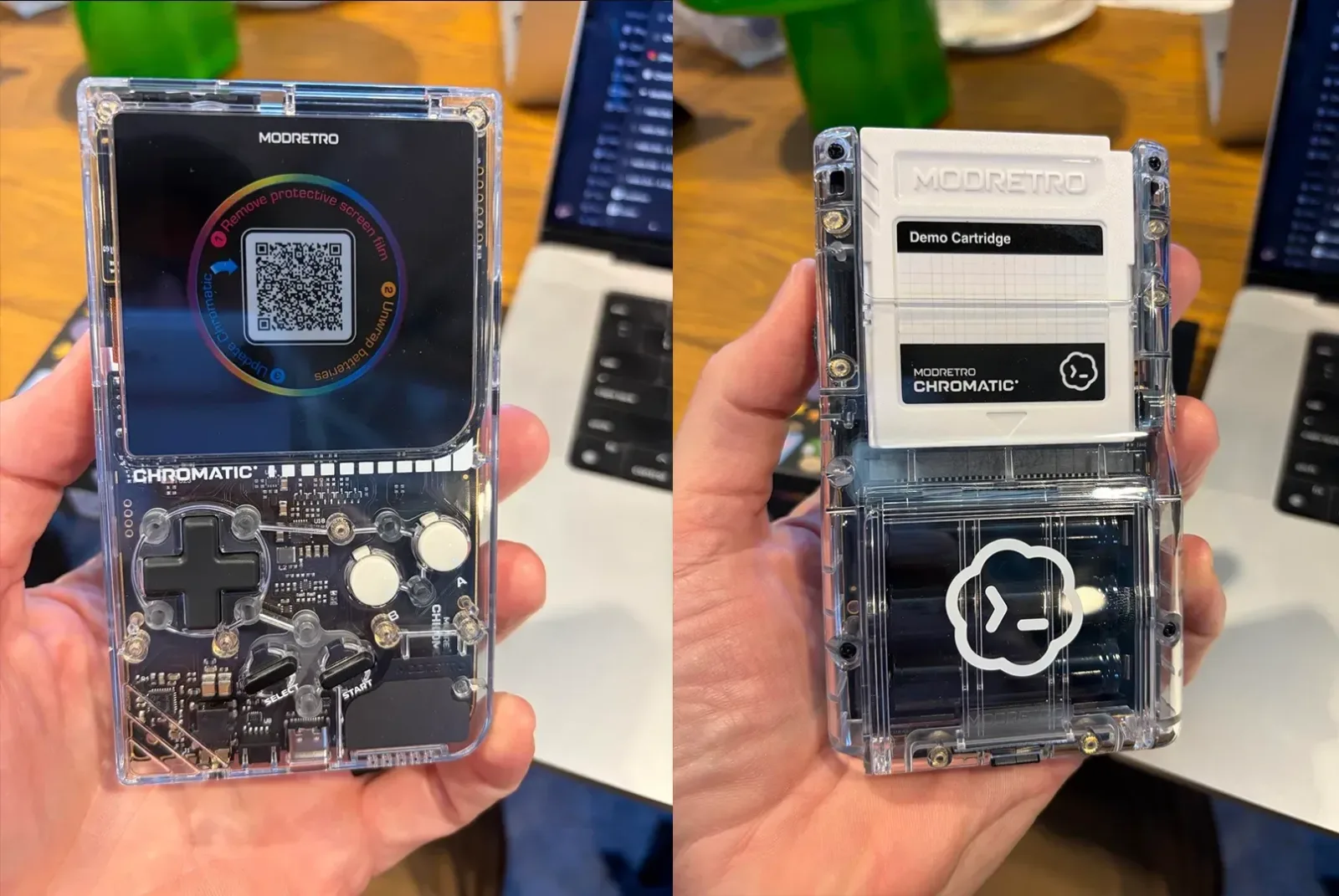
ModRetro has put its Chromatic handheld at the center of a new artificial-intelligence debate after distributing a fully transparent version of the device to attendees at an OpenAI developer conference on September 29. The special hardware was used to promote OpenAI's coding agent, Codex, and the possibility of using it to help create games designed for the Chromatic's retro-focused ecosystem.
The collaboration arrives while ModRetro is already teasing additional plastic Chromatic variants. Customers had first been encouraged through email to install a firmware update, while a green transparent unit subsequently appeared in a short video from Logan Paul, a ModRetro ambassador. The clear system handed out at the OpenAI event is another visible sign that the company is expanding the Chromatic's color options and marketing reach.
But the Codex angle is likely to be more consequential than the new shell. ModRetro has built much of its identity around physical releases, retro hardware, FPGA technology, and games from independent developers. Tying that strategy to a high-profile AI coding tool has prompted concerns among players and creators who see human-made games as the central appeal of the modern retro scene.
A transparent Chromatic becomes a developer giveaway
The Chromatic is ModRetro's handheld designed around Game Boy and Game Boy Color-compatible cartridges, with an emphasis on a premium build and an FPGA-based approach. Since its original launch in 2024, ModRetro has also pursued new physical games for the platform, working with developers and publishers to bring fresh releases into a cartridge-driven market.
For useful background on this topic, read Halo: Combat Evolved Is Being Adapted for Nintendo 3DS and Web Browsers.
The transparent console distributed at the OpenAI gathering follows a long tradition of clear handheld hardware, a look closely associated with late-1990s and early-2000s gaming. In this case, however, the system was more than a collector's item or event souvenir. It functioned as a promotional device for an initiative encouraging developers to experiment with Codex while making small retro-style projects.
Recipients also received blank cartridges. Those carts can be patched with a finished ROM after a game is created, providing a route from code to playable physical media. That is a compelling technical idea on its face: a developer can prototype a title, test it on hardware, and ultimately place it on a cartridge rather than leaving it as a browser demo or a file on a PC.
ModRetro's efforts suggest it sees Codex as a way to reduce the barriers facing people who want to make games for constrained, vintage-inspired hardware. Retro platforms can appear simple because of their limited visuals and controls, but building a satisfying game still requires programming knowledge, design instincts, testing, balancing, art, audio, and an understanding of hardware limits. AI-assisted coding could potentially help newcomers navigate some of those technical hurdles.
Codex-assisted games raise questions beyond coding
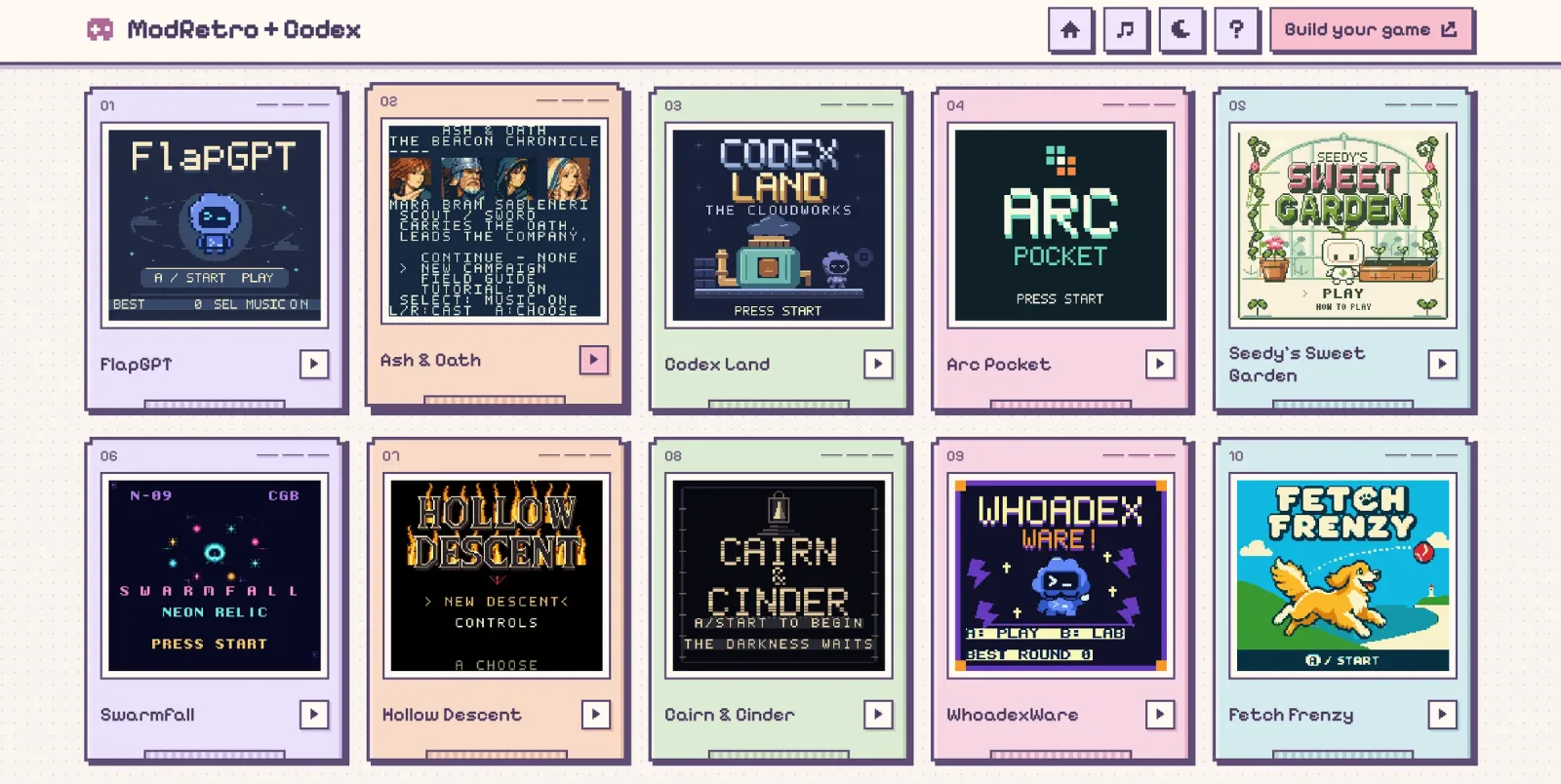
The reaction to the promotion has not been universally positive. Critics have objected to the framing of rapidly generated projects as a meaningful answer to the challenge of game development. Videos and images shared around the event showed quick demonstrations of Codex-made games, but some observers felt the examples looked more like disposable prototypes than projects with the care, originality, and polish expected from commercial retro releases.
A major concern is intellectual property. Generative AI systems have sparked ongoing arguments across the creative industries over training data, copied styles, and outputs that may resemble protected characters, mechanics, branding, or games. In game development, those concerns become especially immediate when prompts ask for something recognizably similar to an existing hit.
One of the showcased experiments was described as a recreation of Flappy Bird. While cloning familiar concepts has long been part of hobbyist development, critics argue that using AI to rapidly imitate a known game can normalize a shortcut-first culture. The issue is not simply whether a small prototype is legal, but whether a platform holder should actively promote tools and examples that appear to encourage derivative work.
There is also an important distinction between AI as an assistant and AI as a substitute. Developers already use many tools that automate repetitive tasks: compilers, code completion, game engines, debugging tools, asset pipelines, and audio software. Supporters of coding agents argue that Codex belongs in that lineage, helping developers learn, revise code, and spend more time on higher-level decisions.
Opponents counter that a promotional campaign focused on making games in seconds risks understating the human work that gives a game its identity. A working ROM is not automatically a good game. Level design, feedback, pacing, player accessibility, visual language, music, bug testing, and purposeful iteration cannot be reduced to the moment a program first launches on a handheld.
Why the response matters for ModRetro
The pushback is particularly notable because ModRetro has spent considerable effort cultivating relationships with independent creators. The company has stated that it has paid more than $1 million in royalties to developers. For a niche physical market, that is a meaningful figure and a sign that original cartridge games can still support the people who make them.
That record is why some members of the community see the OpenAI partnership as a mismatch. They do not necessarily reject coding assistance outright. Instead, they worry that an emphasis on instant generation could devalue the developers whose games have helped establish the Chromatic as more than simply another device capable of running older cartridges.
Original software is essential to the long-term health of any hardware ecosystem, particularly one aimed at retro enthusiasts. Legacy compatibility gives players a reason to buy in initially, but new releases, homebrew projects, and distinctive physical editions give a platform an ongoing identity. If creators conclude that their work is being placed beside a flood of low-effort generated experiments, that relationship could become harder to maintain.
The audience question is equally significant. People drawn to modern retro hardware often value preservation, craftsmanship, tactile controls, manuals, box art, cartridge production, and the visible contribution of individual artists and programmers. These players may be open to new technical tools, but many are skeptical of marketing that treats AI output as an attraction in itself.
For ModRetro, the challenge will be explaining how Codex experimentation fits alongside, rather than replaces, its support for conventional independent development. A clear policy on rights, attribution, commercial submissions, and quality control would help establish that distinction. So would highlighting projects where developers use assistance responsibly while remaining accountable for the game's design and final code.
The educational opportunity
The giveaway has also fueled discussion about who should receive tools intended to lower the entry barrier to development. Some critics believe that hundreds of special Chromatics and blank cartridges might have made a stronger statement if they had been directed toward schools, teachers, coding clubs, or young people interested in learning how games are made.
That argument is not inherently anti-technology. In fact, retro hardware can be an effective educational target because its limitations make game systems easier to grasp. A student can learn about sprites, input handling, collision detection, memory constraints, sound effects, and game loops without confronting the vast complexity of a modern 3D engine.
Codex could have a constructive role in that environment if it is treated as a tutor or assistant rather than a button that generates finished products. It could explain code, identify errors, offer examples, or help students understand the relationship between a design goal and the programming required to achieve it. The educational value comes from learning why the game works, not merely receiving an output.
More Chromatic hardware is expected
Separate from the AI debate, the new transparent shell has drawn attention because it hints at what ModRetro may announce next. The company is expected to formally reveal new Chromatic plastic models in October. No price, complete color lineup, or final specifications have been confirmed for those upcoming versions.
The clear hardware shown at the developer event appears to retain the Chromatic's familiar form while swapping in a transparent exterior. A lower price point has been suggested as a possibility for plastic versions, though ModRetro has not confirmed pricing. Prospective buyers should therefore treat any assumptions about cost, colors, or hardware changes as speculation until the official announcement arrives.
Transparent handhelds have obvious collector appeal, and multiple colors could broaden the Chromatic's reach. Yet the larger story is likely to remain ModRetro's attempt to connect physical retro gaming with AI-assisted creation. It is a strategy with genuine potential for prototyping and education, but also one that touches on unresolved concerns around ownership, quality, creative labor, and the kind of community the company wants to serve.
For now, the transparent Chromatic is a striking piece of event hardware and an unusual vessel for a broader industry argument. ModRetro's next steps -- including how it handles AI-made projects, how it supports its existing development partners, and how it presents the upcoming Chromatic models -- will determine whether this becomes a productive expansion of its ecosystem or a point of lasting friction with its most dedicated audience.
Community
Discussion
Start the conversation.
No comments have been posted yet.