

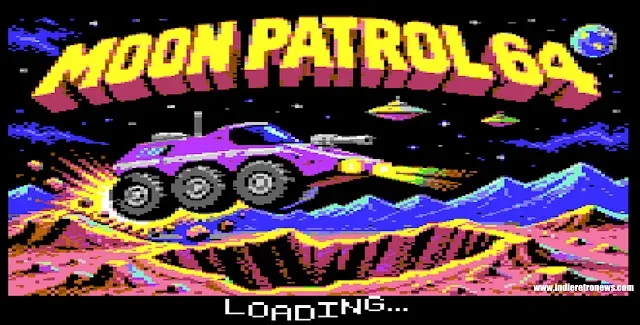
Moon Patrol 64, a new unofficial Commodore 64 version of Irem's landmark 1982 arcade game, has been released by AI/Realite-Games. Built as a fresh interpretation of the celebrated lunar driving challenge, the game puts the familiar moon buggy, its hazards, and its score-focused arcade structure onto Commodore hardware.
The project opens with an animated Realite introduction before moving into the action players would expect from a Moon Patrol-inspired experience: driving across an alien landscape, firing at threats in more than one direction, and carefully managing jumps over obstacles. It aims to evoke the brisk rhythm of an arcade session rather than merely borrowing the original game's setting or premise.
For Commodore 64 fans, the appeal is clear. Moon Patrol has long been remembered for combining a side-scrolling journey with a surprisingly demanding multitasking challenge. A player is not simply steering forward. They must judge the terrain immediately ahead, use the buggy's jump at the right moment, watch for dangers arriving from above, and keep firing while the screen continues to move. Moon Patrol 64 brings that structure to a machine whose library remains one of retro gaming's most active homes for new releases.
A moon buggy built for pressure
At the center of Moon Patrol 64 is the iconic vehicle itself. The buggy is presented with animated wheels and can fire both forward and upward, preserving the essential split-focus design that made the arcade original so memorable. Ground-level threats demand horizontal fire, while airborne enemies and hazards call for shots directed above the vehicle. That means every moment can require a quick decision about where danger is coming from and what action has priority.
For useful background on this topic, read Command & Conquer Reaches 1.0 on Atari ST in Ambitious 16-Color Port.
The lunar route is filled with the kinds of obstacles that turn an otherwise straightforward drive into a test of timing. Craters and boulders must be cleared with well-timed leaps. Falling bombs introduce another source of danger from the sky. Rival ground vehicles complicate the road ahead, while UFO formations sweep into the action overhead. Each element has a simple purpose on its own, but their combination is what gives the formula its lasting tension.
Jump too early and the buggy may not land safely. Wait too long and a crater or boulder may leave no room to react. Focus on firing upward and a ground threat can slip into a dangerous position. Spend too much attention on the road and descending bombs or UFOs can become the decisive problem. This layered hazard design is a major part of why the original Moon Patrol remains an important arcade game, and why new versions still have room to impress players decades later.
Scrolling landscapes and SID sound
Moon Patrol 64 uses smooth, layered scrolling scenery to sell the sensation of travelling across the lunar surface. The use of multiple visual layers is particularly fitting for a game based around constant movement: terrain is not merely a backdrop, but a key part of the game's identity. The passing landscape establishes pace, makes the checkpoints feel like genuine progress, and creates the illusion of a much larger journey beyond the current screen.
The release is also backed by SID sound effects. The Commodore 64's SID chip remains one of the system's defining strengths, and sound is especially important in an arcade-style project where immediate feedback matters. Weapon fire, jumps, impacts, and other on-screen events benefit from clear audio punctuation, helping make every successful dodge or costly mistake feel more immediate.
These technical and presentation choices suggest an effort to capture the character of an arcade run on the C64. The goal is not just to place a moon buggy and UFOs on screen, but to recreate a game loop driven by momentum, visual movement, escalating threats, and rapid repeat attempts. In a score-chasing game, responsiveness and readability are every bit as important as the theme.
Checkpoints keep the run moving
Like the arcade design that inspired it, Moon Patrol 64 is structured around racing between checkpoints. Those markers give the journey a clear short-term objective while ensuring that the player remains under pressure throughout the stage. Reaching a checkpoint provides a tangible sense of advancement, but it is not an invitation to relax. The route continues, the pace remains urgent, and the next stretch can introduce an entirely new sequence of hazards.
This checkpoint-driven format is one reason the game works so well as an arcade challenge. It turns a long ride into a series of manageable goals: survive this crater sequence, deal with this wave of aerial enemies, reach the next marker, and then attempt to improve on the previous run. It is easy to understand in seconds, yet difficult to master once hazards begin overlapping.
Moon Patrol 64 also includes a session high-score table with the traditional three-initial name entry. That feature may sound small, but it is central to the classic arcade atmosphere. High scores give players a reason to return after a failed run, encourage competition among friends or household players, and transform survival into a more ambitious question: how efficiently can the route be conquered?
For a game rooted in early-1980s arcade design, that direct competitive loop remains powerful. The rules are visible, the failures are usually immediate, and a new attempt is never far away. Players can identify exactly where a run went wrong--an ill-timed jump, an ignored bomb, a missed shot at a UFO--and try to correct it next time.
An unofficial return for a foundational arcade game
Irem's Moon Patrol debuted in 1982 and became one of the defining arcade games of its era. Its lasting reputation comes from more than its distinctive science-fiction theme. The original blended driving, jumping, shooting, scrolling, and checkpoint progression into a format that felt unusually dynamic for the period. That combination has made it a frequent point of reference for both retro developers and players interested in the evolution of action-game design.
Moon Patrol 64 is explicitly unofficial, placing it among the many fan-made and homage-style projects that keep classic game ideas visible on original retro platforms. Such releases can be especially appealing because they invite players to imagine how a familiar arcade concept might have felt on a different home machine, while also giving today's C64 community something new to explore.
The project was developed with the capabilities of AI, as described by its creators. That detail is part of the game's identity, but the game itself remains focused on recognizable retro priorities: animated sprite work, scrolling environments, sound effects tailored to the platform, quick play sessions, and a score table built for replayability. Whatever tools contributed to its creation, the intended experience is firmly rooted in classic arcade conventions.
Why Moon Patrol still fits the C64
The Commodore 64 has an enduring relationship with arcade conversions and original action games. Its visual capabilities, joystick-friendly controls, and celebrated audio hardware make it a natural platform for projects that prioritize immediate play over lengthy tutorials or complicated systems. Moon Patrol 64 fits comfortably into that tradition.
The game's control concept is also well suited to the machine's style of play. Movement is easy to grasp, while the need to jump and fire in different directions creates depth without demanding a complicated interface. It is the sort of design where the first attempt can begin almost instantly, but meaningful improvement comes from learning the behavior and timing of every hazard.
Players looking for a modern C64 release with an old-school arcade mindset should find the premise familiar: a single vehicle, a hostile route, a growing number of distractions, and a score worth chasing. The focus is on reflexes, observation, and keeping cool when several threats arrive at once.
A compact arcade challenge with lasting appeal
Moon Patrol 64 arrives as another example of how active the Commodore 64 scene remains. Rather than treating retro hardware solely as a museum piece, developers continue to create games that speak the visual and mechanical language of the era while giving players fresh software to test on the platform.
Its appeal will likely rest on how effectively it captures the restless energy of Moon Patrol's original design. The ingredients are all present: the animated buggy, forward and upward firing, craters, boulders, bombs, ground vehicles, UFOs, checkpoints, scrolling scenery, SID sound effects, and a three-initial high-score table. Together, they form a familiar but demanding lunar road trip where every second asks the player to make the right decision.
For retro enthusiasts, that is more than enough reason to take another ride across the moon. Moon Patrol 64 does not need to reinvent the arcade classic's central idea. Its purpose is to bring that idea to the Commodore 64 with speed, style, and the kind of immediate challenge that has kept the buggy rolling for more than four decades.
Community
Discussion
Start the conversation.
No comments have been posted yet.