

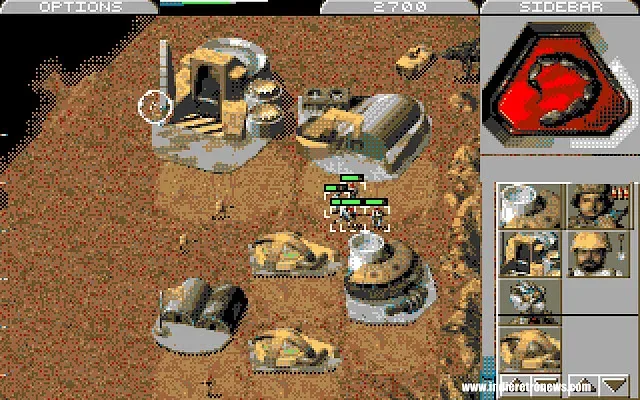
Command & Conquer, the landmark real-time strategy game originally released by Westwood Studios in 1995, has now reached a 1.0 release on the Atari ST. Developed by indyjo, the project brings the conflict between the Global Defense Initiative and the Brotherhood of Nod to a machine whose original era predates the PC version of the game by several years.
It is an especially striking conversion because of the gulf between the systems involved. Command & Conquer was built around the capabilities of MS-DOS PCs using 256-color VGA graphics, while the Atari ST works within a far tighter 16-color visual limit. The completed port does not merely attempt to reproduce a few screens or a technical demo. It aims to deliver the strategic gameplay, military units, terrain, audio presentation, and cinematic identity that made the original so influential.
After development experiments began in late 2025, the work continued for nearly a year before arriving at the 1.0 milestone. The result is a notable addition to the Atari ST homebrew scene and a reminder that long-established hardware can still be pushed in surprising directions.
A real-time strategy landmark on very different hardware
When Command & Conquer first appeared, it helped define what many players now recognize as the language of the real-time strategy genre. Players gather resources, construct bases, manage power, produce forces, scout enemy territory, and issue orders while the battle continues in real time. The formula is familiar today, but its combination of accessible controls, recognizable factions, intense tempo, and memorable presentation made it a major success in the mid-1990s.
For useful background on this topic, read Playtonic Faces Xbox Backlash After Ruling Out Impossible Lair Definitive Edition Port.
Moving that design to Atari ST hardware presents challenges beyond simply displaying graphics. A strategy game is made up of many interacting elements: unit movement, interface updates, map data, AI behavior, effects, sound, and the rapid player input expected during combat. The port therefore has to account for both the original game's visual complexity and the hardware's available memory and processing resources.
The stated minimum requirement is an Atari ST-compatible computer with at least 4 MB of RAM. That alone makes the conversion more accessible than a project requiring a rare high-end configuration. At the same time, the recommended specification reveals where the experience is expected to shine: a 68020 processor or better running at 32 MHz, 4 MB or more of memory, DMA sound, and a Blitter-equipped machine. An Atari TT is given as an example of a recommended setup.
A 16 MHz Mega STe or better is also recommended for optimal performance. That distinction matters for retro enthusiasts because the Atari ST family covers a broad range of machines, from standard models to substantially more capable later systems. The port is intended to run with 4 MB, but faster hardware should offer the smoother, more responsive presentation that a real-time strategy game naturally benefits from.
Making 256-color art work in 16 colors
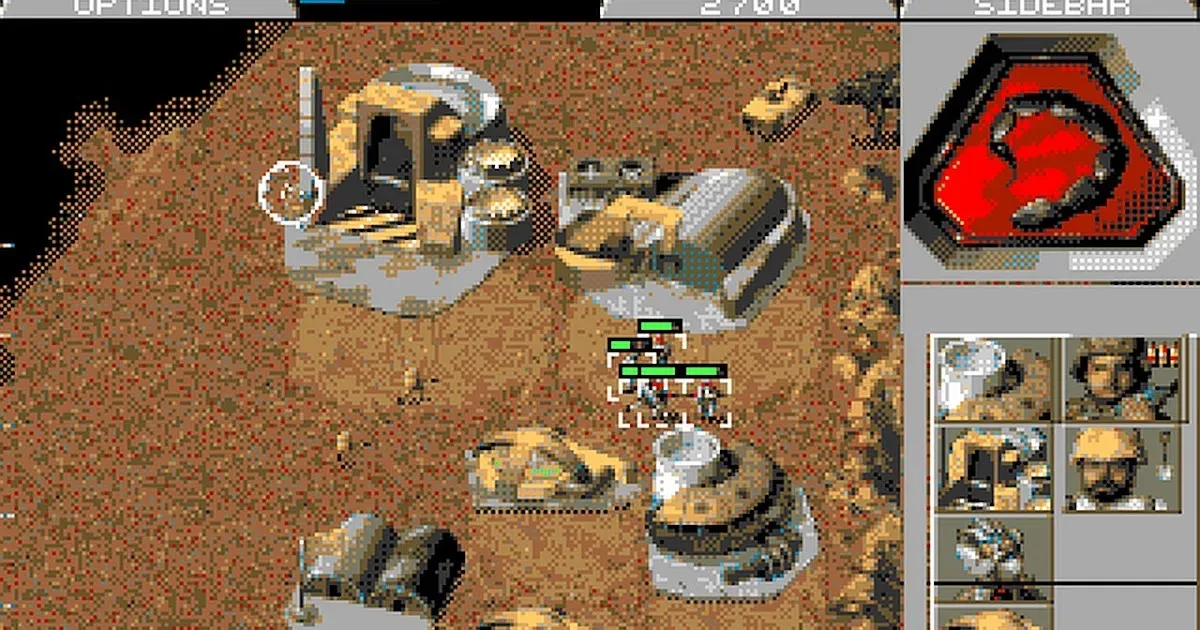
The most immediately visible technical challenge is color. The DOS original used 256-color VGA visuals, giving its environments, units, explosions, menus, and cinematics a broader palette than the Atari ST can directly display. The new version reduces those assets to 16 colors, requiring a careful balance between accuracy, readability, and the visual character of the original.
Rather than treating the limitation as a reason to abandon detail, the conversion uses an automated asset workflow to process the game's material into the smaller palette. This is not simply a matter of stripping away colors. In a strategy game, players need to quickly recognize infantry, vehicles, structures, terrain boundaries, and opposing sides. If a color-reduced image becomes too muddy or if important silhouettes disappear into the map, gameplay suffers.
The Atari ST edition consequently offers its own interpretation of Command & Conquer's look. It cannot be identical to the VGA original, but the 16-color palette gives the game a distinct pixel-art identity. For players who appreciate Atari ST graphics or the aesthetic of tightly constrained 16-bit-era visuals, that difference is part of the project's appeal rather than merely a compromise.
The conversion also reportedly cuts the required memory footprint in half. That optimization is central to making the game viable on a system with 4 MB of RAM. Memory management has always been one of the defining crafts of development for older machines, and this project's ability to fit a large, content-heavy strategy game into that environment is as significant as the finished screenshots or feature list.
FMV cutscenes arrive on Atari ST
Perhaps the most remarkable feature is the inclusion of full-motion video cutscenes. Command & Conquer's live-action briefing and story sequences were a major part of its personality in 1995. The dramatic, sometimes deliberately theatrical videos helped distinguish its campaign structure from strategy games that delivered their narrative mainly through text and static screens.
On this Atari ST release, the video runs at 320x200 resolution and 15 frames per second. That is an ambitious achievement for the platform, particularly alongside digital soundtrack playback, speech, and sound effects. The port is described as the first of its kind on Atari ST hardware to offer this combination of full-motion video presentation.
There are multiple supported audio paths as well. Players can use DMA sound, the system's YM-2149 sound chip, or a Covox Speech Thing. That flexibility is important in a retro computing community where individual setups can vary significantly. A player with hardware suited to DMA audio may approach the audiovisual experience differently from someone using the YM-2149, but the project has been designed to accommodate those possibilities.
Digital music and voice work are especially valuable to Command & Conquer's atmosphere. The game's audio helps give missions their urgency, whether it is a commander's briefing, unit acknowledgements, a warning sound, or the music accompanying an attack. Preserving those elements helps this feel like an adaptation of the complete game experience rather than a reduced strategic approximation.
A milestone built on Atari ST community knowledge
The 1.0 release is dedicated to the late Thorsten Otto. The developer credited Otto's foundational contributions to the Atari ST software development ecosystem as an important part of what made the conversion possible. It is a meaningful acknowledgment of how retro development often depends on years, sometimes decades, of accumulated tools, documentation, technical research, and community-maintained knowledge.
Projects such as this are rarely the result of one breakthrough alone. They grow from emulators, compilers, debugging utilities, hardware references, preservation efforts, reverse engineering, and the work of enthusiasts who continue to study systems after their commercial lives have ended. An Atari ST port of a 1995 PC strategy giant may sound improbable, but it becomes possible when a platform's development environment remains active and its technical boundaries are still being explored.
The timing is also notable. Command & Conquer itself belongs to a period when the Atari ST was no longer the mainstream destination for major new commercial PC games. Seeing it return to the machine now reverses the expected direction of technological history: a later game is being reimagined for older hardware, not as a novelty screen or a single-level proof of concept, but as a substantial 1.0 conversion.
What the release means for retro strategy fans
For Atari ST owners, the release offers an opportunity to experience one of the defining strategy games of the 1990s on a platform that never received it during its original commercial run. For Command & Conquer fans, it provides a fresh lens through which to view familiar missions, factions, visuals, and audiovisual cues.
It should also be approached on its own technical terms. A 16-color Atari ST interpretation will not replicate the original DOS game pixel for pixel, and performance will naturally depend on the machine configuration. But that is exactly what makes the project compelling. It is an effort to preserve the game's core identity while solving problems imposed by an entirely different generation of hardware.
The release demonstrates that the Atari ST remains more than a museum piece. It is still a live development target, capable of receiving ambitious software that expands expectations of what the system can do. With its reduced palette artwork, optimized memory use, multiple sound options, and full-motion video implementation, Command & Conquer 1.0 stands as both a tribute to Westwood's classic and a technical showcase for the enduring Atari ST community.
- Minimum hardware: Any Atari ST-compatible machine with 4 MB of RAM.
- Recommended hardware: 68020 or better at 32 MHz, 4 MB or more RAM, DMA sound, and Blitter support.
- Additional performance guidance: A 16 MHz Mega STe or better is recommended for optimal results.
- Video: Full-motion cutscenes at 320x200 and 15 frames per second.
- Audio support: DMA sound, YM-2149, and Covox Speech Thing.
Community
Discussion
Start the conversation.
No comments have been posted yet.