

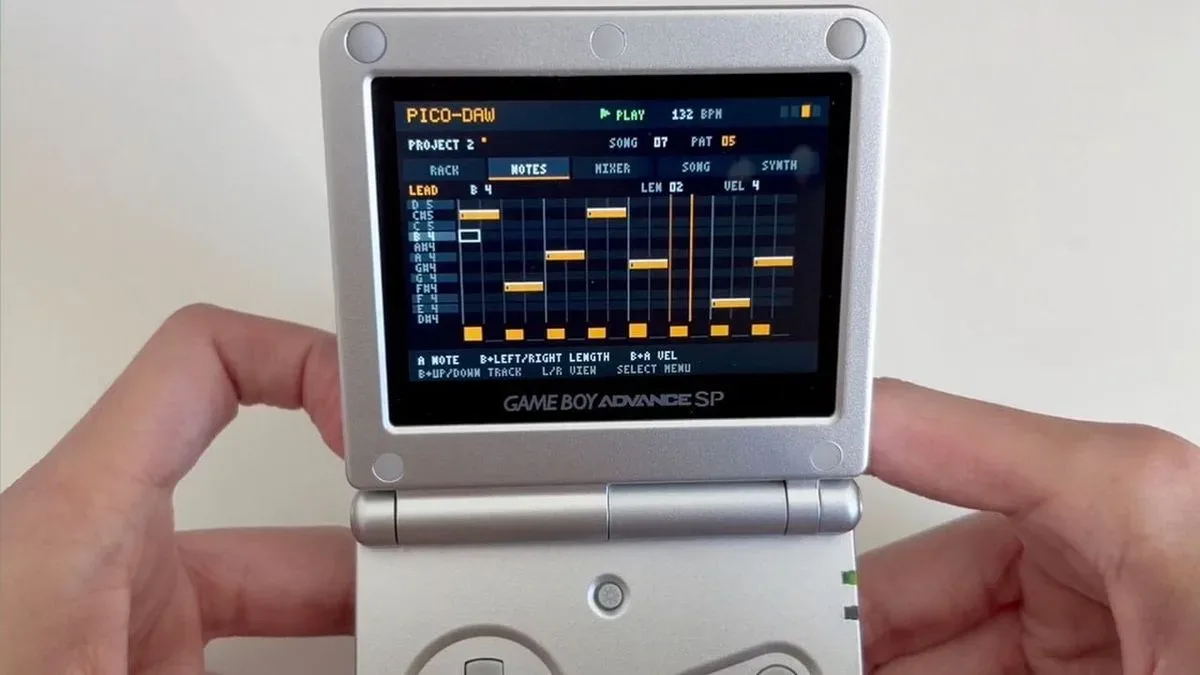
The Game Boy Advance has spent decades proving that its creative potential extends well beyond its original library of cartridges. It remains a favorite target for homebrew developers, chiptune musicians, modders, and artists who enjoy testing the boundaries of Nintendo's 32-bit handheld. The latest project to underline that versatility is Nano-daw, a compact digital audio workstation created for the Game Boy Advance by developer Hugo Duprez, also known as SpriteFusion.
What makes the project particularly notable is its development time. Duprez built Nano-daw over a single weekend, yet the early result is not merely a music toy or a narrowly focused tracker. It presents an interface designed to feel immediately recognizable to people who have used contemporary music-production software, bringing the broad logic of MIDI sequencing to a device better known for pixel-art adventures and portable platformers.
For retro music fans, the Game Boy family is already established territory. Software including Nanoloop and Little Sound Dj has enabled musicians to compose tracks on Nintendo handheld hardware for years. Nano-daw approaches the idea from a different direction, however. Its design aims for the visual clarity and structured workflow associated with desktop digital audio workstations, or DAWs, rather than requiring users to learn a more specialized tracker-oriented system.
Embedded X/Twitter post
A familiar arrangement on a very unfamiliar workstation
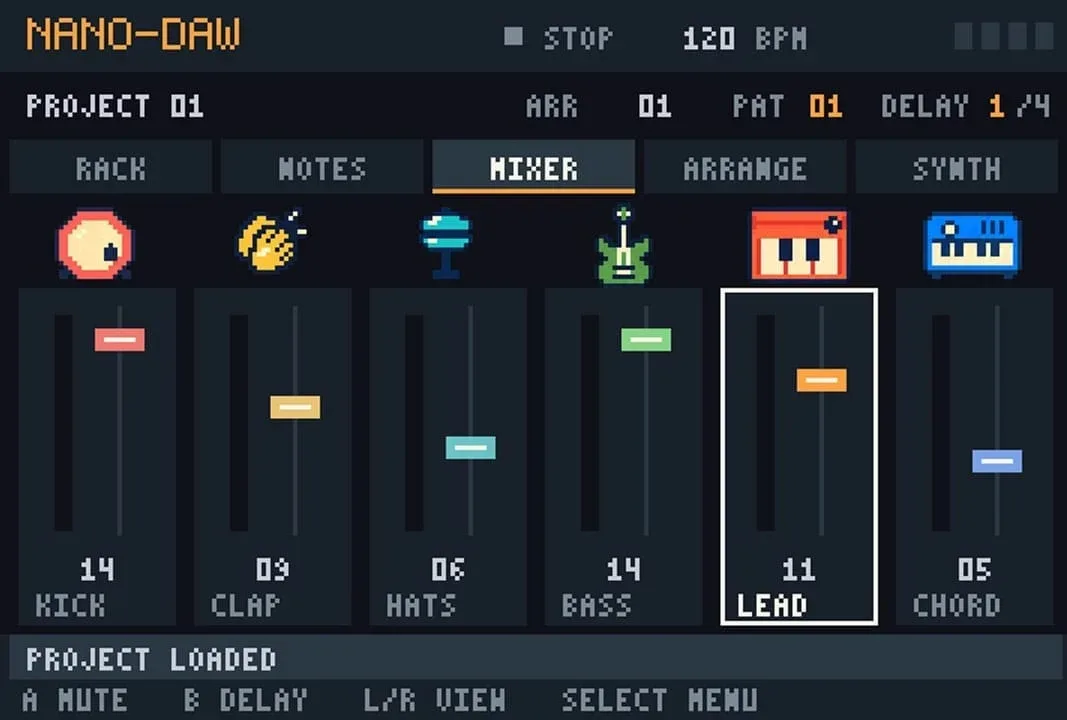
Nano-daw offers six separate tracks, organized around the components of a straightforward electronic-music arrangement: kick drum, clap, hi-hats, bass, lead, and chords. That deliberate setup gives the software an accessible starting point. Instead of confronting a new user with an open-ended bank of channels and unfamiliar sound-management rules, the program lays out a basic palette for building a beat and turning it into a full musical pattern.
For useful background on this topic, read R-Type DX Returns to Game Boy in a Five-Game Plasma Purple Cartridge Collection.
The arrangement will be easy to parse for anyone accustomed to working with piano rolls, drum grids, or MIDI clips in software such as Logic Pro or Pro Tools. Notes can be placed with the Game Boy Advance's D-pad and A button, keeping the interaction simple enough for the handheld's limited controls while retaining the directness that makes grid-based sequencing useful. Select a position, enter a note, and continue building the pattern step by step.
Each pattern supports up to 16 steps. That is a familiar length for beat-making and dance-music sequencing, where a single bar can become the backbone for a drum groove, bass phrase, or chord progression. The BPM can begin at 120 and be adjusted to another tempo, allowing users to move away from a default club-oriented pace and shape the feel of their composition.
The software also runs at 59 frames per second, an impressive technical detail for a music interface on Game Boy Advance hardware. Timing and visual responsiveness matter in sequencing tools. A grid that updates smoothly and responds consistently is important when users are trying to place events rhythmically, edit a loop quickly, or simply stay oriented while a pattern is playing. Nano-daw's performance target suggests that the project was built with the experience of actually composing on the system in mind.
For another perspective on this story, read Nano-daw Brings a Six-Track Music Sequencer to Game Boy Advance.
More than a novelty for GBA homebrew
A DAW on the Game Boy Advance may initially sound like a novelty, but the format has genuine appeal. Modern music-production suites are enormously capable, yet their abundance of plug-ins, mixing options, panels, and settings can be intimidating. By contrast, a restricted six-track environment creates productive limits. A musician has a kick, percussion, a bassline, a melodic voice, and chords; the question becomes how effectively those pieces can work together.
That limitation is especially well suited to chiptune, electronic sketches, rhythm-focused loops, and quick songwriting experiments. A 16-step grid encourages concise decisions. There is less room to endlessly tweak and more reason to commit to a pattern, hear how it works, and revise it. The Game Boy Advance's physical buttons may also provide a more tactile alternative to clicking notes with a mouse or tapping a touchscreen.
The visual approach could be just as important as the feature list. Music applications tend to develop their own languages, and a program that visually resembles a familiar MIDI-style sequencer lowers the barrier for musicians arriving from desktop production. Nano-daw does not ask them to abandon everything they understand about arranging notes in time. It translates that basic language to an older portable machine.
That distinction matters in the broader retro-hardware scene. There are plenty of powerful creative tools built around constraints, but the most inviting ones are often those that make the first steps clear. Nano-daw's named tracks and clean grid make its purpose readable at a glance: program percussion, place bass notes, add a lead, establish chords, then listen to the combination.
Built in a weekend, with AI assistance under developer control
Duprez has been open about how Nano-daw came together so quickly. The project was created from scratch by an experienced developer, with AI used as an assistant during the work rather than as an autonomous substitute for technical decisions. Duprez said he used Astra to execute architectural decisions and optimizations, while reviewing every line of code and manually refactoring substantial portions himself.
That distinction is increasingly relevant in software development, particularly as projects described as AI-made can range from carefully engineered work supported by tools to code generated with little human oversight. In Nano-daw's case, Duprez characterized the process as AI-assisted, not "vibe-coded." The architectural direction, optimization work, review process, and final control remained in the hands of the developer.
For a Game Boy Advance project, that level of oversight carries extra weight. Older hardware imposes hard technical restrictions. Developers have to consider memory, processing budgets, display behavior, input handling, timing, and the quirks of a platform released long before today's software ecosystems. A tool can help accelerate individual tasks, but producing a smooth, coherent application for such a machine still depends on knowing which compromises are acceptable and how individual systems interact.
Nano-daw is therefore an interesting example of a modern development workflow being directed toward retro hardware. It is not trying to disguise its use of present-day tools. Instead, it shows how a developer can use assistance while remaining responsible for the code, the design, and the technical outcome. The result is a project that embraces both eras: a Game Boy Advance program built around a music-production concept more commonly associated with current computers.
A possible gateway to handheld composition
For players who own a Game Boy Advance or use compatible hardware and emulation setups, Nano-daw could provide a low-pressure route into making music. The tool's six-part structure removes some of the uncertainty that comes with a blank project. A user can begin with a kick pattern, fill in claps and hi-hats, add bass, and then experiment with a melody and harmonic layer. Even someone with limited theory knowledge can learn a great deal by changing one step at a time and listening to the effect.
It could also appeal to experienced producers looking for a deliberate change of pace. Constraints have long been part of electronic music culture, whether imposed by vintage samplers, early console sound chips, grooveboxes, or tracker software. Working on a handheld with a tightly defined layout can produce ideas that might not emerge in an expansive desktop session. A short loop composed on Nano-daw could be satisfying in its own right or become the starting point for a larger production elsewhere.
The project's current identity is also part of its charm. Duprez has referred to it as Nano-daw, while noting that NintenDAW would have been an appealing name. Whichever name users associate with it, the core achievement is clear: a six-track, MIDI-like music workstation now exists for the Game Boy Advance, and it was assembled in remarkably little time.
Where Nano-daw fits in the GBA scene
Homebrew projects often keep older platforms alive in ways that official support never could. They turn consoles into development systems, art tools, network experiments, media players, and musical instruments. Nano-daw joins that tradition by treating the Game Boy Advance not as a museum piece but as a platform that can still support new creative software.
It does not need to replace a full desktop DAW to justify its existence. Its strength is that it cannot be one. Nano-daw offers a focused musical workspace built around the Game Boy Advance's screen, controls, and technical limits. That focus makes it approachable, portable, and distinctly tied to the character of the handheld.
Nano-daw is available to download through Duprez's website for those ready to try composing on Game Boy Advance hardware. Whether it becomes a regular part of a musician's process or simply a fascinating weekend experiment to explore, it is another compelling reminder that retro platforms still have room for entirely new ideas.
Community
Discussion
Start the conversation.
No comments have been posted yet.