

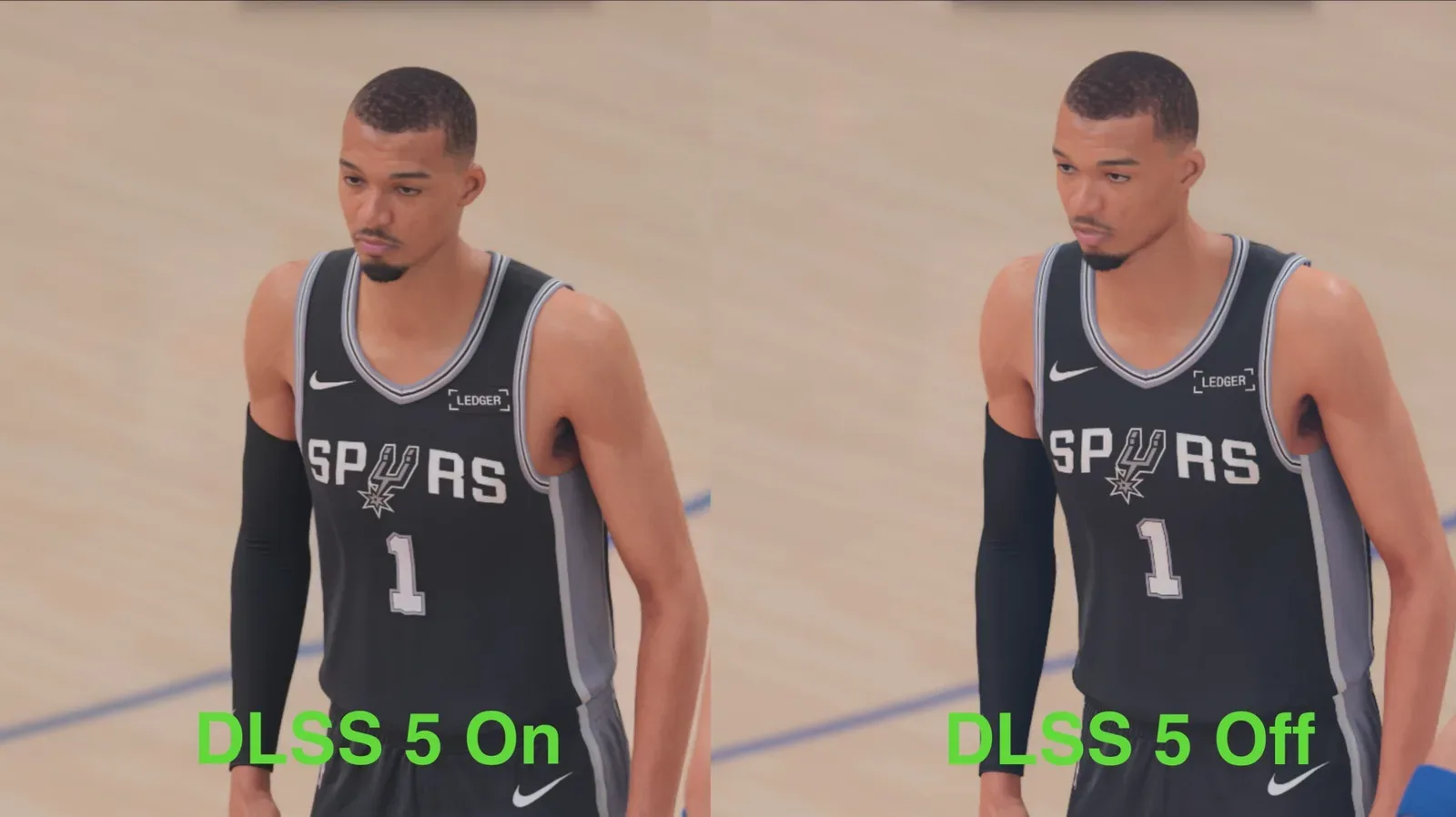
NVIDIA's DLSS 5 has arrived in NBA 2K27, and its first public showing is an intriguing but demanding one. The new AI-driven neural rendering technology can improve the look of players, crowds and lighting in subtle ways, particularly during close camera shots. Yet its launch implementation also highlights the questions that will follow DLSS 5 as it reaches more games: how much performance, energy and hardware stress should players accept for improvements many will only notice when comparing screenshots or scrutinizing replays?
NBA 2K27 is currently the first game to officially support DLSS 5. It therefore carries the burden of demonstrating why gamers should care about a feature NVIDIA presents as a route toward more lifelike visuals without relying exclusively on ever-larger conventional rendering workloads. The results suggest real potential, but they do not make the technology feel essential in its current form--especially at 4K resolution, where even NVIDIA's flagship RTX 5090 can see a dramatic reduction in frame rate and a notable jump in power consumption.
What DLSS 5 changes in NBA 2K27
DLSS began as NVIDIA's AI-assisted approach to producing a higher-quality image from a lower internal resolution. Its broader purpose has always been to let hardware deliver an image that resembles a more demanding native render without requiring the same level of raw GPU performance. DLSS 5 extends that AI focus into neural rendering, with the stated aim of bringing additional realism to scene elements and materials.
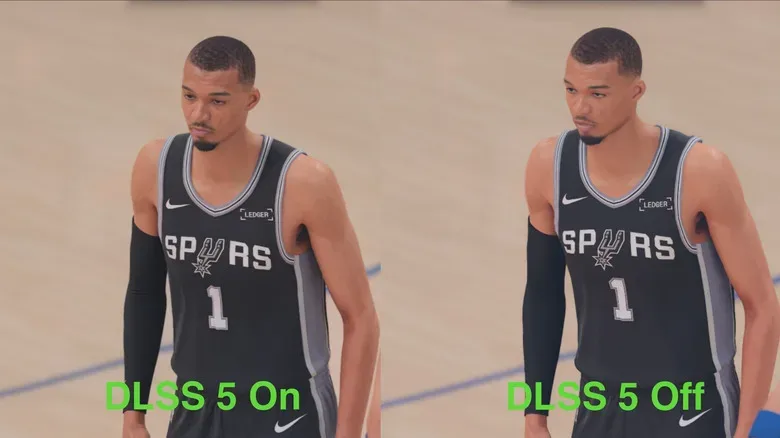
In NBA 2K27, the difference is most apparent around human models. Players' faces and arms gain extra visible texture, reducing the overly smooth, synthetic look that can affect digital athletes in close-up shots. Skin appears more natural, while shadows take on slightly more convincing definition and depth. Crowd members also benefit from the treatment, although the effect is less striking when they are viewed from across the court.
For useful background on this topic, read Sprawl Zero Revives the Punchy Feel of Early 2000s Console FPS Games.
Those improvements matter because basketball games spend plenty of time framing athletes tightly. Broadcast-style replays, cutscenes, player introductions and free-throw sequences all put faces and bodies near the camera. With DLSS 5 enabled, those moments can look more refined. Once the visual differences are recognized, it is possible to spot when the feature is active, particularly in the way character skin catches light and in the less flat appearance of certain shadows.
However, the upgrade remains restrained rather than transformative. NBA 2K27 without DLSS 5 does not suddenly become unattractive, and its standard visual presentation still uses NVIDIA's wider suite of graphical options. The change is better described as a polish pass than a generational leap. In some side-by-side situations, models without the new feature can resemble polished plastic mannequins more readily. But during the normal flow of a match, that distinction can fade quickly.
Broadcast camera angles limit the benefit
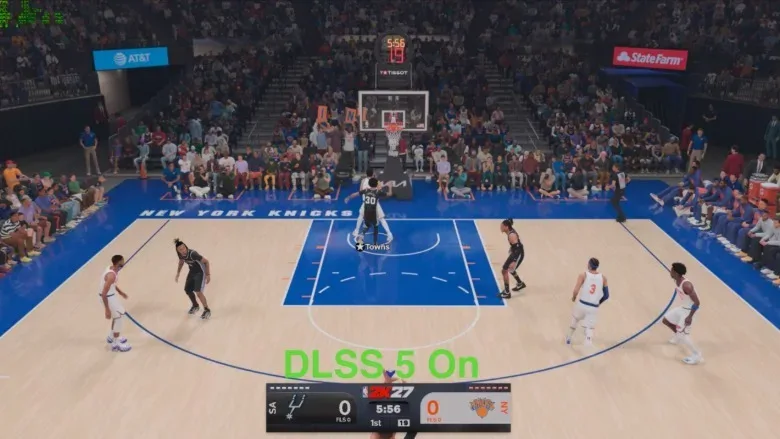
The practical issue for a sports game is that players do not spend every minute in facial close-ups. The usual elevated gameplay camera places the action at a distance, and at that range DLSS 5's extra detail is much harder to appreciate. The player models are smaller on screen, the crowd occupies the background, and the major visual priority is following the ball and reading spacing on the court.
There are still small improvements visible in wide shots. The arena crowd can appear more naturally separated from the intensely lit court, with lighting that better reflects the fact that spectators sit farther away from the floor's bright illumination. But the difference does not substantially alter the experience of playing a typical game. For many players, a smoother and more responsive frame rate may be more valuable than modestly improved distant lighting.
This creates a difficult value proposition for DLSS 5's debut. A technology aimed at visual realism naturally has its strongest moments when the camera is close enough for its detail work to be seen. NBA 2K27 has those moments, but its core game is still usually viewed from above. That makes this a useful technical showcase, though not necessarily the ideal proof of what neural rendering can do in a game designed around cinematic first-person or third-person close-ups.
A major frame-rate drop on RTX 5090
The performance cost is where the launch implementation becomes far more controversial. Testing at 4K on an RTX 5090 found that NBA 2K27 ran at roughly 240 frames per second without DLSS 5. Enabling the feature reduced that figure to around 150fps. A frame rate in that range remains very high by ordinary standards, but the scale of the loss is impossible to overlook on NVIDIA's most powerful current consumer GPU.
That reduction also changes how gamers should think about the name. DLSS has long been associated with performance gains through AI upscaling and frame-generation technologies, even though its settings and effects vary by game. DLSS 5's neural-rendering component is instead asking the GPU to do significantly more work to achieve better image quality. The result in NBA 2K27 is a feature that looks closer in spirit to an expensive visual setting than a simple route to faster performance.
For competitive players, the trade-off may be especially unappealing. Basketball games do not require the lightning-fast reactions of a competitive shooter, but responsive input and consistent performance are still meaningful in online games. Sacrificing approximately 90fps for improvements that can disappear under the standard overhead camera will be a hard sell for anyone who prioritizes fluidity.
It is also worth keeping the context clear: this is a launch title and an early implementation of a new technology. Results in NBA 2K27 should not be treated as a permanent rule for every future DLSS 5 game. Developers may find ways to better tune neural rendering workloads, use the technology selectively, or make the visual improvement more obvious in genres and camera perspectives that favor it. Still, first impressions are important, and this debut makes DLSS 5 look unusually costly for its present benefit.
Power draw raises more serious concerns
The frame-rate hit is not the only price. At 4K without DLSS 5, the RTX 5090 used in testing typically drew around 400 watts. With DLSS 5 switched on, power consumption immediately rose to roughly 525 watts. That is an increase of about 125 watts for a relatively minor visual enhancement.
Modern high-end graphics cards are already power-hungry components, and the RTX 5090's baseline draw demonstrates how demanding top-tier PC gaming has become. An additional 125 watts has implications beyond electricity costs. More power becomes more heat, which may mean louder cooling, higher case temperatures and greater strain on power delivery hardware. Those considerations are particularly relevant for players who have built systems close to the limits of their power supply or thermal capacity.
There is also a troubling anecdotal report from a HardOCP forum member, who said their RTX 5090 exceeded 600 watts while using DLSS 5 in NBA 2K27. The user reported that the graphics card's power cable ultimately melted. One community report does not establish a broad hardware failure pattern or prove that DLSS 5 alone caused the damage. Cable seating, adapter condition, system configuration and other factors can all be important in high-wattage GPU incidents. Nevertheless, it is an alarming story in the context of a feature that already appears to push power draw much higher.
With premium graphics cards carrying enormous prices, many owners will reasonably decide that a small improvement to digital skin and arena shadows is not worth adding more stress to their hardware. Until power behavior is better understood across more systems and games, cautious players may prefer to leave the setting off.
DLSS 5 still has an uncertain future
DLSS 5 has also had a complicated reception before its first official game launch. Leaked demonstrations and modifications in games such as Control and Final Fantasy VII Remake showed how badly AI-based rendering can look when pushed beyond an appropriate level. The disturbing results in those unofficial experiments underscored a familiar concern: image-generation tools can add detail, but they can also distort an artist's intended work when their output is not carefully constrained.
NBA 2K27 avoids that extreme. Its use of DLSS 5 is measured, with no obvious attempt to overwhelm the game's art direction or turn every surface into an aggressively AI-enhanced spectacle. That restraint is a positive sign. At the same time, the modesty of the effect makes the current performance and power requirements harder to defend.
NVIDIA has responded to complaints about DLSS 5 hardware access by saying the feature will eventually come to RTX 4000-series GPUs. It had initially been positioned as a capability for the newer RTX 5000 line. No timetable has been established in the available information, and support on prior-generation cards will raise further questions about performance headroom, since even an RTX 5090 is paying a substantial cost in NBA 2K27.
Capcom, Tencent and Ubisoft have committed to future DLSS 5 support, but specific games have not yet been identified. That limited software roadmap makes NBA 2K27 the clearest indication of what prospective users can expect right now. Players who own a recent NVIDIA card and want to experiment can also use mods in existing DLSS-enabled games such as Control and Cyberpunk 2077, though unofficial modifications should be approached carefully.
Promising technology that needs a stronger case
NBA 2K27 proves DLSS 5 can add convincing visual refinement without the bizarre artifacts seen in more extreme experiments. Close-up character rendering looks better, shadows gain nuance, and the game's human models lose some of their artificial sheen. But its launch showcase also demonstrates that neural rendering cannot be judged on visual fidelity alone.
A drop from 240fps to 150fps and a rise from around 400 watts to 525 watts on an RTX 5090 are significant sacrifices. For a feature whose advantages are most visible in replays and close camera shots, the equation currently favors conventional rendering for most players. DLSS 5 may become far more compelling once developers find better use cases, optimize its workload and integrate it into games where every scene benefits from its detail. For now, NBA 2K27 presents an impressive technical experiment rather than an essential new setting.


Community
Discussion
Start the conversation.
No comments have been posted yet.