

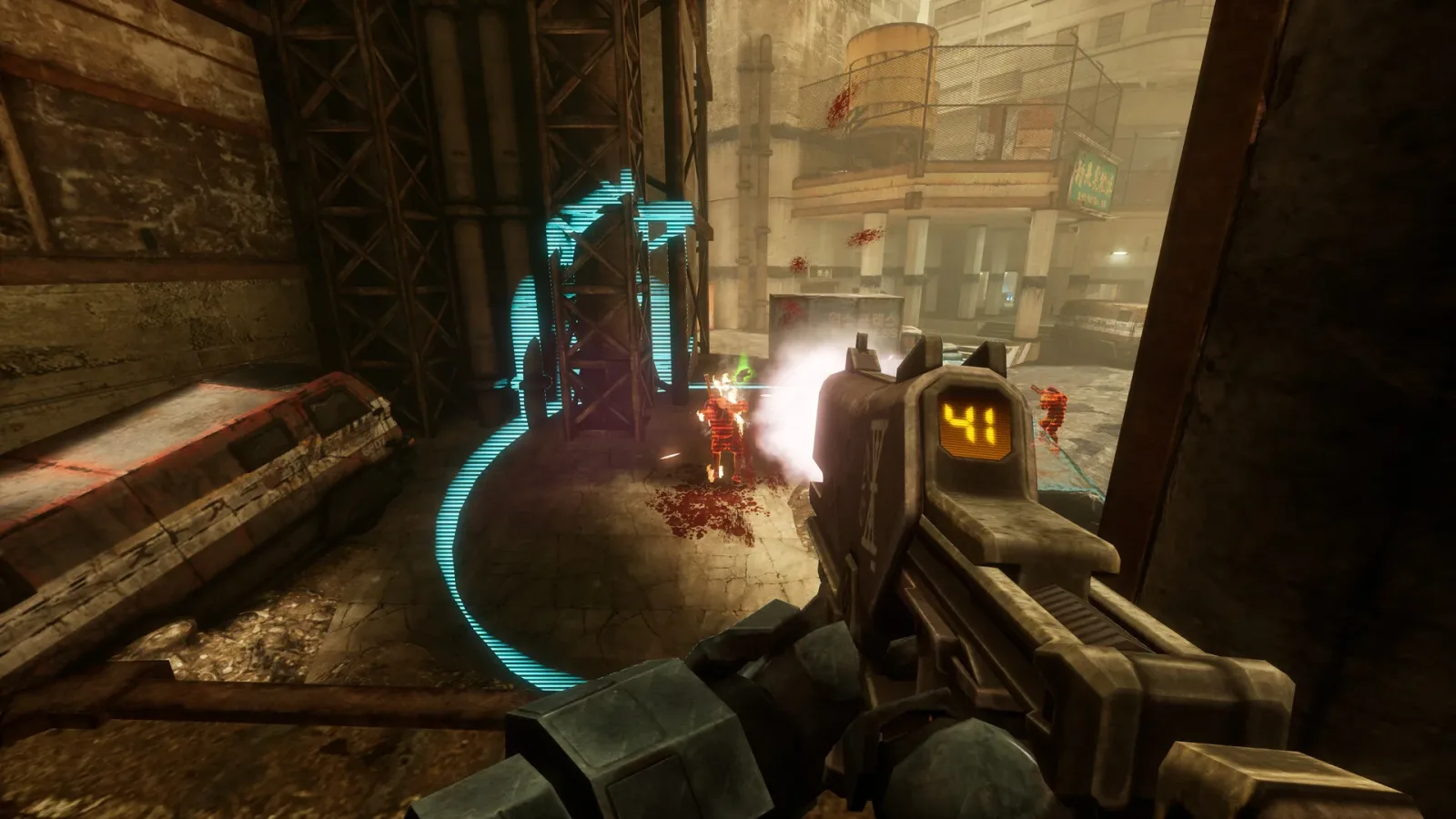
Sprawl Zero is aiming at a very particular kind of first-person shooter nostalgia. While the modern retro-FPS movement has frequently looked back to the rapid circlestrafing and pixel-heavy presentation of games such as Doom, Quake, and Wolfenstein 3D, MAETH's latest game reaches for a later generation. Its inspirations are the shooters that defined the PlayStation 2 and original Xbox period: loud, linear, grimy action games full of chunky firearms, industrial cityscapes, tense firefights, and electronic soundtracks.
That influence is immediately visible in Sprawl Zero's overall presentation, but the game is not simply recreating an old control scheme or replaying old ideas unchanged. It pairs its early-2000s visual and mechanical sensibilities with a combat system built around constant movement, quick improvisation, and the forced exchange of weapons. The result is a fast FPS that borrows its mood from classics including Halo, Killzone, Black, Half-Life 2, and F.E.A.R. while finding a distinct identity through its own rules.
Sprawl Zero is available now for PS5, Xbox, Switch 2, and PC.
A return to the brown-and-grey shooter era
The game takes place in the same universe as MAETH's earlier shooter, Sprawl. Players control Five, a genetically altered super-soldier enforcer sent into a vast dystopian city to confront a militant religious cult. It is a familiar foundation for a genre that has often thrived on grim futures, militarized factions, and anonymous enemies filling abandoned streets and severe concrete interiors.
For useful background on this topic, read Sega Says Fans Who Never Play Its Games Still Count as Gamers.
Five's mission is direct: move through a series of handcrafted levels, complete objectives, eliminate hostile forces, and search for collectibles tucked away from the main route. There are no elaborate crafting menus, sprawling role-playing skill trees, or loot-driven equipment systems competing for attention. Sprawl Zero instead keeps its focus on the immediate pleasures of an action campaign: entering a hostile area, assessing the weapons nearby, and surviving the encounter with whatever tools can be pulled together.
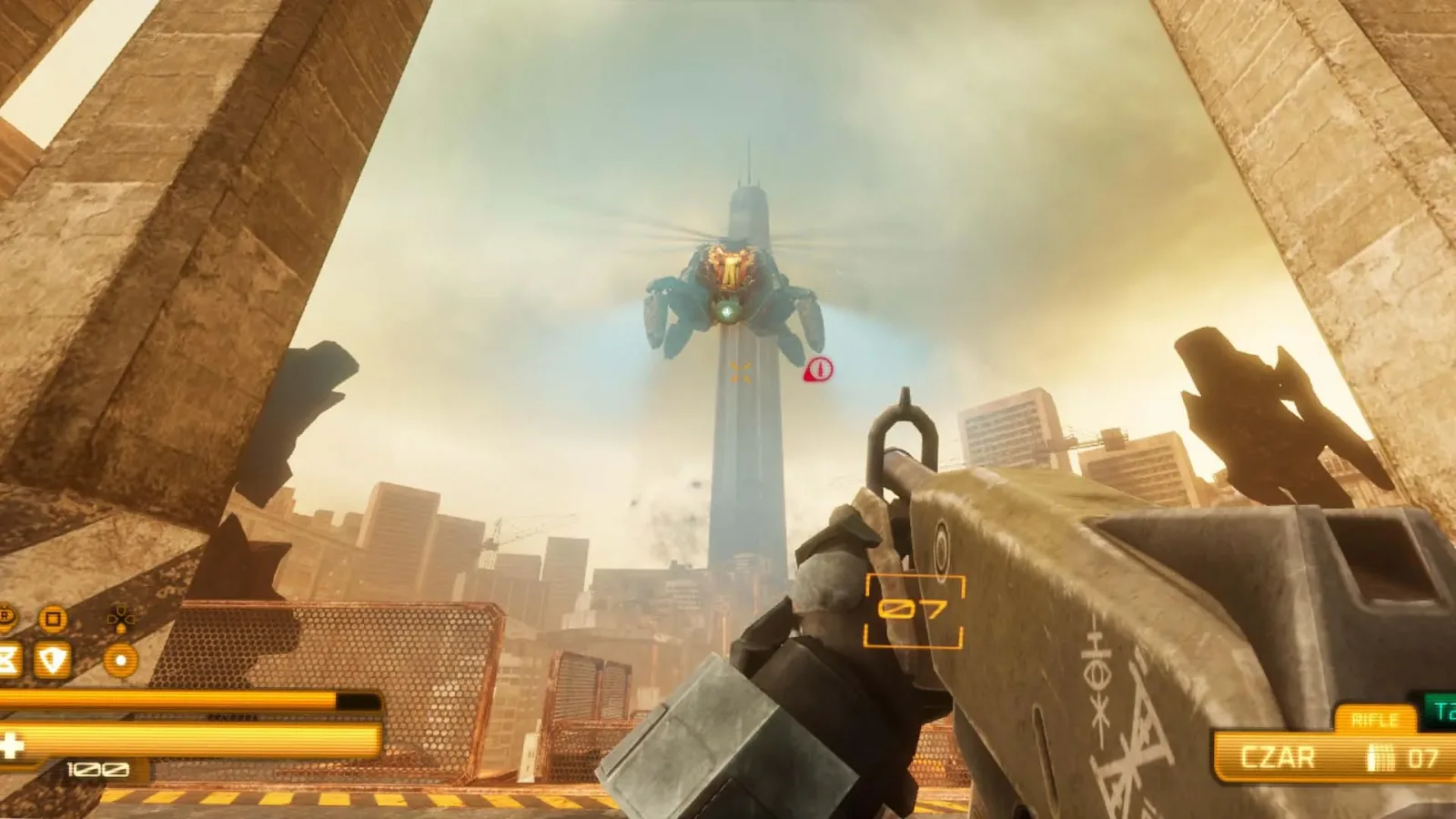
That stripped-back approach is part of what makes its inspirations feel so clear. Levels are largely linear, enemy chatter is a regular part of the atmosphere, and the environments lean heavily into brown, beige, grey, and black. Rather than treating that palette as something to avoid, Sprawl Zero embraces it as a deliberate callback to an era of shooters that found personality in hard-edged industrial spaces, shadowy alleys, and battle-scarred urban corridors.
The aesthetic extends to the guns themselves. Weapons are hefty and visually pronounced, designed to feel substantial in the player's hands. Combined with the electronic soundtrack and a console-era pace, the game evokes the sensation of sitting close to a television with a controller in hand, working through a campaign one aggressive combat arena at a time.
One weapon, no reloading, no comfort zone
Sprawl Zero's most important departure from many of the games it recalls is its weapon system. Five can carry only one gun at any given time, and weapons found in the field cannot be reloaded. Ammunition is therefore a temporary resource tied to the firearm currently held, not a stockpile that can be replenished while preserving a favored loadout.
That decision radically changes the rhythm of combat. A pistol scavenged at the start of a fight may not have enough ammunition to clear the entire room. When the magazine runs dry, there is no pause to top it up and settle back into a familiar routine. Players need to secure another weapon from a defeated enemy, grab one from the environment, or make a risky decision at close range.
In a lesser shooter, this could easily become frustrating. Running out of ammunition often creates downtime, and being forced away from a preferred weapon can feel like a punishment. Sprawl Zero avoids much of that problem by making its arsenal varied and satisfying enough that a sudden swap becomes an opportunity. The uncertainty of what weapon might be collected next adds pressure, but it also keeps combat from becoming static.
Every arena becomes a small exercise in adaptation. A player might begin an encounter at range, exhaust a firearm, pull an unfamiliar gun from a body in the middle of the room, then push forward before the enemy side can recover. The constant turnover makes weapon choice matter in the moment without asking players to spend extended periods managing inventories.
It also makes the act of picking up a weapon part of the game's combat language rather than a routine interaction. Five uses Gravity Gloves to pull objects from a distance, allowing a replacement firearm to fly directly into his hands during a firefight. With several enemies down, there can be a split-second element of surprise: the player knows a weapon is coming, but not always precisely which one will arrive.
Gravity Gloves turn the environment into a weapon
The Gravity Gloves do more than keep the action moving when ammunition runs out. They are also Sprawl Zero's clearest link to the physics-driven combat energy associated with Half-Life 2. Five can seize loose items in the environment, including barrels, and hurl them at enemies. The ability to weaponize objects gives firefights another layer beyond aiming and firing, especially when a player needs to interrupt an opponent or create a brief opening.
Throwing the currently held gun is another option. Instead of treating an empty weapon as useless debris, Sprawl Zero lets players launch it at an enemy to stun them or potentially kill them. It is a fitting feature for a game built around rapid weapon replacement. When firearms are meant to be expendable, discarding one aggressively becomes a natural extension of the system.
This design gives Five a strong sense of physical presence. The player is not only cycling through firearms but also pulling gear across a room, lobbing environmental hazards, and using an empty gun as an improvised projectile. Those actions help distinguish Sprawl Zero from shooters that use nostalgia solely as a visual filter.
As the campaign progresses, Five unlocks further abilities to handle more punishing encounters. Bullet time slows the action during especially chaotic moments, offering an opportunity to react when enemies begin to crowd the screen. A Gravity Shield can stop incoming projectiles and send them back when released. There is also a powerful punch capable of breaking shields, giving players a close-range answer when conventional firepower is not enough.
These powers are not merely decorative upgrades. Later battles bring larger waves of enemies, creating pressure that asks players to combine firearms, gravity manipulation, slowed time, defensive timing, and melee force. The game's encounters become more demanding as its toolset expands, encouraging players to use the full range of abilities rather than relying on one reliable gun.
Inspired by the past without being trapped there
Sprawl Zero is unusually open about the lineage it is drawing from. Its atmosphere and structure have clear parallels with early-2000s shooters, and its references include some of the most recognizable games of that generation. Yet its strongest idea is not a visual homage. It is the decision to make weapon scarcity and swapping the engine of its action.
Older console shooters often gave players a dependable arsenal to carry through an entire level, with each weapon occupying a familiar tactical role. Sprawl Zero trades that comfort for volatility. Having one gun means every pickup can alter a fight. The lack of reloading means the player is always thinking a step ahead. Gravity-based collection means that adapting does not require stopping the flow of the encounter.
That combination lets the game preserve the accessible, campaign-focused feel of its inspirations while adding a more reactive combat loop. It has the straight-ahead objective design and heavy audiovisual character associated with PS2 and original Xbox FPS games, but it does not feel restricted to reproducing the exact rules those games used more than two decades ago.
For players who miss the era of bombastic single-player shooters but have found most retro-FPS revivals focused on the 1990s, Sprawl Zero occupies a different and welcome space. It is built around the appeal of chunky weapons, harsh city backdrops, chatty enemies, and controller-friendly momentum, then pushes that formula forward with a restless one-gun system and a set of powers that keep fights flexible.
Sprawl Zero is out now on PS5, Xbox, Switch 2, and PC.
Community
Discussion
Start the conversation.
No comments have been posted yet.