

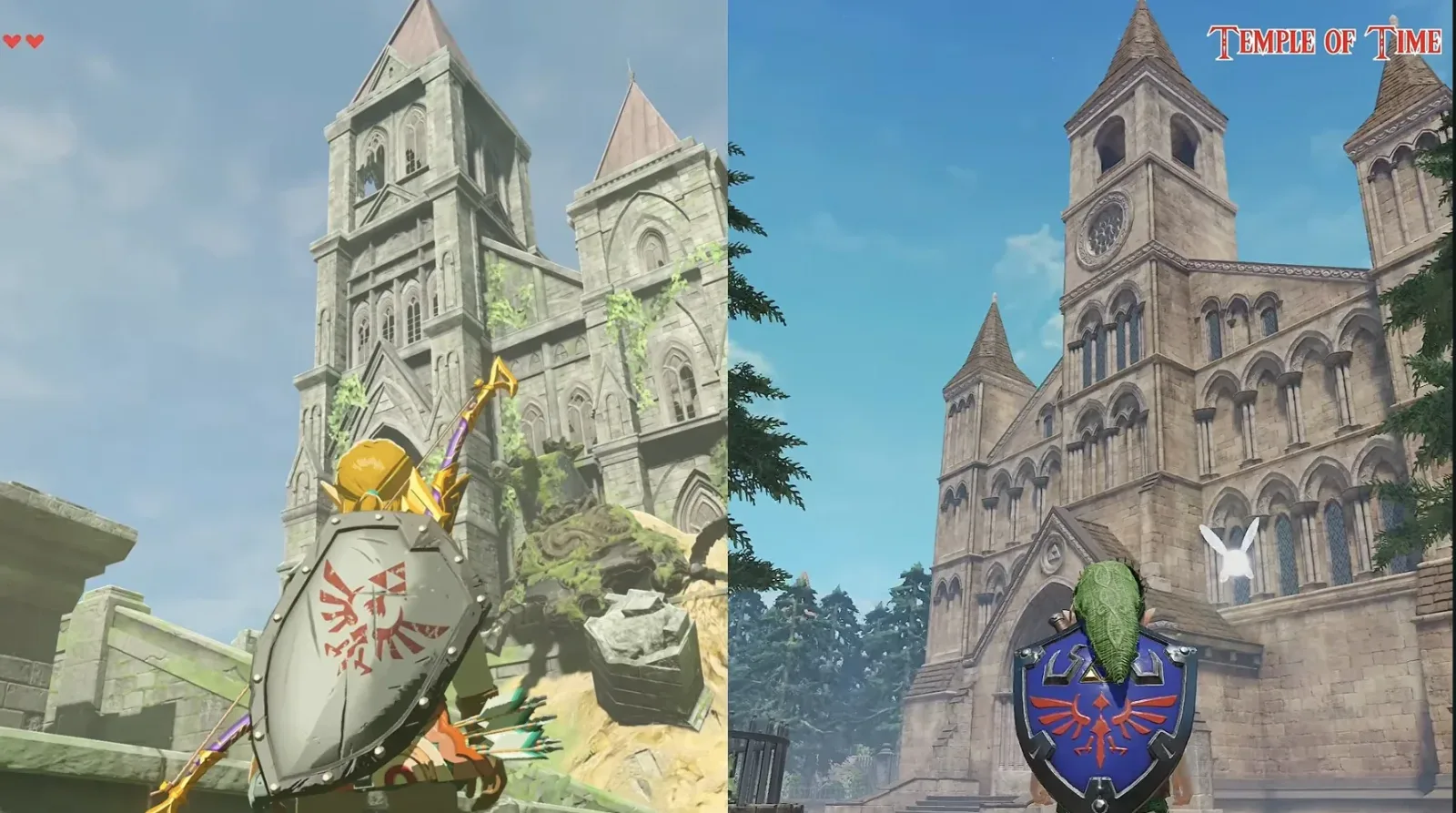
Hyrule has always been a place built on repetition, legend, and transformation. Its heroes return under familiar names, evil rises again in altered forms, and locations that seem permanent are regularly swallowed by oceans, buried beneath centuries of earth, or left in ruins. A new set of side-by-side comparisons between the Switch 2 remake of The Legend of Zelda: Ocarina of Time and The Legend of Zelda: Breath of the Wild gives that idea an unusually tangible form.
The footage examines locations that players can recognize across both games, including the Temple of Time, Lake Hylia, Lon Lon Ranch, and Death Mountain. The immediate draw is visual: the remake presents the older Hyrule with modern detail, while Breath of the Wild depicts a version of the kingdom shaped by calamity, abandonment, and an immense passage of time. But the more compelling aspect is not simply the improvement in image quality. It is the way the shared geography and surviving architectural details make two very different Zelda worlds feel like stages in the history of one country.
For a series whose chronology has often invited debate, this sort of environmental connection can be more persuasive than a chart of branching timelines. A player can look at a structure in its earlier state, then look at the damaged or weathered version in Breath of the Wild, and understand the relationship without needing an explanation. The land itself becomes the evidence.
The Temple of Time Is the Clearest Link
The Temple of Time stands out as perhaps the strongest example. In Ocarina of Time, it is one of Hyrule's defining landmarks: a sacred structure that connects Link's childhood journey with the fate of the Master Sword and the kingdom's future. In Breath of the Wild, its counterpart is no longer pristine. A substantial portion of its exterior has been lost, and the building carries the scars of destruction and neglect.
For useful background on this topic, read Ocarina of Time's New Jump Button Is Sending Link Straight Into the Water.
Even so, the comparison makes the resemblance difficult to miss. The surviving arrangement, silhouette, and major features encourage players to see the ruined building not as a vague callback, but as an ancient version of the same site. The emotional effect comes from the contrast. One game lets players see a place tied to the beginning of a great adventure. The other presents a version that has endured a disaster so complete that much of Hyrule's identity has become archaeological.
Small differences do not necessarily weaken that reading. The interior layouts are not identical, and certain design elements appear to have changed. Yet those changes can make the history feel more believable rather than less. Buildings are renovated, restored, expanded, damaged, and rebuilt. A sacred site that has survived for thousands of years would not be expected to remain untouched in every detail. The fact that the shared elements remain recognizable is what matters most.
That interpretation adds a quiet layer of storytelling to Breath of the Wild. Its Temple of Time is already meaningful as part of the Great Plateau's desolate opening landscape. Seen beside the remake's version of the landmark, it also becomes a reminder that Hyrule's ruins belonged to people who had lives, traditions, and memories long before the player arrived.
A Kingdom Changed by Time Rather Than Replaced
It can be easy to treat each Zelda setting as a separate fantasy playground. Every entry has its own artistic style, mechanics, regional priorities, and version of familiar mythology. Ocarina of Time is structured around a compact, landmark-focused Hyrule where travel between key places helps frame a coming-of-age story. Breath of the Wild is a vast open world built around freedom, isolation, survival, and discovery.
Those structural differences can make the games feel worlds apart. The comparisons emphasize that they need not be. Instead, they can be read as snapshots of the same place at radically different moments. The landmarks do not need to match with perfect, map-level precision for that idea to work. In fact, changes in terrain and construction are the point. Time has altered the kingdom so dramatically that players are left to recognize it through fragments.
Death Mountain offers a striking geographic example. In Ocarina of Time, the volcanic landmark rises prominently above its surrounding region. In Breath of the Wild, the mountain's appearance is significantly altered, as though countless years of volcanic activity and erosion have reshaped it. The difference gives the landscape a sense of geological history. Mountains may appear eternal in fantasy worlds, but even they change when enough time passes.
This is where the comparison gains a bit of visual wit as well. Hyrule has endured enough magical catastrophes, wars, floods, upheavals, and natural change to make its geography look as though it has survived an impossible climate record. The altered mountain is not merely a continuity detail; it is an illustration of a world that has been repeatedly remade.
Lon Lon Ranch Turns Nostalgia Into Archaeology
Lon Lon Ranch may carry an even more personal kind of weight. In Ocarina of Time, it is a lively rural location associated with Malon, Talon, horses, and one of the game's most enduringly warm side stories. The ranch is not a palace, temple, or battlefield. Its importance comes from ordinary life. It is a working home with people, routines, and a sense of comfort outside Hyrule Castle's political and supernatural crises.
By the era of Breath of the Wild, only abandoned remnants remain. Seen in isolation, those pieces of debris and old construction are easy to pass by as another ruined point of interest in a world full of them. Set beside the remake's intact ranch, however, they acquire a more melancholy meaning. What was once a home has become a trace.
That is one of Breath of the Wild's greatest strengths as a setting. It often asks players to infer stories from collapsed walls, broken foundations, and place names rather than spelling everything out. The connection to Lon Lon Ranch shows how effectively that approach can interact with Zelda's own history. Returning players may see more than a ruined ranch. They may imagine the distance between an era when Malon and Talon lived there and the lonely, post-Calamity Hyrule explored by Link.
It also makes Hyrule feel inhabited across generations, not just across game releases. The series has long used recurring names and archetypes to communicate continuity. Seeing a familiar building reduced to remnants achieves something different. It conveys that the people tied to a place can disappear while the place itself lingers on, altered but not entirely erased.
Lake Hylia and the Value of Familiar Geography
Lake Hylia is another location where the connection between eras is especially useful. Bodies of water and major terrain features provide an important sense of stability amid the kingdom's many transformations. They can change in shoreline, surroundings, and nearby architecture, yet remain recognizable enough to serve as geographic anchors.
In a franchise with stories separated by vast spans of in-world history, such anchors are valuable. They help make Hyrule feel less like a name applied to unrelated settings and more like a land with persistent features. Rivers shift, towns rise and fall, castles are destroyed and rebuilt, but a lake can preserve a memory of where a player has been before.
The side-by-side footage encourages a different way to explore Breath of the Wild. Rather than treating its ruins only as collectibles or set dressing, players can view them as historical clues. A crumbled wall, an old road, or the remains of a foundation may point toward a familiar location from another age. The open world becomes not just a wilderness to cross, but a record to interpret.
Visual Continuity Can Say More Than Timeline Arguments
Zelda chronology has always been a subject of enthusiastic discussion. Official history material and fan analysis have worked to connect games with different styles, story structures, and eras. Yet the most memorable continuity is often not found in a formal explanation. It is felt when a player recognizes something.
The comparisons between Ocarina of Time and Breath of the Wild achieve that through architecture and terrain. They do not require every question to have a definitive answer. The exact reasons for all discrepancies, the implications of particular building interiors, and the full route between distant eras can remain open to interpretation. What matters is that the visual echoes are strong enough to invite a coherent story: an old Hyrule endured, decayed, changed, and left its marks on the Hyrule that came later.
That ambiguity is fitting for the series. Zelda often works best when it balances mythic certainty with unanswered questions. Players know that a hero, a princess, and a great evil are bound together through history. The details around them shift. Familiar places return in new forms. Each game can stand on its own while still suggesting that old events have not been forgotten by the world.
A New Lens on Two Very Different Adventures
The Switch 2 remake gives players an opportunity to revisit Ocarina of Time with a more detailed view of the kingdom that once stood whole. Meanwhile, Breath of the Wild remains a powerful image of what happens after that wholeness has been broken. Putting their shared locations next to one another does more than celebrate callbacks or graphical advancement. It turns the distance between the games into part of the story.
The Temple of Time becomes a monument that survived only in part. Death Mountain becomes evidence that even the land has aged. Lon Lon Ranch becomes a memory preserved in foundations and ruins. Lake Hylia becomes a geographic thread connecting eras that otherwise seem impossibly far apart.
That is why these comparisons resonate. They make Hyrule's history visible. Rather than simply being told that the kingdom has persisted through ages of change, players can look at its weathered stones and altered horizons and believe it. The result is a richer connection between two landmark Zelda adventures: one showing a world close to its legendary past, and the other asking players to search its ruins for what remains.
Community
Discussion
Start the conversation.
No comments have been posted yet.