

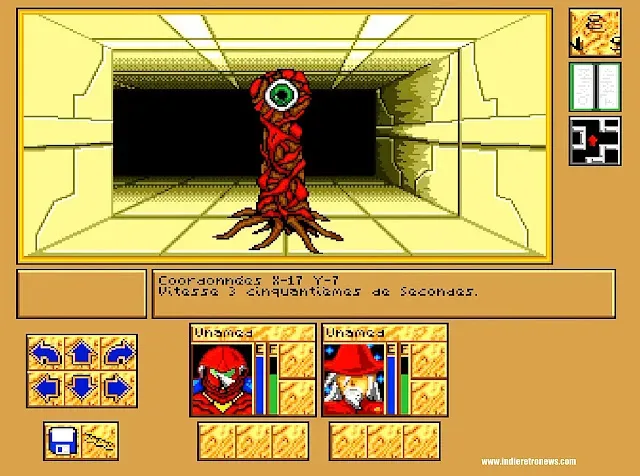
A piece of unfinished Amiga history has returned in playable form. Oracle (La Légende de / The Legend of), a first-person 3D dungeon-crawling RPG that disappeared during development in 1996, has resurfaced as a preserved ADF disk image. The newly prepared build gives retro enthusiasts a chance to explore the game on compatible Commodore Amiga hardware or through emulation, including WinUAE, without needing to reconstruct its original development setup.
Oracle was never completed or commercially released in its intended era. Its creators had planned to distribute it as shareware, a common route for smaller Amiga projects of the time, but work stopped before that ambition could be realized. The surviving version, identified as 0.3d and dated December 13, 1996, is effectively the final record of the project as it existed. That makes this release less a rediscovered finished game than a playable archival snapshot: an opportunity to see a work in progress from the later life of the Amiga platform.
A Dungeon Master-Style Adventure From the Amiga Era
Oracle belongs to the tradition of first-person, grid-based dungeon RPGs popularized by genre landmarks such as Dungeon Master. Players navigate enclosed corridors from a first-person viewpoint, exploring spaces one step at a time rather than moving freely through a fully polygonal world. The appeal of this format has always rested in its mixture of exploration, mapping, atmosphere, resource management, and encounters that can turn an apparently empty passage into a moment of tension.
Although Oracle remains unfinished, its available build already demonstrates many of the foundations required for that style of game. It has a mouse-led interface, allowing players to interact with the adventure through a control method familiar to Amiga users. It also includes automatic map creation, with the map updating as locations are explored. For a dungeon crawler, that feature is especially significant: getting lost is part of the genre's identity, but a live map gives players a practical way to record their progress while still preserving the mystery of unexplored rooms and corridors.
For useful background on this topic, read Cygames Edge Launches to Bring Smaller Games to Players Faster.
The surviving version also contains early non-player character systems, including movement and combat behavior. These elements offer a glimpse at what Oracle was building toward before development ended. Rather than presenting a complete RPG with a fully known campaign, polished balance, and a finished suite of content, the game shows its underlying ambitions through the mechanics that were already functioning. For preservation-minded players, that unfinished quality is central to its value.
Built With AMOS Professional
One of Oracle's most interesting technical details is its development environment. The game was made with AMOS Professional, an Amiga programming language and development package that gave creators accessible tools for building games, demos, utilities, and multimedia software. Beginning work on Oracle in 1996 placed the project in a period when the Amiga's commercial presence had declined substantially, while its dedicated hobbyist community continued finding ways to create technically ambitious software for the machine.
Using AMOS Professional did not prevent developers from aiming high. Oracle features corridor rendering for walls, floors, and ceilings, giving it the visual framework expected from a first-person dungeon exploration game. Its doors are animated through AMAL scripting, another recognizable part of the AMOS ecosystem. AMAL allowed for animation and movement routines, and its presence in Oracle helps illustrate how the game's creator approached environmental details that could make a maze of passages feel more alive.
For another perspective on this story, read Oracle, an Unfinished 1996 Amiga Dungeon Crawler, Returns as a Preserved ADF Build.
Sound and music are handled through AMCAF, adding another layer to the project's technical profile. Even in an incomplete state, the combination of rendered dungeon views, animated doors, audio, interface work, mapping, and early enemy behavior reveals an attempt to assemble a substantial Amiga role-playing experience rather than a simple prototype. It is precisely the kind of project that can be easy to lose when it never reaches a formal retail or shareware release.
An Archival Release Rather Than a Newly Finished Game
It is important to approach Oracle with the right expectations. This is not a modern remake, a fan completion, or a newly expanded edition that resolves the development work left unfinished in 1996. Version 0.3d is the historical endpoint currently being preserved. Its rough edges, incomplete areas, and limitations are part of the artifact.
For many retro players, that is not a drawback. Unreleased games can provide a different kind of fascination than completed classics. They expose decisions still in motion: systems that are present but not fully refined, visual ideas that may have evolved, and technical compromises that might otherwise have been obscured by a final commercial product. Oracle offers a view into the process of making an Amiga game at a time when developers were still pursuing projects for hardware that was increasingly becoming a specialist platform.
Preservation also matters because unfinished software is particularly vulnerable. Retail games may survive through boxed copies, magazine coverage, manuals, advertisements, and multiple releases. A project that stopped before distribution can be represented by only a small number of disks, personal archives, or incomplete development materials. Packaging Oracle as a ready-to-run ADF image helps ensure that its surviving state can be experienced and studied without requiring players to work directly with the original programming environment.
Hardware Requirements May Be a Barrier
While the ADF format makes access more convenient, Oracle is not necessarily suited to every Amiga configuration. Testing indicates that it runs well in a Workbench 3.0 or Workbench 1.3 environment using an Amiga 1200 profile with a Motorola 68020 processor, 2 MB of Chip RAM, and 8 MB of Fast RAM. That setup gives the game the expanded resources it needs for its presentation and systems.
The game makes notable use of the Amiga's AGA capabilities, but that also means owners of more basic machines should be cautious. A stock Amiga 500 with only 1 MB of memory may encounter compatibility problems. In other words, Oracle is best viewed as a release for enthusiasts with expanded classic hardware, or for players prepared to configure an emulator around the recommended specification.
For PC users, WinUAE provides a practical route to doing just that. Emulation can recreate the required Amiga profile more easily than tracking down period-appropriate expansions, and it allows players to test different Workbench environments if needed. As with many revived Amiga programs, careful configuration may be part of the experience. That is a small price for those interested in seeing a lost project operating in conditions close to the ones it was designed around.
Why Oracle's Return Is Worth Noting
The Amiga remains associated with a deep library of games, demos, and experimental software, but its history is not limited to the titles that made it into shops. Projects such as Oracle are reminders that a platform's creative legacy includes the games that nearly happened as well as the games that became household names among its community.
Oracle does not arrive with the certainty of a finished campaign or the polish of a long-supported commercial release. Instead, it brings something rarer: a tangible build from a stalled 1996 project, now preserved in a form that can be loaded and explored. Its mouse-controlled interface, developing automap, NPC mechanics, AMAL-driven doors, rendered corridors, and AMCAF audio form a substantial record of an ambitious dungeon crawler still taking shape.
For fans of Amiga software, first-person RPG history, and game preservation, that makes Oracle an intriguing discovery. It is a chance to step into an alternate corner of the 1990s, where a shareware dungeon adventure was being built for Commodore hardware and then abruptly left behind. Nearly three decades later, the project can finally be examined not only as a description in an archive, but as a playable piece of unfinished game design.
Community
Discussion
Start the conversation.
No comments have been posted yet.